We earn a commission if an account is opened through this button; your price does not change. Bonus size, wagering, maximum stake and time limits are set by the operator and change without notice. 18+ · free confidential help at begambleaware.org, 0808 8020 133.
Short answer. Money enters a casino account on one of four payment rails, and the rail decides who can stop it, who can reverse it and whether it works in reverse for a payout. What it does not decide is speed on the way out, because most of a withdrawal is spent in a review queue and a document check rather than in a payment system.
Paying for gambling with a credit card is not allowed in Great Britain, and the ban follows the credit rather than the card.
A player in the United Kingdom pays no tax on gambling winnings; the duty is charged to the operator.
Every licensed desk appears on a public register kept by the regulator, searchable by the licensed company name.
British banks offer a free switch that refuses gambling payments from your own account, and it fails the payment before any cashier sees it.
A licensed gambling account in Britain is 18+, and the age check is not something a desk may skip.
The button on a cashier page does not move money. It writes an instruction, and that instruction then travels through somebody else's system — a card scheme, a wallet provider, your own bank's payment service — before a balance changes anywhere. That single step explains most of what looks strange about casino payments: why a charge shows on a bank statement before it shows in a gaming account, and why the same card sails through at one desk and is turned away at the next.
Instructions come in two shapes. A pull is the desk asking your bank for money: you hand over the details once, the operator sends a request, and your bank answers yes or no, which is exactly what happens with a debit card. A push is you telling your own bank or wallet to send money out, which is what happens with a bank transfer or an open banking payment. Pull is quicker to repeat; push leaves the last word with you, because nothing leaves your account unless you approve it inside your own banking app.
Every logo on the list of payment methods is one of those two shapes in different clothing. Tell which shape you are holding and you can usually predict where a payment will stop and who has to unstick it.
Four families of rail, and what each one is really doing
Two dozen icons on a cashier page collapse into four families, and the family matters far more than the logo. Cards ride the card schemes and run as a pull. Wallets sit on top of a funding source you chose earlier, which is the whole point of PayPal at a casino: the wallet holds your details so the operator never sees them. Bank rails move money straight between accounts, either as a transfer you type out yourself or through open banking, which is what Trustly is doing when it shows you your own bank's login screen. Stored and billed rails start from value set aside in advance or from an account that bills you afterwards — a prepaid voucher on one side, pay by mobile on the other.
The family decides who can reverse a payment, who sees the merchant name on a statement, whether the same channel works in reverse for a payout, and which party you argue with when something goes wrong. A card dispute runs through the scheme and your bank. A wallet dispute runs through the wallet, under the wallet's own policy on gambling. A voucher has no account behind it at all, so there is nothing to dispute and nowhere obvious for money to come back to.
App-based banks do not form a fifth family; they sit inside the card and bank families but behave differently enough to deserve their own reading, because their gambling controls live in the app and are switched on for some customers from the start. That is why Revolut needs separating from an ordinary high street account.
The four rail families and what each one decides
Family
Direction of travel
Where it usually stops
Return path for a payout
Cards
Pull: the desk asks your bank
Bank risk rules and merchant blocks
Often back to the same card
Wallets
Pull from a source you chose
The wallet's own gambling policy
Usually back to the same wallet
Bank and open banking
Push: you approve it yourself
Your own confirmation step
Into the account you named
Stored and billed value
Push from stored or billed value
No account sits behind the payment
Rarely: a second method is needed
Three different minimums stack on top of one another
The minimum deposit gets talked about as though it were a single figure. There are three, they stack, and the one that binds you is whichever sits highest. The desk sets a floor for the account. The rail sets a floor of its own, because a voucher has a smallest denomination and a charge to a phone account has a smallest billable amount. A promotion attached to the payment sets a third floor, and that one is usually above both of the others.
This is why money can arrive correctly and a promotion still sit unclaimed: the payment cleared the house floor and the rail floor and missed the bonus floor, and nothing on the confirmation screen says so. It is also why the smallest figure advertised on a landing page is rarely the smallest figure available on every method. The page on the minimum deposit takes the three floors apart one at a time.
Ceilings behave the same way and are easier to forget, because they only bite when you are in a hurry. The rail has a maximum per payment, the desk has a maximum per day, and anything you have set through deposit limits sits above all of it. The last of those is deliberately hard to lift: a limit you raise yourself does not take effect on the spot, which is the entire point of having one.
A deposit can leave your bank and still not appear
A card payment is two events, not one. First your bank reserves the money and answers the request, which is the authorisation and is what you see as a pending line on a statement. Later the merchant collects it, which is the capture. Between those two events the money is neither yours to spend nor anybody else's to keep, and a cashier still waiting on a confirmation it never received will show you nothing at all.
Most missing deposits are one of a short list of ordinary things: an authorisation the desk never captured, a bank step-up check abandoned halfway, a payment made from a card or wallet in somebody else's name, or money sent to a second account opened by mistake. None of these need a complaint; they need the right reference in front of the right desk. The page on a deposit that has not arrived works through them in the order that resolves fastest.
The useful habit is keeping the proof before you need it: the time, the amount, the instrument and the reference your bank shows are close to impossible to reconstruct a week later.
What a cash desk checks before it accepts anything
A licensed desk is not free to take money from whoever offers it. Before a first payment it has to satisfy itself that you are over eighteen, that you are who you say you are, and that the account the money comes from belongs to you. It also has to check you against the national self-exclusion register, because somebody who has asked to be shut out of licensed gambling must stay shut out, and that check runs on the desk's side whether you think about it or not.
Three of those can be done quietly against data the desk already holds. The fourth, ownership of the payment instrument, is the one that stops deposits, because a third-party card or a wallet funded by someone else is refused on principle rather than on suspicion. Paying for your own account out of your own money is the condition under which a desk is permitted to accept anything.
Anything presented as a way around the self-exclusion register leads to one place: a site outside British licensing. With the licence go the rules, the dispute route and anyone with the power to make a site answer for itself. There is nothing on the other side of that door worth the walk, and we do not point at it.
Where the days in a payout actually go
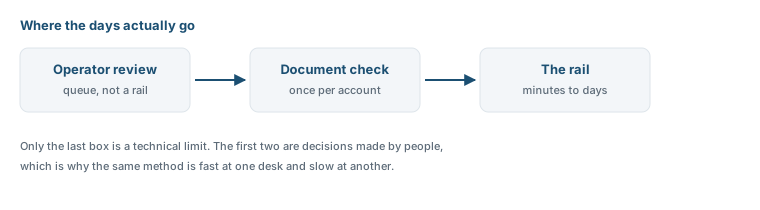
People measure a payout against the rail and then feel misled, because the rail is usually the shortest part of it. A withdrawal spends most of its life in two queues that have nothing to do with payment technology: the operator's review of the request, and a document check on the account if one has not been finished yet. Only after both of those does the money touch a payment system at all.
That ordering explains the complaint you meet most often, which is that one method was quick last month and slow this month at a different site. The method did not change. The queue in front of it did. It also explains why the best thing you can do for your own payout speed happens long before you request one, namely finishing the paperwork while nothing is waiting on it.
The page on how long a withdrawal takes separates the technical parts from the parts that are somebody's decision, so you can tell which delay is worth chasing.
Two of the three stages in a payout are decisions made by people, not transfer speeds.
A withdrawal is reviewed before anything is sent
The request you submit is not an instruction to pay; it is an application. The desk checks that the balance is genuinely withdrawable rather than tied up in bonus conditions, that the destination matches where the deposits came from, that no open check sits against the account, and that the amount falls inside the limits for that account and that method. Any single one of those can send the request back to you instead of forward to a bank.
Closed loop is the rule that surprises people most. Money generally has to leave along the way it came, and only what cannot return that way is paid out somewhere else. It reads as an inconvenience and is in fact a protection: a payout that could be redirected to any account on request would be worth stealing.
The hub page on cashing out sets out the sequence and what each state a request passes through actually means.
Identity checks sit before the money, not after it
British practice puts the document check early. Many desks now ask at sign-up or at a first deposit rather than waiting for a withdrawal request, and the reason is not caution for its own sake: a desk that verifies late is a desk holding money it may turn out not to be allowed to pay. Early checking suits you as well, because paperwork done on a quiet afternoon costs nothing, and the same paperwork done on the day you want your money costs you the wait.
What is asked for is dull and consistent: proof of who you are, proof of where you live, proof that the payment method is yours. What causes failures is almost never the document but a mismatch — a maiden name, a recent move, a thumb across the corner of the card, a statement cropped so tightly that the account number has gone. The ID check page lists what each document has to show and the reasons a file comes back rejected. One account per person belongs to the same system: duplicates are among the commonest reasons a verified player suddenly cannot withdraw.
Credit cards are not an option for British players
Gambling on credit is prohibited in Great Britain, and the prohibition is written against the payment rather than against the plastic in your pocket. That is why it reaches further than people expect. A credit card is refused at the cashier, which is obvious. A wallet is refused too if the wallet draws on a credit line, because the credit is still what arrives at the operator. A transfer service used to turn credit into cash and cash into a deposit falls on the same side of the line.
In practice this removes a whole class of ways to lose money that was never yours: a deposit here comes out of a balance that exists. What the rule does not do is make debit spending safe by comparison, which is why the controls further down this page are worth setting up.
The page on the credit card ban covers which payment routes it reaches, which it does not, and why a refusal that looks like a technical fault is often the rule working exactly as intended.
Winnings reach you whole, because the player is not taxed
A player in the United Kingdom pays no tax on gambling winnings. There is no threshold to watch, no form to file after a good week and no deduction at the point of payment. The duty on gambling is charged to the operator rather than to you, which is why the figure you withdraw is the figure you asked for, less only whatever the rail itself charges to carry it.
Two things still follow from money landing in a bank account. A bank may ask about an unusual credit, and an exported payment history from the gaming account answers that in one message. And untaxed is not the same as untraceable: the money has a paper trail at both ends, which works in your favour in a dispute.
The page on tax on winnings deals with the questions that follow from the headline instead of repeating it, including what changes if gambling stops looking like a pastime.
The gambling block on your card belongs to you
British banks offer a switch that refuses gambling payments from your own account. It is yours, it costs nothing, and it is the only control discussed here that does not depend on an operator honouring anything, because the payment fails at the bank before a cashier ever sees it. Most banks hold the switch down for a cooling-off period once it is on, so a decision taken calmly cannot be undone in a bad half hour.
It is a tool rather than an admission of anything. People use it to keep gambling off a joint account, to seal an account kept for bills, or to put a hard floor under a limit they set themselves. The page on the block on the card covers how the switch is applied and the gaps worth knowing about.
If any of this is reading closer to home than you expected, the help is free, confidential, and does not require you to stop anything first: begambleaware.org, or the National Gambling Helpline on 0808 8020 133.
Every licensed desk sits on a register you can read
A claim of licensing in a website footer is a claim, not evidence. The evidence is a public register kept by the regulator, searchable by the name of the company that holds the licence, and it answers rather more than yes or no: it shows what the licence covers, whether conditions have been attached to it and whether it is still current. Looking that up takes less time than reading a single bonus term.
Two traps deserve naming. The trading name on the website is frequently not the name on the licence, so the search that works is for the company named in the site's own terms. And an image of a badge proves nothing, because an image is a file anyone can make. Go the other way round: start at the register on gamblingcommission.gov.uk and look the company up yourself.
What the licence buys you is everything else on this page: without one there is no obligation to verify anybody, no rule about credit, no self-exclusion and nobody to complain to. The page on the licence walks through a check one step at a time.
Bonus money changes the way out, not the way in
A promotion does not alter how a deposit travels. It alters what the balance may do afterwards, and that is where the cashier and the bonus meet. Until the attached conditions are satisfied, part of the balance is not withdrawable, and a withdrawal requested too early can forfeit the bonus part rather than hold it.
Three terms do the real work, and all three are set by the operator: how much turnover is required, what counts towards it, and the largest stake allowed while it runs. The third is the quiet one, because a single bet above the cap can void the lot even when the turnover target was going to be met comfortably. Weighting matters as well, since playing for real money on slots and playing at a live table normally count at different rates.
The arithmetic is simple once the terms are in front of you, and the page on the wagering requirement shows the calculation with the figures left where they belong: in the operator's own terms, which is the document to read before accepting anything.
The same rail is rarely equally good in both directions
Choosing a payment method on how fast it deposits is the commonest mistake made at a cash desk, because depositing is the easy direction. Pull rails are built to be instant going in; coming back out they depend on whether the operator can reverse along the same path, and some cannot. Stored-value rails are the clearest case: a voucher is excellent at putting a fixed amount in and useless at taking anything out, because no account sits behind it to credit.
So the question to settle before a first deposit is not which method is quickest, but which method you will be paid back through. If the answer is a different method from the one you deposited with, you will be verifying a second instrument at the worst possible moment: after you have won, and while you are waiting.
Matching both directions in advance costs nothing, which is why the method pages here describe the return path as carefully as the deposit.
What to settle before the first deposit
None of this needs a spreadsheet. It needs four decisions taken once, in a particular order, because each one makes the next cheaper. Settle the licence first, since nothing else is worth checking if there is no licence behind it. Settle the method next, in both directions. Settle the paperwork while nothing depends on it. Then set your own limits, which is the only one of the four that nobody else can do on your behalf.
The table below is what we read on a cashier page before using it, and where each thing is usually written down rather than advertised. None of it is hidden; it is simply kept away from the part of the page designed to be read.
What to read on a cashier page, and where it is usually written down
What to look for
Why it decides something
Where it usually lives
The licensed company name
It is the only name the public register will find
Terms and conditions, and the page footer
The return path for each method
Decides whether a payout needs a second instrument
The banking or payments help pages
Floors and ceilings per method
Explains a refused payment that looks like a fault
Cashier screen and the payments help page
When documents are requested
Decides whether a payout waits on paperwork
The verification section of the terms
Turnover and maximum stake on a bonus
Decides whether a balance is withdrawable yet
Promotion terms, not the banner
Your own limit settings
The one control nobody else can set for you
Account settings, under safer gambling
Questions people ask
Why has my deposit left my bank but not shown in the casino account?
Usually because the payment was authorised and never captured, or because a bank confirmation step was abandoned before it finished. The money is reserved rather than taken, and it falls back to you when the reservation expires. Send the desk the time, the amount and the reference your bank shows, and keep a screenshot of the confirmation screen while you still have it.
Can I deposit with a credit card at a British casino?
No. Gambling on credit is prohibited in Great Britain, and the rule is written against the payment rather than the card, so a wallet funded from a credit line is caught as well. Debit payments are unaffected. A refusal of this kind is the rule working, not a fault at the cashier.
Do I pay tax on money I withdraw from a casino?
Not as a player in the United Kingdom. Gambling duty is charged to the operator, so there is no deduction when you are paid and nothing to declare afterwards. Your bank may still ask where an unusual credit came from, and an exported payment history from the gaming account answers that.
Why does a payout have to go back to the method I deposited with?
Because returning money along the path it came by is what stops an account being emptied to a stranger's card. Only the part that cannot be returned that way is paid somewhere else, and that destination has to be in your own name. It feels restrictive and it is the reason a stolen login is worth much less than it looks.
Can I withdraw before my documents have been checked?
You can submit the request, but it will wait until the check is done, which is why a payout and a document review so often arrive as one delay. Getting verified while nothing is pending removes that queue entirely. Many desks now ask at sign-up or at a first deposit rather than at a withdrawal.
Which part of a payout actually takes the longest?
The operator's review of the request, and the document check if it has not been completed. Both are decisions made by people in a queue. The payment rail itself is normally the shortest stage, which is why the same method can feel fast at one desk and slow at another.
Does paying by mobile work for withdrawals too?
No. A charge to a phone account or a prepaid voucher moves value one way: there is no account behind it for a payout to be credited to. If you deposit that way, you will need a second method in your own name for the money to come back through, and that method will have to be verified.
Is a licence badge in the footer enough to trust a site?
No, because an image is a file and anyone can place one. The check that means something is the regulator's public register, searched for the company named in the site's own terms rather than the trading name on the homepage. If the company cannot be found there, treat everything else the site claims as unverified.
How do I find the real minimum deposit for the method I want?
Read three places rather than one: the figure the desk sets for the account, the floor the rail itself imposes, and the qualifying amount in the terms of any promotion you intend to claim. Whichever is highest is the one that binds you. The number on the landing page is only the first of the three.
What if I have put myself on the national self-exclusion register?
Then licensed desks are required to refuse you, and that is the register doing what you asked it to do. Anything advertised as a way around it is a site outside British licensing, which means no obligation to verify anyone, no rule about credit and nobody to complain to. Free and confidential support is on 0808 8020 133.
 UKCash DeskOpen the cashier