18+. The welcome offer shown here is the one the partner gives the site owner; availability depends on your country and your eligibility. Bonus size, qualifying deposit, wagering, eligible games, maximum bet, expiry and withdrawal limits are set out in the operator’s own terms and are not repeated here. We do not promise payout times. Offshore operator, not licensed by the Gambling Commission of Great Britain. Gambling involves financial risk — free confidential help at begambleaware.org, 0808 8020 133.
Short answerGambling winnings paid to a player in the United Kingdom are not taxed in that player's hands. The tax on gambling exists, but it is charged to the operator on its takings, which is why nothing is deducted from a payout.
Our top pick
22BET — 100% up to £100 on your first deposit
Regulator
Gambling Commission of Great Britain
Credit cards
Banned for gambling since April 2019
Minimum age
18
Tax on winnings
None for the player
Self-exclusion
GAMSTOP, free and nationwide
The short answer, and why it is genuinely short
If you gamble as a private individual in the United Kingdom and you win, the win is not taxed in your hands. There is no return to file for it, no box to tick, no threshold above which it changes, and no difference between a small win and a large one. The amount you ask to withdraw is the amount that leaves, as far as tax is concerned.
People distrust this answer because it is unusually clean, and because so much other financial advice comes hedged. The reason it is clean is structural rather than generous: the state taxes the activity where it is easiest to measure and collect, which is at the operator, on everything it takes in. Taxing individual players would mean assessing millions of small, unverifiable events. Taxing the supplier means auditing a licensed company's books.
Everything else on this page follows from that single design choice, including the handful of situations where tax does appear — never on the win, always on something next to it.
Where the tax actually sits
Licensed gambling businesses pay duty on their gambling receipts. The rate and the mechanism belong to the operator's accounts rather than to yours, and the figures are published by the tax authority rather than by anyone else, so we will not reproduce numbers here that you can read at source. What matters to a player is the direction: the charge runs from the operator to HMRC, and your payout is not part of that calculation.
This is why the whole subject is quieter in Britain than in several other countries. There is no withholding form at a cashier, no reference number to keep for a tax return, no certificate of a deduction. The desk has no tax role in relation to you at all.
It also explains a question that comes up constantly: whether using a site licensed somewhere else changes your position. Your own position as a UK resident player does not change. What can change is what the foreign operator does at its end, which is a reason to know who you are dealing with — the register that names the licensed company is the place that answers it.
What this means for the figure that arrives
Because nothing is withheld, any gap between the amount you requested and the amount that lands has an ordinary explanation. A payment rail may charge for the transfer. The desk's own terms may apply a fee on certain methods or on repeated withdrawals. A pending bonus may have been removed from the balance before the payout was built. None of those is tax, and asking support about tax will produce a confused answer.
The way to settle it is to compare three numbers: the balance before the request, the amount requested, and the amount credited to your account. Whatever the difference is, it was created by a term printed somewhere — in the cashier, in the method's own page, or in the bonus conditions. The mechanics of a payout request set out which of those is likeliest for each route.
One pattern worth naming: a payout split into instalments because of a cap is not a deduction either. The ceilings that cause it are described on the page about caps on money leaving, and they are a scheduling rule rather than a charge.
No deduction, but the wait is real
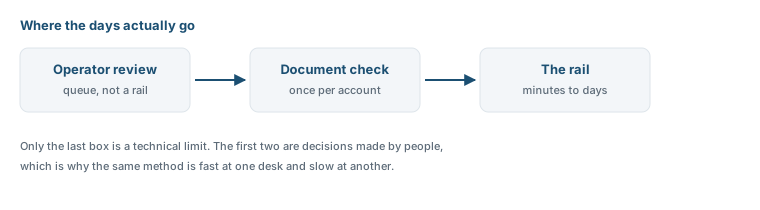
Since there is no tax step, the delay between a request and the money arriving is made of something else entirely, and it helps to know which part is which. A review queue at the operator is a human decision. A document check is a one-off event on the account. The rail itself is the only part that is a technical limit, and it is usually the shortest of the three.
That ordering is why the same method is quick at one desk and slow at another with no rule changing anywhere. If you want to compress the wait, the levers are on the account rather than in the payment: finishing the checks a desk runs on documents before you need the money, and requesting within the pattern your account already has.
It is also worth separating speed from certainty. A quick route is not a route with fewer rules, and the handful of things that genuinely shorten the wait are listed on what actually makes a payout quick. Tax appears nowhere on that list, in either direction, because it never enters the transaction at all.
None of these three stages is a tax step. Two of them are decisions made by people.
Professional players and the money around the game
The question that fills forums is whether gambling full time turns winnings into taxable income. The long-standing position is that betting and gaming winnings are not treated as the profits of a trade, however systematic the player is. Skill, scale and regularity do not convert a win into trading income on their own.
What is taxable is everything built around the playing. Payment for tips or picks. Advertising and sponsorship. Affiliate commission. Appearance fees. Subscription income from streams or a channel. Teaching, coaching and writing about the game. Those are ordinary earnings, and the fact that gambling is the subject matter does not exempt them. A player who makes money from an audience as well as from the tables has two income streams with two completely different treatments.
This is also the one area where the answer depends on facts about you rather than on a general rule. Anyone whose situation is close to that line should take advice from HMRC or an accountant rather than from any website — including this one, which is not a tax adviser and has no way of knowing your circumstances.
Once the money is in a bank account, ordinary rules resume
The exemption covers the win, not the rest of your financial life. Interest earned on the money after it lands is savings income and is treated like interest from any other source. Put it into investments and the normal rules on returns and gains apply to those investments. Buy something that generates rent and the rent is rent.
None of that is a tax on gambling. It is the same treatment the money would receive if it had arrived from a salary, a sale or a gift. The win is the entry point; what the money does afterwards is a separate story with its own paperwork.
The same logic applies to the balance left sitting with an operator. A balance at a desk is not an investment, it earns nothing, and it is exposed to whatever happens to that company. Taking winnings out and keeping them in your own account is the simpler position in every respect, and a direct transfer to the bank is usually the cleanest route for a sum you intend to keep.
Gifts, shared wins and syndicates
Giving money away is where the clean answer stops being enough. Gifts have their own rules, and large transfers can matter for inheritance tax depending on amounts, timing and who receives them. The win was untaxed; a gift of the proceeds is a different transaction, and it is worth asking someone qualified before moving a significant sum rather than afterwards.
Shared stakes deserve a written note at the time. If several people funded the play, the sensible record is a short message agreed in advance saying who contributed what and how a win divides. It costs nothing when nothing happens and settles the argument when something does, both between the people involved and with a bank that later asks why a large credit was split four ways.
Paying someone else's winnings into your account, or theirs into yours, also collides with the operator's own rules. A desk expects the account holder to own the instrument the money goes to, which is one of the checks described in the document process and the reason third-party payouts are refused rather than merely frowned upon.
When a bank asks where the money came from
This is the enquiry people mistake for a tax investigation. Banks have their own duties around unusual credits, and a large, unexpected payment from a gambling company is exactly the shape that prompts a question. The bank is not assessing tax; it is confirming the origin of funds, and a clear answer ends it.
A clear answer is documentary: the cashier's transaction history showing the payout, the dates, and the account the money was sent to. That is why the record-keeping habit below matters even though nothing is owed. Reconstructing a payout trail from memory months later, after the operator has closed your account, is the version of this conversation nobody wants.
The same evidence does a second job. If a payout goes missing between the desk and the bank, the record is the whole of your case. A payout stuck in pending and a credit a bank will not release look similar from the sofa and are solved in opposite directions.
What is taxed and what is not
The table puts the cases side by side, because almost every argument about this subject comes from mixing two of the rows together.
The money
Taxed in your hands?
Who deals with it
A win paid to a UK player
No
Nobody: there is nothing to declare
The operator's gambling receipts
Not yours to pay
The operator, through duty on its takings
Interest earned on winnings after they arrive
Yes, as savings income
You, under the ordinary savings rules
Payment for tips, coaching, streaming or affiliate work
Yes, as income
You, as earnings or self-employment
A gift of winnings to someone else
A separate question
Worth advice before the transfer, not after
A win from a site licensed outside the UK
Not taxed here
Your position is unchanged; the operator's end may differ
Gambling money and the tax system
What to keep even though there is nothing to declare
No declaration does not mean no records. Four things are worth having, and all four are free: the transaction history exported from the cashier while your account still exists, bank statements showing the credits, a note of which rail each payout used, and copies of whatever you sent during document checks.
The uses are mundane and they arrive without warning. A bank questioning a credit. A lender asking about activity on an account during an application. A dispute with a desk that has stopped replying. A mortgage adviser who wants to understand six months of statements. In each case a short, dated trail ends the conversation quickly.
Export the history rather than relying on the account staying open. Operators close accounts, change platforms and lose old data, and a closed account takes its statements with it. This is the single most practical thing on the page, and it takes a couple of minutes while nothing is wrong.
How Britain differs from systems that withhold from the player
In several countries the arrangement is reversed: tax is taken from the win at the point it is paid, or the player is required to declare winnings as income and settle it later. In those systems a cashier produces a deduction and a statement, and keeping that paperwork is essential.
Britain does neither. The collection happens upstream, at the operator, on its receipts rather than on your outcome. The player-facing consequence is the absence of a mechanism: no withholding, no certificate, no annual reconciliation of wins against losses. There is also, for the same reason, no relief for losses — if winnings are outside the system, so are the losses that produced them, and no deduction exists for a bad year.
That symmetry is worth sitting with, because it is the honest version of the good news. Untaxed winnings are not a subsidy. They are the other side of losses that count for nothing, and the arithmetic of the games is unchanged by either. The published return figures on what games actually pay back describe that arithmetic better than any tax rule.
Where tax questions meet lending and affordability
Two things commonly get muddled here. Gambling spend is visible on a bank statement because payments to gambling merchants carry their own transaction category, and the reasons for that sit on the page about paying by card. Winnings, meanwhile, are not income in the sense a lender means, however large and however regular.
So presenting a run of winnings as income on an application is a poor idea, and not only because an underwriter will decline to treat it as such. The same statements show the spending that produced them. The useful posture is the opposite: understand what your accounts show before someone else reads them, rather than discovering it during an application.
If what the statements show is itself the problem, the practical tools are not financial but functional — a block at the bank or a limit at the desk, both described on the page covering limits, pauses and help. They change what the next six months of statements look like, which is more than any explanation can do.
Getting an answer that applies to you
Everything above is the general position for a private player resident in the UK. Three groups should not rely on it: anyone whose income is substantially connected to gambling, anyone tax-resident elsewhere or recently moved, and anyone handling a sum large enough to involve gifts, trusts or estates. For those, the right source is HMRC's own guidance or a qualified adviser who can see the facts.
We deliberately publish no rates, no thresholds and no worked examples on this page. Those numbers change, they are published at source, and a stale figure repeated on a casino payments site is worse than no figure at all. Where a number matters to your decision, read it from the tax authority.
What this site can usefully tell you is what happens at the cashier: which rail carries money back, what delays it, and what a desk is entitled to ask before releasing it. Those are the questions a payout actually turns on, and the stages a withdrawal passes through is the page that answers them.
Questions people ask
Do I pay tax on casino winnings in the UK?
No. A win paid to a private player in the United Kingdom is not taxed in that player's hands, and there is nothing to declare for the win itself. The duty on gambling is charged to operators on their takings instead.
Is there a threshold above which a win becomes taxable?
There is no threshold, because the win is outside the system rather than below a limit. A small win and a very large one are treated identically. What can attract questions is a bank wanting to confirm the origin of a large credit, which is not taxation.
Why did less money arrive than I requested if nothing is withheld?
The gap came from a rail charge, a term in the cashier, or a bonus balance removed before the payout was built. Compare the balance before the request with the amount credited, then find the term that explains the difference. Tax is not part of it.
I gamble full time. Does that make it taxable income?
Winnings are not treated as the profits of a trade, however systematic the play. Money earned around the activity is a different matter: tips, coaching, sponsorship, streaming and affiliate income are ordinary taxable earnings. If you are near that line, take proper advice.
What about interest earned on my winnings?
That is savings income and is taxed like interest from any other source. The exemption covers the win itself, not what the money does afterwards. Investing it brings the ordinary rules for those investments with it.
Do I need to keep records if there is nothing to declare?
Yes, for reasons that have nothing to do with tax. A bank may query a credit, a lender may ask about account activity, and a desk may stop replying. Export the cashier history while the account is open, because a closed account takes its statements with it.
Does playing on a site licensed abroad change my tax position?
Your position as a UK resident player does not change. What may differ is what the foreign operator does at its own end, which is a reason to know which company you are dealing with before you deposit rather than after you win.
Can I offset my losses against anything?
No. Because winnings sit outside the tax system, losses sit outside it too, and no relief exists for a losing year. That symmetry is the plain version of the rule: nothing to pay, and nothing to claim.
Will HMRC ask about a big payout into my current account?
An enquiry about a large credit is far more likely to come from your own bank, under its duties on unusual payments, than from the tax authority. Either way the answer is documentary: the cashier record, the dates and the destination account.
Can I count winnings as income on a mortgage application?
Lenders do not treat gambling winnings as income, and the statements that evidence them also show the spending that produced them. Understanding what your accounts show before an underwriter reads them is more useful than trying to present winnings as earnings.
 UK Cash DeskOpen the cashier



 100% up to £100 on your first deposit