18+. The welcome offer shown here is the one the partner gives the site owner; availability depends on your country and your eligibility. Bonus size, qualifying deposit, wagering, eligible games, maximum bet, expiry and withdrawal limits are set out in the operator’s own terms and are not repeated here. We do not promise payout times. Offshore operator, not licensed by the Gambling Commission of Great Britain. Gambling involves financial risk — free confidential help at begambleaware.org, 0808 8020 133.
Short answerA welcome offer does not reward a deposit, it attaches conditions to one. Whether your payment qualifies depends on the rail you used, the amount, and whether you opted in before the money arrived.
Our top pick
22BET — 100% up to £100 on your first deposit
Regulator
Gambling Commission of Great Britain
Credit cards
Banned for gambling since April 2019
Minimum age
18
Tax on winnings
None for the player
Self-exclusion
GAMSTOP, free and nationwide
The offer is a condition attached to a payment
It helps to invert the usual description. A welcome offer is not something added to your first deposit; it is a set of rules that your first deposit triggers, and once triggered they govern the account until they are satisfied or abandoned. From the moment the payment lands, how you stake, how much you may stake, which games you may stake on and whether you can take money out are all decided by a document you accepted at the cashier.
That framing answers most of the complaints people have about these offers. The money did not disappear, the stakes were not secretly capped, support is not stalling. A contract took effect at the moment of payment, and its terms have been running ever since. Reading it afterwards is the expensive way round.
It also explains why the sequence matters so much. Opting in, paying, and playing have to happen in that order, and a mistake in the order is usually not fixable. Everything below is really about one question: what state is the account in at the instant the money arrives?
What makes a deposit a qualifying deposit
A qualifying deposit has to satisfy four things at once, and failing any one of them leaves you with a funded account and no offer. It has to be the first payment on the account — genuinely the first, not the first since you last played. It has to reach or exceed the amount the offer names. It has to arrive on a rail the offer accepts. And it has to arrive after the offer has been attached to the account.
The first of those is stricter than people expect. An account that received any payment previously, however small and however long ago, has generally used up its eligibility, and reopening a closed account does not restore it. A second account in the same household, on the same device, or on the same card is a different problem again, and one that tends to end with both accounts frozen rather than one of them rewarded.
The amount is the condition most people check and the one least likely to catch them. The rail and the sequence are the ones that do.
Why whole rails are excluded from promotions
Exclusions look arbitrary until you look at the chargeback risk behind each route, at which point they are entirely predictable. Operators exclude rails where the payment can be reversed after the fact, where the payer cannot be identified with confidence, or where the route cannot receive money on the way back.
A prepaid voucher is the clearest case. It carries no account behind it, often no name, and in many cases no return path at all, which is why a voucher-funded deposit is so often outside the promotional terms. Certain wallets sit in the same category for a different reason: the operator sees the wallet, not the underlying instrument, so it cannot tell whether the money originated on a card it is not allowed to accept.
A plain debit payment is accepted almost everywhere, for the symmetrical reason: the name, the institution and the identifying digits are all visible, and the same route can pay you back. That reliability is why the debit route remains the default on British accounts even where faster-looking options exist. Check the exclusion list before you choose the rail, not after.
The qualifying amount is one floor among several
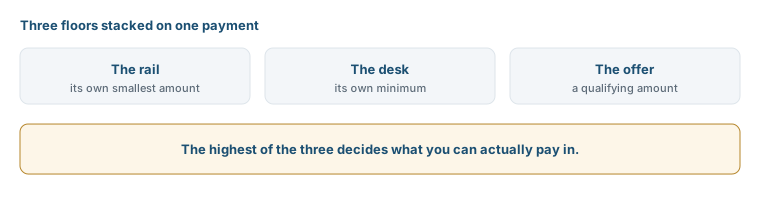
People treat the qualifying amount as the number to beat, and it often is not the binding one. Three separate floors apply to the same transaction, set by three different parties, and the payment has to clear the highest of them. The rail imposes its own smallest transfer. The cashier imposes a site-wide minimum, which is the subject of the page on the smallest payment a desk will take. The offer imposes a qualifying amount, and that one can sit above both.
The consequence is the specific failure that generates most support tickets about welcome offers: the payment goes through, the balance appears, and no bonus arrives. Nothing malfunctioned. The payment cleared two floors and missed the third, and because it is now a completed deposit it cannot be topped up into qualification afterwards. A second payment is a second payment, not an extension of the first.
This is also why small-stake pages exist as separate entries on this site rather than as one. What a modest fixed deposit unlocks at the cashier and what it unlocks promotionally are two different questions with two different answers.
Test
Decided by
What fails it
Is this the first payment on the account
The operator's records
Any earlier deposit, including on a closed account
Does the amount reach the qualifying floor
The offer terms
A payment that cleared the cashier but not the offer
Is the rail an accepted one
The offer's exclusion list
Vouchers and some wallets, and any credit card
Was the offer attached before payment
The opt-in or the code
Paying first and claiming afterwards
Does the name on the rail match the account
The payments team, at the exit
A card or wallet in somebody else's name
Is the account cleared to be paid
The verification queue
Missing or unreadable documents
What a welcome offer tests on the first payment
Three floors sit under the same payment and the highest of them wins. A payment can clear the cashier and still fall short of the offer.
Opting in is the step that quietly decides everything
Some offers attach themselves automatically to a first payment. Many require a positive act: a tick box in the cashier, a code typed in the deposit screen, a selection from a list of concurrent promotions. Where an act is required and you do not perform it, the deposit completes perfectly well and arrives with nothing attached.
Retrospective attachment is almost never possible, and the reason is structural rather than obstinate. The promotional engine stamps the deposit as it processes it, and once the transaction is settled there is no stamp left to apply. Support can see what happened and usually cannot change it, which is a frustrating conversation for everyone involved.
If the cashier shows a list of promotions, read what selecting one does to the others. Offers of this kind are frequently mutually exclusive, so taking the largest headline can mean giving up a better set of conditions. The counterpart product is simpler on this specific point: an offer that needs no payment cannot be mistimed against a deposit, because there is no deposit to mistime it against.
Two balances in one account, kept deliberately apart
Once the offer is live, the cashier is tracking two figures that share a currency symbol and nothing else. One is the money you paid in, which is yours; you may play it, and you may ask for it back. The other is the promotional credit, which you may play under restrictions and may not withdraw. The on-screen total is the sum of the two, which is exactly why the total is the least useful number on the page.
The separation is not cosmetic. Each balance has its own permissions. Promotional funds are limited to the eligible game list, are subject to a maximum stake for as long as the offer is open, and may be barred from particular bet types inside an otherwise eligible game. Your own funds carry none of those limits in themselves — but, as the next sections set out, the moment they are mixed into a live offer the account's permissions apply to the whole of it.
So the question that decides your position is not how much you hold. It is which of the two balances the next round is going to draw from.
Which balance is spent first
Every cashier has a spend order, it is written in the terms, and it is one of the few genuinely consequential lines in the document. One convention takes your own money first and only touches the promotional credit once your own balance is exhausted. The other takes the promotional credit first and holds your deposit back. A third variation draws proportionally from both on every round.
Nothing about the game changes between those conventions. What changes is where you stand if you decide to stop. Under one order you may still have your own money sitting in an unrestricted state; under another your money has been held back but is locked behind an offer you have been playing with somebody else's funds; under the third, your money is being consumed round by round and no clean exit exists at any point.
The terms rarely use the phrase spend order, which makes the clause harder to find than it should be. Look for wording about which funds are used first, or about what happens to the deposit balance when a bonus is active. It is usually a single sentence.
Spend order
Effect of withdrawing part-way
What you are likely to keep
Your own funds drawn first
The promotional credit is forfeited when the offer closes
Whatever remains of your own money, after it has been staked
Promotional credit drawn first
The offer must be closed or completed before anything leaves
Your deposit, if the terms protect it on forfeiture
Drawn proportionally from both
A withdrawal usually ends the offer at any point
The unrestricted share only, as calculated by the operator
What the spend order does to a withdrawal taken mid-offer
When your own money goes first, the exit stays open
This order is the gentler of the two for a cautious player, provided you understand what it costs. Your deposit is being staked from the first round, so it is genuinely at risk, and you may well never reach the promotional credit at all. If you stop early, you walk away with whatever survived, and forfeiting an untouched credit costs you nothing because you never relied on it.
The hazard here is a different one: the account's restrictions start applying the instant the offer goes live, not when the promotional funds are first touched. The maximum stake applies to your own money too. The eligible game list applies to your own money too. Breach either of them while staking your own funds and you can void a promotional credit you have not yet reached, and on some drafting you put the winnings from those rounds at risk as well.
If you wanted an unrestricted session with your own money, the clean way to have it is not to take the offer. That is a legitimate choice and the cashier will let you make it.
When bonus money goes first, the exit closes behind you
This order feels generous and is the one that traps people. Your deposit is held back while the promotional credit is staked, which looks like playing for free. The catch is that the credit cannot leave, so every round spent on it moves you deeper into an obligation while your own money sits immobilised behind it.
The specific position to picture is this: the credit is partly spent, the turnover is partly completed, and you decide you have had enough. Your deposit is still there on screen. Asking for it back means closing the offer, and whether you get the deposit whole depends entirely on how forfeiture is drafted. Some terms return the deposit balance untouched. Others treat the whole combined balance as promotional and remove it. There is no general rule, which is precisely why that clause has to be read before the first payment rather than during the argument about it.
Where this order goes well is when the turnover is modest and you intended a full session anyway. Where it goes badly is everywhere else, and the conditions behind the turnover figure are set out on the page about turnover conditions.
Why an open offer blocks a withdrawal outright
Most systems will not accept a withdrawal request at all while a promotion is live, and the reason is accounting rather than spite. If promotional and real funds could be withdrawn selectively, the whole structure collapses: a player would deposit, take the credit, withdraw the deposit and keep playing on the house. So the cashier does the only simple thing available to it and locks the exit for the duration.
The effect catches people with money that has nothing to do with the offer. Winnings banked before you opted in, a balance left over from a previous session, funds you deposited for an unrelated reason — all of it can sit behind the same lock, because the lock is applied to the account rather than to a particular pot. If a payment matters more to you than the promotion, finish the payment before accepting anything, which is the whole of the advice.
This is a different mechanism from the ordinary caps and queues that govern money leaving a cleared account, and the two are worth keeping apart in your head. Those ordinary constraints are explained on the page about taking money out.
Forfeiting the offer is always available
Whatever the terms say about turnover, you are never locked into a promotion indefinitely. Every licensed cashier has a route to abandon it, usually a button in the promotions area and otherwise a message to support. Forfeiting removes the promotional credit, closes the conditions, and returns the account to its ordinary state, after which the usual exit rules apply and a withdrawal can be requested.
What forfeiting costs you is defined by one clause, and it is the clause to find before you ever need it: what happens to the real-money portion of the balance when a bonus is surrendered part-way through. The answers range from your deposit is returned in full to the combined balance is treated as promotional and removed. Both are drafted and both are in use.
Treat forfeiture as a tool rather than a failure. A promotion that has turned into an obligation you do not want is cheaper to abandon early than to chase, and setting a limit on what you can pay in is a better protection against the next one than resolving to read more carefully.
The checks between the first payment and the first payout
A funded account has given the operator something a promotional-only account has not: a payment with a name on it. That makes the exit easier than it would otherwise be, but it does not make it automatic. Identity, address and the payout method are still evidenced before the first payment leaves, and the method you are paid on normally has to be the one you paid in with wherever that is possible.
That last rule is where excluded rails bite a second time. Fund an account by a route that cannot receive money and the payout has to be redirected, which means documenting a second method and waiting for it to clear. The sequence of those clearances, and the reason they can complete out of order, is set out on the verification page.
One constraint is fixed and in your favour: a British player pays no tax on gambling winnings, so nothing is deducted on the way out. The obligations that sit on the operator at that exit exist because of its licence, and the public register of licensed operators is at gamblingcommission.gov.uk.
Reading the offer before you pay anything in
Six lines decide a welcome offer, and all six are findable in a couple of minutes. The qualifying amount, so you know which floor binds. The excluded rails, so the payment is not wasted. The opt-in requirement, so the sequence is right. The spend order, so you know where you will stand if you stop. The turnover basis and multiplier, so you know what completion costs. And the forfeiture clause, so you know what abandoning it costs.
Notice what is not on that list: the headline percentage. It tells you the size of the credit and nothing about whether the credit is reachable, and an offer with a smaller credit and a gentler spend order is frequently the better deal. The same logic applies to the related products on this site — the no-payment variants, and rounds credited without a deposit, are judged on their ceilings rather than their headlines too.
And the condition that overrides all six: a promotion should never be the reason a payment is made. Credit cards cannot fund gambling in Britain at all, and the thinking behind that restriction is on the credit card page. If deposits have stopped being discretionary, confidential help is at begambleaware.org and on the National Gambling Helpline, 0808 8020 133.
Questions people ask
My deposit went through but no bonus appeared. Why?
Usually one of three things: the payment cleared the cashier's minimum but not the offer's qualifying floor, the rail you used is on the exclusion list, or the offer was never attached because the opt-in or code was missed. All three leave you with a funded account and no promotion, and none of them can normally be corrected after the payment settles.
Can I claim the offer after I have already deposited?
Almost never. The promotional engine marks the transaction as it processes it, so once the deposit has settled there is nothing left to mark. Support will usually be able to see exactly what happened and still be unable to attach the offer retrospectively.
Does the qualifying amount have to be paid in one go?
Yes, in almost all drafting. The offer looks at a single qualifying transaction, not at the total you have paid in. Two payments that add up to the figure are two payments, and the first of them has already been settled as a non-qualifying deposit.
Which payment methods are usually excluded?
Prepaid vouchers most consistently, because there is no account behind them and often no way to pay anything back. Some wallets are excluded because the operator cannot see what funded them. Credit cards are excluded by law rather than by the offer, since gambling cannot be funded with credit in Britain.
What is the spend order and where do I find it?
It is the rule deciding whether a round draws on your own money, on the promotional credit, or on both proportionally. The terms rarely label it, so look for a sentence about which funds are used first, or about what happens to the deposit balance while a bonus is active.
Why can I not withdraw while the bonus is open?
Because the cashier cannot let promotional and real funds be separated on the way out without breaking the structure of the offer entirely. The lock is applied to the account rather than to a particular pot, so unrelated funds sitting in the balance are caught by it as well.
If I forfeit the bonus, do I get my deposit back?
That depends on one clause and it varies. Some terms return the real-money portion untouched on forfeiture; others treat the combined balance as promotional and remove it. Find that line before the first payment, because it is the only term that tells you what abandoning the offer actually costs.
Does the maximum stake apply to my own money too?
While the offer is live, yes, on most drafting. The cap belongs to the account state rather than to the funds, so a single oversized round staked with your own money can void a promotional credit you have not yet touched, and sometimes the winnings from that round with it.
Can I take two welcome offers on the same site?
No. Eligibility attaches to the first payment on an account, and an account only has one of those. Opening a second account to try again breaches the terms outright and is routinely detected through device, address and payment matching, with both accounts frozen as the usual result.
Is a welcome offer taxed when it converts?
No. Gambling winnings are not taxable in the hands of a player in Great Britain, and converted promotional funds are treated no differently. What reaches your bank is whatever cleared the offer's ceiling, the account's payment limits and your bank's own processing.
 UK Cash DeskOpen the cashier



 100% up to £100 on your first deposit