18+. The welcome offer shown here is the one the partner gives the site owner; availability depends on your country and your eligibility. Bonus size, qualifying deposit, wagering, eligible games, maximum bet, expiry and withdrawal limits are set out in the operator’s own terms and are not repeated here. We do not promise payout times. Offshore operator, not licensed by the Gambling Commission of Great Britain. Gambling involves financial risk — free confidential help at begambleaware.org, 0808 8020 133.
Short answerA desk verifies three separate things — your identity, your address and the payment method the money came from — and clearing one of them does not clear the other two.
Our top pick
22BET — 100% up to £100 on your first deposit
Regulator
Gambling Commission of Great Britain
Credit cards
Banned for gambling since April 2019
Minimum age
18
Tax on winnings
None for the player
Self-exclusion
GAMSTOP, free and nationwide
One word, three separate questions
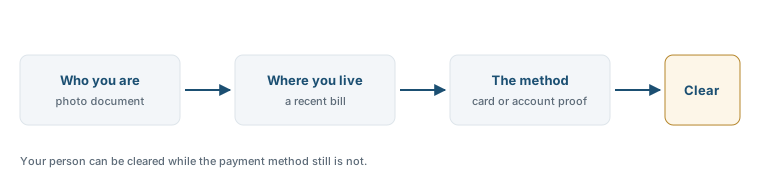
When a cash desk says your account needs verifying, it is asking three questions that have very little to do with one another. Who are you. Where do you live. And whose money came in. The third one catches people out, because it is not about you at all: it is about the card, wallet or bank account that funded the balance, and whether the name sitting behind it matches the name on the gambling account.
Each question has its own document, its own reviewer and its own result. One can pass while another stays open, which is why a message telling you that your identity is confirmed is not the same as permission for a payout to leave the desk. An operator can be entirely satisfied that you are a real adult at a real address and still refuse to pay out to a card it has never been shown.
Keeping the three apart is most of the skill. When something is held up, the useful question is never am I verified. It is which of the three is still open, and what is it waiting for.
Why the request lands before the money moves
A licensed operator has to know who holds an account before it hands winnings over, and the obvious moment to find out is the first time money tries to leave. That is why so many people meet the document request at the payout screen and not at sign-up. Taking a deposit costs the desk nothing it cannot reverse; sending money out is final, so the certainty has to be in place first.
Many desks now pull the whole check forward to registration or to the first payment in, and the reasoning is not hard to follow. A balance built up over several weeks by somebody who turns out to be unverifiable has no clean ending: staked money cannot be unstaked. Asking early is less painful for both sides, which is why a request can reach you before you have funded anything at all.
Whichever moment it arrives in, the check is the operator's, not your bank's. If a payment left your account and never showed on the balance, that is a rail problem and belongs with a deposit that has not appeared. A balance you can see but cannot move, with a document request attached to it, is a desk problem and no amount of talking to your bank will shift it.
Age is settled before you stake, not before you cash out
The legal minimum age to gamble in Great Britain is 18. Age sits slightly apart from the rest of verification because it cannot be left until a payout: an operator is not permitted to take a stake from someone underage in the first place, so this part has to be closed at the front of the relationship rather than the back.
In practice that means a desk will check your date of birth against a data source before it lets you play properly, and it may park the account at a state where the cashier is open but the games are not. If the date of birth you typed does not match the one the data source holds, the fix is a document, not a retyped form — and it is worth typing it carefully the first time, because a corrected date of birth is one of the changes that reopens every other check on the account.
If age cannot be established at all, the operator has to stop the account from staking. What then happens to money already put through is set out in the account terms rather than left to goodwill, and those clauses are not written in the customer's favour. This is the one part of verification where nothing is negotiable.
What a reviewer actually reads on a photo document
A reviewer is not admiring your photograph. They are comparing strings of text: the full name as printed, the date of birth, the expiry date, the document number and the issuing country. Those strings have to line up with what the account says. A middle name typed into the first-name box, a hyphen dropped from a double-barrelled surname, a transposed pair of digits in the date of birth — each of those produces a mismatch that a human then has to adjudicate.
The physical qualities of the upload matter just as much, and they are the commonest reason a file comes back. All four corners of the document must be inside the frame, with nothing cropped. The whole of the machine-readable strip at the foot of a passport has to be legible. Glare across a laminate hides exactly the part that matters. A photograph of a document displayed on another screen is usually refused outright, because a screen image cannot be checked for the security features the reviewer is looking for.
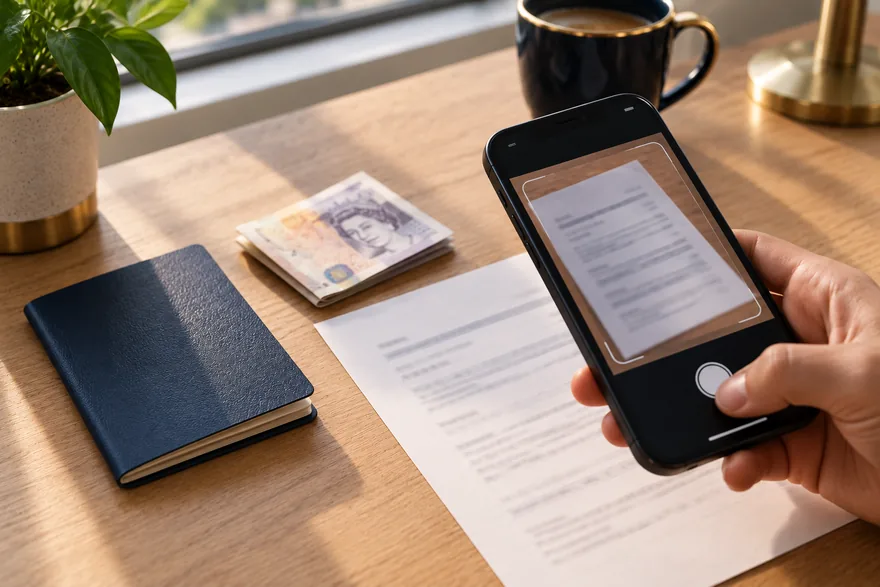
Flat light, a dark background, the document lying still on a table, no fingers over the print. That is the entire recipe, and it beats any amount of arguing with support afterwards.
Proof of address is a test of dates
The address document answers a narrower question than people expect. It does not prove who you are; identity has already been asked elsewhere. It proves that the name on the account is connected to a real postal address right now, which means four things have to appear in the same frame: your name, the address, a date, and something that shows who issued the thing — a bank, a utility, a local authority.
That requirement is why a cropped screenshot almost never passes. People tend to photograph the part with the address and cut away the letterhead and the date, removing both of the elements the reviewer actually needs. Desks also set their own maximum age for the document and print it beside the upload box. Read that line before you dig through a drawer, because an old bill is a wasted upload, and every wasted upload is another wait.
Statements downloaded from a banking app are usually accepted when they come out as the bank's own document, with the bank's name and the statement period on the page. A list of transactions copied into a spreadsheet is not an address document at all, however accurate it is, because nothing on it shows who produced it.
Whose money came in: proving the payment method
The third check is about the rail rather than the person, and it exists because gambling accounts are a convenient way to move someone else's money. The desk wants evidence that the instrument behind the deposit belongs to the account holder. For a card that normally means an image showing the name embossed on it, with the desk telling you exactly which digits to leave visible and which to cover. Follow that instruction literally; do not invent your own masking.
Wallets and bank apps work differently. For a wallet funding the balance the proof is usually the account page carrying your name and the registered email, not the payment receipt. For a modern bank account such as a Revolut balance used at the desk, it is the account detail screen or an exported statement showing the name and the sort code. In every case the document has to show ownership, not just that a payment happened.
Two rails cannot be proven in the usual way at all, and that changes how you get paid rather than whether you get paid. A prepaid voucher bought in a shop carries no name, so a desk which accepts one on the way in still has to send the money out by another route and will verify that route instead. The same is true of a deposit added to a phone bill, which has no return channel whatsoever.
A cleared person with an unproven card
This is the state that generates most of the angry messages, and it is not a fault. Identity cleared, address cleared, payout refused — because the card you want the money sent back to has never been evidenced. The rule a desk is working to is simple: money leaves by the way it came in, to an instrument proven to be yours.
The same shape appears when you fund an account from one place and ask to be paid at another. A deposit from a wallet and a withdrawal request to a different bank account is two instruments, which means two proofs, and the second one was never started. Adding a new method late in the day restarts this part of the check even on an account that has been fully verified for months.
If you want to know in advance which instrument will be used on the way out, the answer belongs to the rail rather than to the terms, because it depends on what that rail can physically do, not on what the operator would prefer.
Three checks run in parallel, and the slowest one decides when the account is actually usable.
Three checks, three documents, three ways to fail
Laid side by side, the pattern is easier to hold on to. Each row below is a separate decision inside the same word, and the failure column is where most uploads come back from.
Check
What it establishes
Where it usually fails
Identity
That the named person exists and is old enough
Cropped corners, glare on the laminate, a name typed differently from the document
Address
That the name is tied to a current postal address
No date or issuer in the frame, or a document older than the limit printed by the upload box
Payment method
That the instrument behind the money belongs to you
A payment receipt sent instead of proof of ownership, or a rail that carries no name at all
Source of funds
Where the money being gambled comes from
Nothing is sent at all, because the request is mistaken for a repeat of the identity check
What each part of verification is for
What never belongs in an upload box
Some things a desk will never need, and sending them anyway creates a risk that has nothing to do with gambling. The three digits on the back of your card are one. A card PIN is another. Account passwords, one-time codes from your bank, and the full unmasked front of a card are all in the same category: no legitimate verification team asks for them, and anybody who does is not a verification team.
Where you send things matters as much as what you send. Use the upload box inside your account. An email address dropped into a live chat, a messaging app, or a link in a text message telling you your documents have expired should all be treated as somebody else's project until you have logged in independently and seen the same request waiting for you there.
Finally, do not send someone else's document to prove your own payment. A card in a partner's name does not become yours because the household shares it, and offering it as evidence turns a slow check into a closed account. If your household has reasons to keep gambling money away from a shared card, the block your bank can apply is a cleaner answer than borrowing a different one.
What starts a fresh check in the middle of play
Verification is not a gate you pass once. Several ordinary events reopen it, and knowing them removes the sense of being singled out. Adding a payment method is the most frequent. Changing your name or address is another, since both documents on file stop matching the account at the same moment. A payout that is far out of step with everything you have asked for before will often route to a human, and so will a long gap in activity followed by a sudden return.
There is a second family of questions that looks like verification but is not. Safer-gambling teams review patterns of spending and time, and they are allowed to ask about them. Those exchanges can pause an account just as effectively as a missing document, and the only sensible way through them is a plain answer. The tools and help available to players are worth reading before that conversation arrives rather than after.
If a request appears while a withdrawal is already sitting in the queue, the withdrawal normally waits rather than failing. That distinction is worth checking on the status screen, because a payout held in pending and a payout rejected need completely different responses from you.
When a check stalls, ask for four specific things
Support answers vague questions vaguely. If days are passing, write once and ask for four items: a reference for the open case, which of the three checks is unresolved, which uploaded file was rejected and the actual reason, and what format would be accepted instead. Those four turn a standstill into a task.
Keep your own record in parallel — the date and time of each upload, the file you sent, and the wording of each reply. Not because anybody is lying, but because a complaint that travels anywhere needs dates, and reconstructing them from memory later is miserable. If the desk stops answering altogether, that record is the whole substance of the case for a desk that will not release money.
One thing not to do is upload the same rejected file again in the hope of a kinder reviewer. Repeated identical submissions are read as a failed check rather than a pending one, and they move your case backwards in a queue you cannot see.
Source of funds is a separate conversation
A question about where your money comes from is not part of identity, however much the email looks the same. It belongs to the anti-money-laundering duties an operator carries, and it is triggered by amounts and patterns rather than by doubts about who you are. Being thoroughly verified is no protection against being asked.
What satisfies it is evidence of income or of the origin of a lump sum: a payslip, a statement showing salary arriving, paperwork for a sale or an inheritance. You are entitled to decline, and the desk is then entitled to close the account and return the balance by the route it came from. Nobody wins that exchange, but it is a legitimate outcome rather than confiscation.
Where it stings is the timing: this request tends to appear exactly when a large payout is requested, which is also when a player is least patient. Requesting money out in steps that fit your account's own history, within the caps the desk prints on the payout screen, is simply less likely to trip the review in the first place.
Names that do not match, and what happens to the files
Mismatched names are the most human failure in the whole process. A married name on a passport and a maiden name on a bank card. A middle name included on one document and absent from another. A name transliterated one way by a foreign authority and another way by a British bank. None of these mean anything sinister, and all of them stop an automated comparison dead.
The way through is to give the desk the bridge rather than an argument: the document that shows both versions of the name, or the certificate that connects them. Send it unasked, with one line of explanation. A reviewer who can see why two strings differ can clear the case; a reviewer who cannot will keep requesting the document that will never match.
As for the files themselves, a licensed operator is holding sensitive identity documents and is bound by data protection law in how long it keeps them and what it does with them. The retention periods and the way requests are handled belong in the operator's own notice, and the way this site handles anything you send us is set out in our own privacy notice. Before you hand documents to any desk at all, it is worth confirming that the company behind it holds a licence — the public register that answers that takes a minute to search.
Questions people ask
Can I play before my documents are approved?
Often yes, and that is what makes the whole thing confusing. Many desks let you deposit and stake while the review runs, then stop the money on the way out. Age is the exception: if that cannot be settled, staking is blocked from the start.
Why does the desk want proof of my card when my ID is already approved?
Because they answer different questions. Identity proves you exist; card proof shows the instrument belongs to you. Money leaves by a route the desk can tie to the account holder, so an unproven card holds up a payout even on a fully cleared person.
My address document was rejected and nobody said why. What is usually wrong?
Almost always a missing element rather than a wrong document. The frame has to contain your name, the address, a date and the issuer together. Cropped letterheads and screenshots of a transaction list are the two commonest rejections.
Is it safe to send a passport to a casino?
Sending it through the upload box inside your account at a licensed operator is a normal, lawful step, and the company is bound by data protection law. Sending it to an email address that arrived in a chat message or a text is not the same thing at all.
Can I withdraw to a different card from the one I deposited with?
Sometimes, but it is a second instrument and therefore a second proof. Expect the desk to ask for ownership evidence for the new destination, and expect that request to add time even though your identity is already settled.
What if my name has changed since my passport was issued?
Send the document that links the two names along with the rest, without waiting to be asked. A marriage certificate or deed poll lets a reviewer reconcile the mismatch. Without it, an automated comparison will keep failing and the case will keep bouncing.
Does being verified at one casino help at another?
No. Each operator carries its own obligation and runs its own review, so the documents have to be sent again. The only thing that carries across is your own preparation: good scans, a current address document and a correctly spelled name.
Why am I being asked about my income?
That is a source-of-funds question rather than an identity one, and it comes from anti-money-laundering duties. It is driven by amounts and patterns, not suspicion about who you are. You can refuse, but the usual result is a closed account with the balance returned.
Can a desk keep my money if I never complete the check?
An unverified account normally ends with the balance being returned by the route it arrived on, minus anything already staked. What happens to winnings made before the check cleared depends on the account terms, which is a strong argument for finishing the process early.
 UK Cash DeskOpen the cashier


 100% up to £100 on your first deposit