18+. The welcome offer shown here is the one the partner gives the site owner; availability depends on your country and your eligibility. Bonus size, qualifying deposit, wagering, eligible games, maximum bet, expiry and withdrawal limits are set out in the operator’s own terms and are not repeated here. We do not promise payout times. Offshore operator, not licensed by the Gambling Commission of Great Britain. Gambling involves financial risk — free confidential help at begambleaware.org, 0808 8020 133.
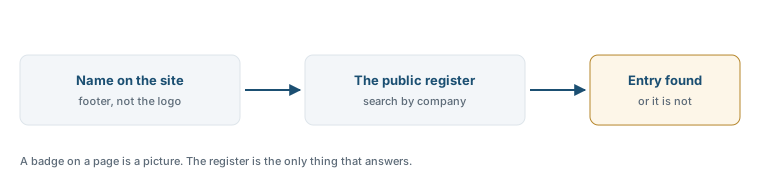
Short answerAnybody can place a regulator's logo in a footer, because a logo is a picture file. The only answer that counts comes from the public register, searched by the name of the company behind the site.
Our top pick
22BET — 100% up to £100 on your first deposit
Regulator
Gambling Commission of Great Britain
Credit cards
Banned for gambling since April 2019
Minimum age
18
Tax on winnings
None for the player
Self-exclusion
GAMSTOP, free and nationwide
A badge in the footer is an image file
Every regulated casino shows a line of small print and usually a logo at the bottom of the page. The logo is an ordinary image, served from the site's own server, chosen by whoever built the page. Copying one takes a right-click. It is evidence of nothing, and treating it as proof is the single most common mistake players make before handing over a document or a card.
The text beside it is more useful, but only because of what it contains rather than because it is true. A compliant footer names the company that holds the licence, its registered address and a licence number. Those strings are the search terms you need. Whether they correspond to anything real is a separate question, and it has exactly one place to be settled.
So the honest reading of a footer is this: it is a claim, written by the site, about itself. The claim is cheap to make and quick to test, and the test takes about a minute.
Only the public register answers the question
Great Britain's regulator keeps a register of the companies it has licensed, and it is open to anybody without an account or a login. You can reach it from the Gambling Commission's own site. Nothing else has standing: not a review site's shield graphic, not a seal on a comparison table, not a support agent's assurance in a chat window.
The register is also the only source that is current. Licences change state — companies surrender them, let them lapse, or have them revoked — and a footer graphic carries on looking identical through all of that. A page can show the logo for months after the entry behind it has stopped being live, because updating that image is not on anyone's list of priorities.
This is why every practical check on this site routes back here. Before you upload identity documents during the document checks a desk runs, before you fund anything, before you trust a term that sounds too convenient: the entry, or there is no entry.
Search by company, never by domain
The register is built around licensees, which are companies. It is not a directory of websites. Typing a domain into it is the usual reason a player concludes that a perfectly legitimate site is unlicensed, or that an unlicensed one cannot be checked.
One company can trade under many names. A single licence can sit behind a dozen brands with different colours, different bonuses and different cashier screens, all pointing at the same corporate entity in a European registry. The register generally records trading names alongside the licensee, which is precisely the field that connects the brand you are looking at to the company that answers for it.
The practical sequence is therefore: read the footer, take the company name, search the company, then look for your brand in the trading names on that entry. If the brand is nowhere on the page, you have found something worth knowing, and no amount of logo-matching changes it.
Where the company name hides on a casino page
Operators do not make this prominent, but they are obliged to make it available. The usual places are the very foot of the home page, a page called something like terms, legal or about, and the small print at the bottom of the cashier. Look for a sentence in the shape of X Limited is licensed and regulated by, followed by a registration number and an address.
Two details are worth noticing while you are down there. First, the company registered in one country may be licensed to serve Great Britain through a British entity, and the entity name is the one to search. Second, if the footer names no company at all — only a brand — that absence is the finding. Licensed operators do not forget this line, because somebody is paid to make sure it is there.
Mobile layouts hide it most often, collapsing the footer into a tappable strip. If you cannot find it on a phone, load the desktop version of the same page before you conclude it is missing.
How to read an entry once you find it
Start with status. An active licence and a surrendered one look much the same at a glance, and they mean completely different things for you: one is a company currently bound by conditions, the other is a company that has walked away from them. If a status word other than active is on the page, stop there and keep your documents.
Then read the activities. A licence is granted for specified kinds of gambling, and a company licensed for one thing is not thereby licensed for another. Then the trading names, which is where you confirm that the brand in front of you belongs on this entry. Then the dates, which tell you how long the arrangement has existed.
What you will not find is a quality rating. The register is not a review: it records permission and conditions, not whether the operator is pleasant to deal with or quick with money. Those questions have their own answers — the published figures on what games return and the payout behaviour of a desk are measured elsewhere, and neither is part of a licence check.
Footer, register, entry. Anything that skips the middle box is not a check.
What a licence actually buys you
The most valuable thing is unglamorous: a licence creates somebody who has to answer. A regulated operator must run a complaints procedure with defined stages, and when it cannot resolve a dispute it must refer you to an independent body that looks at the case for free. That is the whole architecture behind every argument about a held payout, and it is why the single word unlicensed turns a disagreement into a loss.
Second, your money is treated as a subject the operator has to disclose. A licensed company must say, in terms you can read before you deposit, how customer balances are held and what would happen to them if the business failed. The answers differ between operators, which is the point: you are entitled to know which answer applies to you rather than to assume the comfortable one.
Third, a set of controls has to exist in your account rather than on request. Deposit caps you can set yourself, pauses, and the option to shut yourself out are conditions of trading, not features. If you want to see what each of them does in practice, the tools and help available to players are set out plainly, and a cap on money going in is the one most people reach for first.
Rules that apply to the cashier itself
Licensing reaches into payments in ways you can observe without reading a single regulation. Paying for gambling with a credit card is not permitted in Great Britain, so a site offering you one for a deposit is telling you something about itself. That ban, and the ways people try to walk around it without success, is covered on the page about paying by credit card.
Licensed desks also have to be clear about what a payout request does, what can delay it and what caps apply. That is not the same as being fast. It means the rules exist in writing, in your account, before you need them — and that the ceilings on what can leave at once are something you can read rather than discover.
Bonus terms sit in the same category. A licence does not make a wagering requirement generous; it requires that the condition is presented fairly rather than buried. When you read about turnover conditions attached to a bonus, you are reading a commercial term that a regulator insists be legible, not one it has approved on your behalf.
What a licence does not promise
It does not promise you will be paid quickly. Queue times are operational choices, and a licensed desk can be slow without breaking anything. It does not promise pleasant service, sympathetic decisions on goodwill, or that a bonus you misread will be honoured. It does not promise that your account will stay open: an operator may close an account within its terms, and often does.
Above all it does not change the arithmetic of the games. A licence covers how a game's return is tested and declared, not whether you come out ahead. Over any run of play the house edge is the mechanism, and no regulatory condition softens it.
Knowing the limits of the promise is what makes the check useful. A licence is a floor under your position, not a ceiling over the operator's behaviour, and the floor only matters when something goes wrong.
This also settles a question players ask in the wrong order. A payout sitting in a queue for longer than you expected is not evidence of an unlicensed desk, and a licensed desk is not obliged to explain the queue to your satisfaction while it runs. The states a request passes through are worth understanding on their own terms, which is what a payout stuck in pending sets out. The register answers who the company is; the cashier screens answer what the money is doing.
Signs you are not dealing with a licensed desk
Several of these are visible before you register. A cashier offering a credit card for gambling. No company name anywhere on the site. No age statement, or one that contradicts itself. No way to set a deposit cap inside the account. Terms that refer to a regulator in a different country while claiming to serve British players. A support channel that exists only inside a messaging app, with no postal address anywhere on the site, belongs on the same list: a company with nothing to lose from a complaint arranges itself so that complaints have nowhere to land.
The loudest signal of all is an invitation to get around a self-exclusion you have already requested. Sites built to catch people in that position are, by definition, outside the British licensing system, and with that system go the complaints route, the rules about customer money and the obligation to offer you any control at all. If the register is the thing you were hoping to avoid, the register has already given you the answer.
Free, confidential help with gambling is available without going near any of this, from BeGambleAware and on the National Gambling Helpline on 0808 8020 133.
Two sides of the same check
The table below is the short version: what a licence gives you, and what people assume it gives them. Reading the two columns together is a better guide to expectations than any amount of marketing copy.
Question
Covered by the licence
Not covered
Complaints
A procedure with stages and a free independent referral
Whether the outcome goes your way
Your balance
Disclosure of how customer money is held
A guarantee that it is fully protected
Controls
Caps, pauses and self-exclusion existing in your account
Making you use them
Payments
No credit cards for gambling; terms in writing
How quickly a payout clears
Games
How a return figure is tested and declared
That you will win anything
A licence: what it covers and what it leaves alone
When a desk goes quiet and the register still says active
A live entry and an unresponsive operator can coexist, and this is where the licence earns its keep. The route is fixed: raise the complaint with the operator first and in writing, let its own procedure run, then take the refusal to the independent body it names. Skipping the first stage is the mistake that costs the most time, because the second stage asks for evidence that you completed it.
Keep the case boring and documentary. Dates, amounts, the exact wording of refusals, the reference numbers. What a complaint needs looks nothing like what feels satisfying to write. Our longer walk-through of a desk that will not release money covers the order of steps in detail.
And if the register says the licence has gone, there is no procedure left to use. That is the whole reason the check belongs before the deposit rather than after the dispute.
Surrendered, lapsed, revoked: three different stories
These words are not interchangeable. A surrendered licence was given up, usually because a company stopped trading in the market. A lapsed one ended without being renewed. A revoked one was taken away. For your purposes the practical effect is identical — no live conditions, no complaints route — but the three say very different things about what happened.
What matters is the state on the day you look. A brand can be sold, a licence can move between entities, and an old entry can sit in the register as a historical record while the current licence lives under a different company name. If you find both, the live entry with your brand in its trading names is the one that governs your account.
Where money has already gone into a desk whose entry turns out not to be live, the sequence is: stop funding it, request a payout, record everything, and take advice. Do not send further documents on the assumption that compliance is what the delay is about.
A check you can do once and reuse
Done properly, this is a four-line note you write once per operator and keep: company name, licence number, status on the date you looked, and which trading name you were using. It takes a minute, and it makes every later conversation with support shorter, because you already know who you are talking to.
It also tells you whether the rest of the cashier's behaviour makes sense. A licensed company that asks for documents before your first payout is following its obligations; an unlicensed one asking the same questions is simply collecting documents. Same request, entirely different meaning, and only the register distinguishes them.
Two small habits finish the job. Repeat the check if a familiar site suddenly changes its payment options or its terms, and keep the block a bank can place on gambling payments in mind as a tool you control regardless of what any operator does. Whether the money is taxed when it reaches you is a separate question with a short answer, covered on tax on gambling winnings in the UK.
Questions people ask
Does a Gambling Commission logo mean a site is licensed?
No. The logo is an image anyone can place on a page, and it stays there long after an entry stops being live. Take the company name from the footer and look it up in the public register; the entry is the evidence, the picture is decoration.
Why can I not find the casino's name in the register?
Usually because you searched the domain rather than the licensed company. Register entries are organised by licensee, with brands recorded as trading names. Find the company in the footer small print and search that instead.
What does the licence actually do for me as a player?
Three things, mainly. It creates a complaints procedure with a free independent referral at the end. It obliges the operator to disclose how your balance is held. And it requires caps, pauses and self-exclusion to exist inside your account rather than on request.
Does a licence mean my money is guaranteed if the company collapses?
No. It means the operator has to tell you, in terms you can read before depositing, how customer funds are held and what would happen to them. The level of protection differs between companies, so the disclosure is the thing to read, not an assumption.
Can one licence cover several casino brands?
Yes, and that is common. A single licensee may trade under many names, which is why the trading names field on an entry matters. Your brand appearing there is what links the site in front of you to the company that answers for it.
What should I do if the entry says the licence was revoked?
Treat it as a site with no complaints route. Stop funding the account, request whatever balance is there, keep a record of every message, and do not send more identity documents in the belief that compliance is causing the delay.
Does the regulator settle individual disputes about my payout?
It is not a small-claims service for players. The route runs through the operator's own complaints procedure and then the independent body it is obliged to name. Regulatory interest in a company is a separate matter from your particular case.
Is a casino licensed elsewhere in Europe allowed to take my bets here?
Serving players in Great Britain requires a British licence, so a site relying only on a licence from another jurisdiction is outside the system that gives you a complaints route. The register tells you which situation you are in.
How often should I repeat the check?
Once per operator is enough in normal circumstances, with the status and date written down. Repeat it if the cashier suddenly offers different payment options, if the terms are rewritten, or if a payout starts behaving unlike anything you have seen on that account before.
 UK Cash DeskOpen the cashier



 100% up to £100 on your first deposit