18+. The welcome offer shown here is the one the partner gives the site owner; availability depends on your country and your eligibility. Bonus size, qualifying deposit, wagering, eligible games, maximum bet, expiry and withdrawal limits are set out in the operator’s own terms and are not repeated here. We do not promise payout times. Offshore operator, not licensed by the Gambling Commission of Great Britain. Gambling involves financial risk — free confidential help at begambleaware.org, 0808 8020 133.
Short answerBoku is a connector, not a wallet. It collects from your mobile network on behalf of a gambling site, which is why your bill shows a name you did not choose and why a refusal can come from a party you never dealt with.
Our top pick
22BET — 100% up to £100 on your first deposit
Regulator
Gambling Commission of Great Britain
Credit cards
Banned for gambling since April 2019
Minimum age
18
Tax on winnings
None for the player
Self-exclusion
GAMSTOP, free and nationwide
Boku is a connector, not a wallet
The first thing to get straight is that there is no Boku balance. You do not open an account, you do not load money in, and there is nothing sitting there to withdraw. The company exists to join two systems that would otherwise have no way of speaking to each other: a gambling cash desk and a mobile network billing platform.
Mobile networks do not sign individual agreements with every business that might want to charge a line. They sign with aggregators, who take on the integration work, the risk screening and the reconciliation. Boku is one of those aggregators, and from the network point of view it is the customer, not you.
That single fact reorders the whole payment. Your relationship is with your network. The site relationship is with the aggregator. Nobody in the chain has a relationship with both ends, which is the root of most confusion on this group of cash desk rails.
Four parties and one tap
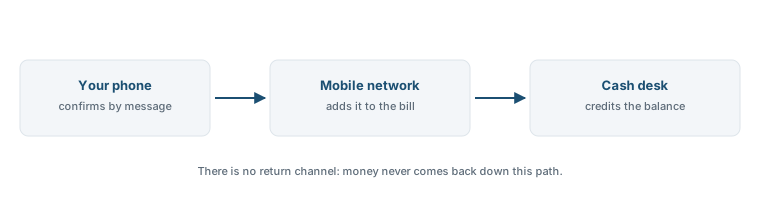
Press the button and four parties take part in quick succession. You authorise. The gambling site asks the aggregator for a charge. The aggregator asks your mobile network. The network checks its own rules and either writes the amount against your account or refuses.
Only the first and last of those links involve you. The two in the middle are commercial arrangements you cannot inspect, cannot appeal to directly and will never receive a statement from. They are nonetheless where a good share of refusals are generated.
The sequence also explains the odd speed profile. Authorisation is near instant because it is a message exchange, while the actual settlement of money between network, aggregator and site unfolds over days on a schedule none of them publishes.
Worth noticing: your playing balance is credited on the strength of the authorisation, long before anybody has actually been paid. The site accepts that risk because the aggregator guarantees it. You are therefore playing with money that exists as a promise between two companies, which is harmless until a charge is reversed and somebody has to decide whose promise failed.
The site never touches your network directly: the aggregator sits in between.
Who bills whom
Follow the invoices rather than the buttons and the structure becomes obvious. Your network bills you. The aggregator claims from your network. The gambling site is paid by the aggregator, net of charges, on the aggregator timetable.
Nowhere in that chain does the gambling site bill you. It never sees your mobile account, never learns your tariff and cannot look up whether a charge succeeded for any reason other than being told. When a site support agent says they cannot see the payment, that is frequently accurate rather than evasive.
It also means the debt you owe is a telecoms debt. If you do not settle it, you are in arrears with your network, not with a gambling company. That distinction matters enormously if a charge is disputed, because only one of those parties can put a credit on your account.
There is a knock-on effect people rarely consider. Arrears on a mobile account are a telecoms matter with telecoms consequences, including the loss of a phone number you may have had for years. A small gambling charge left unpaid is a small gambling charge; a line suspended because of it is something else entirely.
Why the name on your bill is not the name of the site
A merchant description is written by the party that raised the claim, so your bill shows the collector rather than the destination. You may see the aggregator name, a shortened trading name, or a generic reference to charges made by other companies. What you will rarely see is the gambling brand you actually used.
There is a sound reason and an unhelpful consequence. The reason is that the network was charged by one commercial counterparty and records that counterparty. The consequence is that one line on your bill can stand for several different sites, and you cannot tell them apart from the bill alone.
Statement descriptions also change without notice, because trading names and settlement routes are commercial details that get reorganised. A charge you learned to recognise last quarter can appear under something else this quarter with nothing having changed on your side at all.
If you need to reconcile, the only reliable pairing is date and amount. Pull the deposit history from inside the cash desk, line it up against the dates on your statement, and treat the descriptions as noise. This is also the first step when a deposit cannot be found anywhere, because it tells you whether the charge happened at all.
What the aggregator passes on and what it keeps
What travels to the gambling site is thin: a confirmation that a charge of a given amount was accepted, plus an identifier for the transaction. What stays with the aggregator and the network is everything that identifies you, including your mobile number, your tariff and the risk signals attached to the line.
For privacy that is a genuine benefit. No card number, sort code or account number enters the gambling business, because none of those took part in the payment. The site gains a credited balance and almost nothing else.
The cost of that thinness appears later. A site that has never seen a bank instrument in your name cannot use the deposit to help satisfy the identity work required before a payout. Coming in on this rail defers the paperwork rather than removing it.
What each link in the chain can refuse
Every link has its own veto and its own reasons, and the vetoes are checked in order. A refusal reported on screen by the cash desk may have originated three steps away, and the wording you see is simply whatever the site was passed.
The table sets out who can stop a payment and what is visible to you when they do.
Use it as a triage tool rather than a description of faults. The question is never whether the rail is broken; it is which of four parties has made a decision, because only one of them owes you an explanation and only two of them are reachable at all.
Link
Can refuse because
What reaches your screen
Your mobile network
Third party charging barred, cap reached, account standing
A short generic failure with no reason given
The aggregator
Its own risk screening on the line or the pattern of charges
An unfamiliar company name inside the error text
The gambling site
Account state, its own limits, checks outstanding
A specific message about your account or a limit
Nobody, the charge succeeded
Crediting inside the cash desk lagged or failed
Money taken, playing balance unchanged
Where a payment through an aggregator can be stopped
The three places a payment actually halts
Read that last table row carefully, because it is the one people misdiagnose. There is a real difference between a charge that never happened and a charge that happened without being credited, and the fix is different in each case.
If the network refused, nothing was charged and nothing needs chasing; the question is which network rule caught you. If the aggregator refused, again nothing was charged, but repeating the attempt is likely to fail the same way, because risk screening does not change its mind within a minute.
If the charge went through and your balance did not move, that is a crediting problem inside the cash desk and it is the only one of the three the site can fix on its own. Open it with the transaction reference and the exact amount, and keep the record, because a charge that has left your network is money owed to you.
Refunds across three handovers
A refund has to travel back along the same chain it came down, and each handover adds a delay that none of the parties controls end to end. The site instructs the aggregator, the aggregator settles with the network, the network puts a credit against your account. There is no shortcut through the middle.
The destination is also fixed. A reversal lands on your mobile account, not on a card or in a bank account, because that is the only place the original charge existed. On a prepaid line it returns as credit on the line, which is useful for calls and awkward for anything else.
Expect the wait to be longer than you would tolerate from a card refund, and expect nobody to be able to tell you where in the chain it currently sits. Each party can confirm only that it has done its part and passed the instruction on, which is accurate and completely unsatisfying when you are the one waiting.
In other words a refund here is not a payout and cannot be used as one. Winnings leave a cash desk through the normal route money takes when it comes back out, and that route has never involved an aggregator.
One way by design, not by policy
People ask whether any site pays out through this rail. None does, and the reason is structural. The aggregator collects claims from networks; it has no instrument for sending value to a mobile account as a payout, and a network cannot treat somebody winnings as a reduction in a telecoms bill.
If one way traffic is what appeals to you rather than what annoys you, the comparison worth reading is a prepaid voucher deposit, which has the same property for a completely different reason and gives you a hard ceiling in the bargain.
How much can go through at once
The ceiling is your network figure, sharpened by whatever the aggregator decides on top. Neither number belongs to the gambling site, so a site cannot raise it, and neither is published in a form worth quoting. Your network terms and the charges section of your network app are the places to look.
Expect it to be low. That pushes the rail towards the bottom of the deposit ladder, close to the least a cash desk will accept, and makes it unsuitable the moment you want to move a meaningful sum in one go.
Caps that live outside the site do not replace caps that live inside it. A limit you set within your gambling account counts every rail together, which is the only control that sees the whole picture of what you have put in.
Nothing here touches your bank
This is the part most worth knowing. Your bank is not in the chain at any point, so no control your bank offers can see these payments. A gambling block applied to cards and accounts will sit there untriggered while a charge of this type goes through without resistance.
The control that works is a bar on third party charging, placed with your mobile network, because that is the one party actually making the payment possible. The blocks available and where each of them sits compares the two side by side so you can see which layer you have covered.
If this rail has been the easy one at moments you would rather not repeat, that is worth dealing with directly rather than by willpower. Free and confidential support is available from the national advice service and on 0808 8020 133.
What to check before you use it
Three checks, and they take a couple of minutes between them. First, that the line is registered to you, because a charge on somebody else account is somebody else problem and your dispute.
Second, that you have already added and proved the instrument you intend to take money out with. Doing this before you deposit turns the withdrawal into an administrative step instead of a scramble.
Third, that the gambling business holds a British licence, which is a matter of record rather than of design. Look the company up on the public register of licensed operators, since a site that is absent from it has no British complaints route standing behind the payment you are about to make.
A fourth check applies if you share a household plan: find out whose name the account is in before the charge does it for you. Nothing in the flow warns you, and the first notification the account holder receives is a line on an invoice they did not expect to be reading closely.
Where the rail quietly is not available
Availability is decided by the agreements above you, not by your account. A site that has no arrangement covering British networks and gambling simply will not show the option, and nothing in your settings will summon it.
Tariffs matter too. Some prepaid plans and most business accounts exclude third party charging outright, so the button appears and the payment fails, which looks like a fault and is actually a policy. Checking the tariff is faster than retrying, and a single call to your network settles the question for good.
Where everything lines up, the rail does one job well: a small, quick payment that keeps your banking details out of a gambling business and leaves a trace on a bill you can audit later. Measured against that job, and only that one, it is a reasonable tool. The two pages on confirming a payment from your handset and what a phone bill deposit commits you to cover the consequences of using it regularly.
Questions people ask
Do I need a Boku account?
No, and there is not one to open. The service works by joining a gambling site to your mobile network, so the only accounts involved are the one you hold with your network and the one you hold with the site.
Can I withdraw winnings through Boku?
No. The aggregator collects charges from networks and has no route for sending money the other way, and your network cannot pay out a win as credit on a telecoms account. Payouts leave by card or bank transfer.
Why does my bill show a name I do not recognise?
Because the description is written by whoever raised the claim against your line, which is the collecting company rather than the gambling site. One such description can cover several sites, so match by date and amount instead.
My payment failed but no reason was given. Who refused it?
Almost always your mobile network, since its checks run first and it reports failures without explanation. If the error text contains a company name you have not heard of, the refusal came from the collecting company instead.
The charge left my account but my balance did not change.
That is a crediting failure inside the cash desk, and it is the one case the site can resolve itself. Raise it with the transaction reference, the date and the exact amount, and keep your bill as the record of what was taken.
Where does a refund go?
Back to your mobile account, because that is where the original charge lived. On a contract it offsets what you owe on the next bill; on a prepaid line it returns as credit on the line. It cannot be redirected to a card.
Will my bank gambling block stop these charges?
No, as your bank takes no part in the transaction and never sees it. The equivalent control is a bar on third party charging, which you request from your mobile network and which applies to the line itself.
Is this safer than giving a site my card details?
It keeps your card and bank details out of the gambling business, which is a real advantage. It also gives you less to work with if something goes wrong, because the parties that made the decisions have no customer relationship with you.
Can somebody charge my line without me knowing?
They would need access to your handset to approve the request, so a shared or unlocked phone is the actual exposure. If a charge appears that you did not authorise, raise it with your network, which holds the record and the money.
 UK Cash DeskOpen the cashier


 100% up to £100 on your first deposit