18+. The welcome offer shown here is the one the partner gives the site owner; availability depends on your country and your eligibility. Bonus size, qualifying deposit, wagering, eligible games, maximum bet, expiry and withdrawal limits are set out in the operator’s own terms and are not repeated here. We do not promise payout times. Offshore operator, not licensed by the Gambling Commission of Great Britain. Gambling involves financial risk — free confidential help at begambleaware.org, 0808 8020 133.
Short answerEach payout rail has its own rhythm, its own working hours and its own idea of when a payment is finished. Those properties are fixed; the wait in front of them is not, which is why one method can feel quick at one desk and slow at the next.
Our top pick
22BET — 100% up to £100 on your first deposit
Regulator
Gambling Commission of Great Britain
Credit cards
Banned for gambling since April 2019
Minimum age
18
Tax on winnings
None for the player
Self-exclusion
GAMSTOP, free and nationwide
Why nobody can give you one number
Ask how long a payout takes and you are really asking two questions at once. One is about the payment network: how fast can this type of payment move between institutions, and when is it considered finished. That part is knowable and stable. The other is about the operator: how long before anyone releases your request. That part is a business process, it changes with the day of the week, and no table can hold it.
This page deals with the first question properly, rail by rail, because it is the half that behaves predictably. The half that does not behave predictably is described in the way a payout is put together, and it is worth reading first if a request of yours has not moved at all.
Keeping them apart matters because advice gets mixed up otherwise. Picking a quick rail is a real improvement, but only for the stretch after approval. If a request is sitting in a review queue, the rail underneath it is irrelevant: nothing has been handed to it.
What a rail actually is
A rail is the arrangement that carries value between two institutions and the rulebook that says when the transfer counts as done. Those rulebooks differ enormously. Some rails settle in real time between banks. Some clear in cycles with fixed cut-offs and no weekend. Some, like card networks, were designed to carry charges in one direction and handle the other direction as an exception bolted on afterwards.
Two properties decide almost everything you experience. The first is whether the rail pushes or pulls: a payout is always a push, and some deposit routes can only pull, which is why they cannot be used in reverse. The second is whether the rail has an owner who has to post the money at the far end. Where there is such a party, its own schedule is added to the journey and the sender cannot speed it up.
Everything below is a description of those two properties for the routes a British cash desk typically offers. None of it includes a duration, because a duration that was true for one bank in one week would be wrong for the next reader.
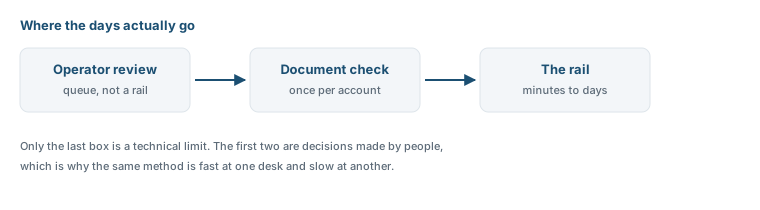
Rail speed describes only the third box. Everything on this page sits inside it.
Debit cards: a credit, not a transfer
A card payout is not a bank transfer that happens to involve a card. It is a credit sent back through the same scheme that carried your deposit, aimed at the card number that was charged. The operator submits it, the scheme carries it, and then your card issuer decides when to post it to your available balance. That final step is the one people underestimate: the money can be on its way for a while before it is visible, and the issuer's posting cycle is not something either you or the casino can influence.
The upside of the route is that it needs nothing from you. The card is already linked, the destination is already known, and a payout to the card you deposited with rarely triggers extra questions about ownership. The downside is that the pending credit is invisible in most banking apps until it posts, so there is a stretch where neither side can show you anything.
One British rule removes an entire branch of this: gambling with a credit card is prohibited, so there is never a credit-card payout to wait for. Prepaid cards are a different matter and often cannot receive a scheme credit at all, which pushes the payment onto another route.
Bank transfers: real-time plumbing, office-hours habits
Payments straight into a current account use the schemes British banks run between themselves, and the modern one is built to settle immediately rather than overnight. On paper that makes it the fastest thing on this list. In practice the bottleneck moves upstream: operators tend to submit these payments in files rather than one at a time, and a file has a preparation step and a submission window.
Beneficiary checks add another step the first time. Because the payment goes to a named account, the name on the account has to match the name on the gambling account, and a mismatch stops the payment rather than slowing it. Where a transfer into your own bank account is being set up as a fallback for a deposit route that cannot receive, expect that check to happen before the first payment rather than during it.
Larger amounts can also be routed differently from small ones. A desk that releases a big win in stages may send each stage on the same rail or move to a different one, and the rail may change without anybody telling you, which is why the reference matters more than the method name.
Wallets: fast to the wallet, then a second journey
A wallet payout has two legs and most people only count the first. The operator pays the wallet, which usually happens on the wallet provider's own internal ledger and can be the quickest hand-off available. Then the money sits in the wallet, and getting it into a bank account is a separate withdrawal you have to start yourself, on whatever rail the wallet uses, with the wallet's own schedule.
Measured end to end, that can still beat a card. Measured honestly, it is two payments rather than one, and the second one is the one people forget to budget for. Anyone using a wallet as the route into a casino balance should know which of the two legs they are timing before comparing notes with anybody else.
Wallet accounts also have their own identity checks, independent of the casino's. A wallet that has not completed its own verification can accept money and then refuse to release it, and that refusal has nothing to do with the operator. It is worth confirming the wallet is in good standing before relying on it as a payout destination.
Open banking: the shortest route on paper
Account-to-account services sit directly on bank infrastructure with no card scheme in between. For deposits that means the payment is initiated from your own bank in the moment; for payouts it means the operator can address your account without holding card details, and there is one fewer institution with a posting cycle. That is a genuine structural advantage rather than a marketing one.
What it does not remove is the queue at the desk, and it does not remove the bank's own checks on an incoming payment it has not seen before. Where an open banking route is used for both directions, the destination is already known from the deposit, which also saves the ownership question that slows a first bank transfer.
App-based banks deserve a note of their own here. They tend to notify instantly and post instantly, which makes them look faster than they are: the payment arrived at the same moment it would have anywhere else, you simply found out about it sooner. Anyone running a payout into an app-based account is mostly buying better visibility.
Phone wallets are a way of paying, not a place to be paid
Tapping a phone to pay does not create an account that can hold money. The wallet on the device is a holder for a card or a bank credential, and the payment underneath it is a card payment or an account payment. When a payout is sent, it goes to that underlying instrument, and the timing is whatever that instrument's timing is.
This confuses a lot of cashier screens. A desk may list the phone wallet as a deposit method and then offer only the card or the bank as a payout destination, which looks like a restriction and is simply the truth about the rail. For anyone who deposited using a phone wallet at the cashier, the practical effect is that the card payout section above is the part that applies.
The same holds for the device-based wallets tied to a bank account rather than a card: the credit lands in the account, the phone merely shows it. There is no separate, faster phone rail hiding behind the icon.
Routes that only work in one direction
Some deposit methods cannot be reversed at all. A charge added to a phone bill is a transaction between you and a mobile network; a voucher bought over a counter was paid for in cash by somebody the operator cannot identify. Neither has an address a payout can be sent to, and no amount of asking changes the architecture.
The timing consequence is the part worth planning around. Because the payment has to go out on a different rail, the desk needs to establish that the new destination belongs to you, so the slowest possible combination is a first payout on a fallback route. That is the situation where a cash voucher used for the deposit turns a quick deposit habit into a slow first withdrawal.
If you expect to win and you know your deposit route is one-directional, the fix is to settle the fallback destination early rather than at the moment of the request.
Rail
What the rail itself adds
Who finishes the job
Debit card
A scheme credit aimed at the card that was charged
Your card issuer, when it posts the credit
Bank transfer
Real-time settlement between banks, submitted in batches
Your bank, on receipt of the payment
Wallet
A quick internal hand-off to the wallet balance
You, by making a second withdrawal from the wallet
Open banking
A direct account payment with no card scheme in between
Your bank, with one fewer party in the chain
Phone wallet
Nothing of its own; it passes through to a card or account
Whichever instrument sits behind the wallet
Phone bill or voucher
No return path exists on the rail
A fallback route, after the desk has checked it is yours
What sets the pace on each payout rail
Weekends, bank holidays and the cut-off nobody publishes
Even rails that settle in real time have a working week around them. Operators prepare payment files during office hours, compliance staff are not all on shift at night, and the banks that receive the money run their own reconciliation. A request made late on a Friday has more opportunities to wait than the same request on a Tuesday morning, and nothing about that is a fault.
Cut-off times are the part that is almost never written down. Most desks have a point in the day after which a released payment joins the next run instead of the current one, and that point is not usually published. You can find it by experiment: note the time you requested, note the time the status changed, and after two or three payouts the pattern becomes obvious.
Public holidays compound it in both directions, because the operator's staffing and the bank's processing can be reduced on different days. This is the one area where a few days of patience genuinely is the right answer, as long as the status has actually moved past review.
Why the same rail is quick here and slow there
This is the question most comparisons dodge, so here is the honest answer. The rail is shared property: the scheme that carries a card credit from one operator is the identical scheme that carries it from another. What is not shared is everything in front of it. How often the desk runs its payment batches, how many requests one person is expected to clear, whether small payments are released automatically while larger ones go to a human, whether compliance sits in the same building or with an outsourced provider, how aggressively a risk system flags unusual patterns for a second look.
Add to that whether your account is already fully cleared. A desk that insisted on documents at registration looks fast later for the simple reason that it moved the slow part earlier. One that leaves the identity check until money is waiting looks slow on the first payout and fine thereafter, with no difference in plumbing at all.
Ceilings produce the same illusion. Where an operator releases a large balance in stages, every single payment can be fast while the total takes weeks, so the caps on how much goes out at once explain more about long waits than any rail does.
What people are actually measuring when they compare speeds
Reports from other players are useful but rarely measure the same thing. Some count from pressing the button, which includes the review queue and any document check. Some count from the moment the status changed to sent, which is a rail measurement. Some count from when their banking app pinged, which adds the issuer's posting cycle. Three people on the same desk and the same rail can quote three very different experiences and all be telling the truth.
There is also a selection effect: the first payout and a payout on a brand-new method are the two slowest cases, and they are the two people most often post about. Steady, repeat payouts on a cleared method generate no stories at all, which is why forums skew pessimistic about speeds that are perfectly ordinary.
Where somebody describes a request that never arrived rather than one that was slow, that is a different category altogether and belongs with a request that has sat in the holding state for longer than a queue can explain.
Timing your own payout so the number means something
You can get a reliable figure for your own desk and your own rail in a couple of attempts, and it will be worth more than any published estimate. Write down four moments: when you pressed the button, when the status left the review wording, when the status said sent, and when the money appeared in your statement. The gaps between them are the three legs, separated.
Do it twice. The first measurement includes whatever documents were outstanding; the second, on the same cleared method, is the figure that will repeat. That second number is the one to use when deciding whether a rail is worth switching to, and it is also the honest answer to give anybody who asks how long that desk takes.
If you want the shortest realistic version of that second number, the preparation is not about choosing a clever rail; it is about having nothing left to check. That is the entire subject of what a fast payout really depends on, and it is mostly work you do before there is any money to move.
Where to check the facts that actually bind the operator
Payout timing is not set by regulation, so there is no rule to quote at a desk that is slow. What is regulated is whether the operator holds a licence, whether its terms are fair and clear, and whether it has a complaints route that leads somewhere. Those you can verify yourself on the public register at gamblingcommission.gov.uk, and an operator that is not on it owes you nothing at all.
Inside the cashier, the figures that do bind the operator are its own stated targets, its ceilings and its charges. Those are published and they are specific to the desk, so they are the only numbers worth trusting on the subject. This site quotes none of them, deliberately: a figure copied here would be stale and would send you to the wrong place for your own answer.
Finally, speed is a poor reason to choose where to play. If chasing a faster payout is turning into a reason to open another account, stepping back is easier than it looks: support is free and confidential at begambleaware.org, with the National Gambling Helpline reachable on 0808 8020 133.
Questions people ask
Which casino withdrawal method is fastest?
Measured only on the rail, account-to-account routes have the shortest chain, because no card scheme and no second withdrawal step sit in the middle. Wallets are close, but finish inside the wallet rather than in your bank. In real life the choice of rail matters less than whether your account and method are already cleared.
Why does a card payout take longer to show up than the deposit did?
Because the two directions are not the same operation. A deposit is a charge authorised in the moment, while a payout is a credit that your card issuer has to post, and posting happens on the issuer's cycle. The money can be in transit and invisible in your app for part of that time.
Are bank transfers really instant now?
The scheme between British banks is designed to settle without waiting for an overnight cycle, so the transfer itself is quick. The delay sits around it: operators submit these payments in batches with a preparation step, and a first payment to a new account is also checked against the name on the gambling account.
Why does the same method take different times at different casinos?
Because only the rail is shared. Batch frequency, the number of staff clearing requests, whether small payments are released automatically and whether documents were collected at registration all differ between operators. Two desks on identical payment plumbing can therefore feel nothing alike.
Can I speed up a payout by asking support?
Sometimes, if the hold-up is a missing document or a question nobody has put to you. Never, if the payment has already been instructed, because at that point the operator has no control over it. The useful request is for the rail reference and the timestamp rather than for the payment to be hurried.
Do weekends really slow payouts down?
They slow the parts people do. Payment files are prepared in working hours, staff numbers drop outside them, and receiving banks run their own reconciliation. The settlement rail may be live around the clock, but a request that arrives after the day's cut-off joins the next run.
Why can I not be paid to my phone bill or a voucher?
Those routes only collect money. A phone bill is a contract between you and a network, and a counter-bought voucher was paid for in cash by somebody the desk cannot identify, so neither has an address a payment can be sent to. The money goes out on a fallback route in your own name instead.
Is a wallet payout finished when it reaches the wallet?
Only from the casino's point of view. The balance is then in the wallet, and moving it to a bank account is a second withdrawal with the wallet provider's own timing and its own identity checks. Comparing a wallet with a card without counting that second leg flatters the wallet.
How do I get a payout time I can rely on for my own desk?
Record four timestamps: the request, the status leaving review, the status saying sent, and the credit landing in your statement. That separates the queue, the rail and your bank. Do it twice, and use the second measurement, since the first one carries whatever checks were still outstanding.
 UK Cash DeskOpen the cashier



 100% up to £100 on your first deposit