18+. The welcome offer shown here is the one the partner gives the site owner; availability depends on your country and your eligibility. Bonus size, qualifying deposit, wagering, eligible games, maximum bet, expiry and withdrawal limits are set out in the operator’s own terms and are not repeated here. We do not promise payout times. Offshore operator, not licensed by the Gambling Commission of Great Britain. Gambling involves financial risk — free confidential help at begambleaware.org, 0808 8020 133.
Short answerCrazy Time is a wheel spun by a presenter in a studio, broadcast live, with a betting window that closes before the wheel moves. Some segments pay directly, others open a separate bonus round you can only enter if you backed that segment, and every figure the game uses is stated in the table's own information panel.
Our top pick
22BET — 100% up to £100 on your first deposit
Regulator
Gambling Commission of Great Britain
Credit cards
Banned for gambling since April 2019
Minimum age
18
Tax on winnings
None for the player
Self-exclusion
GAMSTOP, free and nationwide
What the game is before you look at the wheel
Strip away the studio and Crazy Time is a wheel divided into segments, spun by a presenter while a camera watches, with players betting on which segment the marker will stop against. It is a live product, not a piece of software running on your phone: the wheel is physical, the presenter is a person, and the round is happening whether or not you are in it.
That single fact decides most of the rules below. A game that runs to a studio clock has to open and close a betting window. A game shared by everyone watching has to settle every player from one result. And a game operated by a person at a table has limits set by the table rather than by a bet slider, which is where it diverges sharply from the way a reel game handles a stake.
The rest of the game is a small number of segment types. Some pay against your bet directly. Others are doorways into a separate round with its own rules, played out on the studio floor after the wheel has stopped.
The betting window closes before the wheel moves
Each round begins with a countdown. While it runs you place chips on the segment or segments you want; when it reaches zero the layout locks and the presenter spins. Nothing after that point can be adjusted — you cannot add a segment, raise a stake, hedge or pull out, and there is no cash-out facility on a wheel round.
This is the opposite of how a reel game feels, where the gap between rounds is yours to control. Here the clock belongs to the studio. If you are halfway through typing a stake when the window closes, the stake does not count, and if your connection stalls during the countdown the bet simply never arrives.
The flipside is worth knowing too. Once a bet has been accepted it stands on its own, independent of your screen. If the app crashes after the window closes, the round still resolves and the result is still applied to your balance, which is the opposite behaviour to a slot spin interrupted mid-animation.
Backing several segments is several bets, not one
The layout lets you place a stake on more than one segment in the same round. It looks like spreading risk and it is worth being precise about what it actually does: each placement is an independent bet with its own stake, and only the segment the marker lands against is settled in your favour. Everything else on the layout is lost.
So your real exposure for the round is the sum of every chip on the table, not the largest one. Covering more of the layout raises the chance that something comes in and raises the amount you pay to find out, and the two move together rather than against each other.
Players who come from a reel game regularly misread this, because a slot has one stake per round by construction. Here the stake is whatever you assembled. Before a first paid round it is worth watching the layout fill and emptying it again, which costs nothing and prevents the most expensive mistake in the game.
A bonus segment is a door, and you need a ticket
Some segments do not pay at all. They stop the main game and start a separate round, played out in the studio with its own rules, its own props and its own way of producing a result. Access to that round is conditional: you take part only if you had a stake on that particular segment when the window closed.
This is the single most common complaint about the game, and it is not a fault. If the marker lands on a bonus segment you did not back, you watch the bonus round happen and you are not in it. Nothing is owed to you, and the round that follows does not compensate for the one you missed.
Each bonus round is its own mechanic rather than a variation of the wheel. Some ask the player to choose before the outcome is revealed, some resolve without any input at all. What they have in common is that the rules and the figures are set out in the table's information panel, and that is where to read them rather than guessing from a clip.
A multiplier is not a win and does not pay by itself
This distinction causes more confusion than anything else in the game. A multiplier is a factor applied to a bet. It needs a stake underneath it to produce anything, and it only ever attaches to the bet type it was drawn against. A large multiplier landing on a segment you did not back pays exactly nothing, however loudly the broadcast celebrates it.
The game also runs a mechanism alongside the wheel that can attach a multiplier to one of the bet types before the spin. The same rule applies: the multiplier is wasted unless your chips are on the bet type it selected. People screenshot these moments and read them as near misses; in cash desk terms they are not misses at all, because no stake was ever exposed.
So when a figure appears on screen, read it as a factor waiting for a stake. Whether it has one is a question about your layout, not about the wheel, and it is the reason that a headline return figure tells you so little about what a single round will do.
Why the result cannot be worked out in advance
The wheel has no memory, and nothing in the game carries information from one spin to the next. A history strip showing the last several results is a record of what happened, not a distribution of what is due, and the studio's equipment is checked precisely so that it has no tendency the operator or the player could exploit.
That rules out the whole family of tactics people bring to the table. Waiting for a segment that has not appeared recently does not improve its chance. Doubling after a loss does not change what the wheel does; it changes how fast your balance moves. Tracking the presenter's spin does not help, because the wheel is designed so that the spin cannot be aimed.
The honest summary is that every round is priced the same, and the price is paid out of turnover. More rounds means more turnover, which is why pace matters as much here as it does at a wheel with numbered pockets, where the same arithmetic is easier to see on paper.
Table limits, not game limits
A reel game carries its bet range in its own panel and that range is the same wherever the game runs. A live wheel does not work that way. The minimum and maximum stake are limits on the table, set by the operator who licensed it, and the same game is frequently offered on several tables with different ceilings.
Two consequences follow. First, a limit you read about elsewhere may simply not be the limit on the table in front of you. Second, the ceiling can bite in the middle of a session: a layout spread across several segments can hit a per-segment maximum, or a total-stake maximum, while each individual chip still looks modest.
Both figures sit in the table's own information panel, next to the rules. If a stake is refused and the balance is clearly sufficient, the limit is the first thing to check, before assuming anything is wrong with the method the deposit came in on.
The decision
Who makes it
Where you can see it
The rules of the wheel and the bonus rounds
The studio that produces the game
The table's information panel
Minimum and maximum stake
The operator, per table
The betting layout and the same panel
When the betting window opens and closes
The studio clock
The countdown on screen
Whether your bet was accepted
The operator's server
The bet confirmation and the round history
Whether the balance can be withdrawn
The operator's cash desk
The cashier, not the table
Who sets what in a live wheel round
What the broadcast shows and what it does not
The video is the presentation layer. What settles your bet is the result registered by the studio's own equipment and sent to the operator, which is then applied to every player who had a stake on that outcome. Your screen is a view of that process rather than the process itself.
It is worth understanding because of what happens when the two disagree. A frozen stream, a dropped frame or a delayed overlay changes nothing about the registered result; the round is settled server side and the history panel will show it. Equally, if a round is voided in the studio — a misread wheel, a mechanical problem, an interrupted bonus round — the void applies to everyone and stakes are returned under the published rules.
This is also where a British licence does practical work. The studio, the equipment and the operator all sit inside the conditions the regulator attaches, and checking that the site holds a licence is the one verification you can do yourself, against the Gambling Commission public register, before any money is involved.
The cash desk view: a debit at the close, a settlement at the end
In the ledger a round is as unglamorous as a reel spin. Your stakes are debited when the window closes and the bets are accepted; the settlement is credited once the result, including any bonus round, has finished. Between those two entries the money is neither in your balance nor paid out, which is why a long bonus round can make a balance look oddly low for a minute or two.
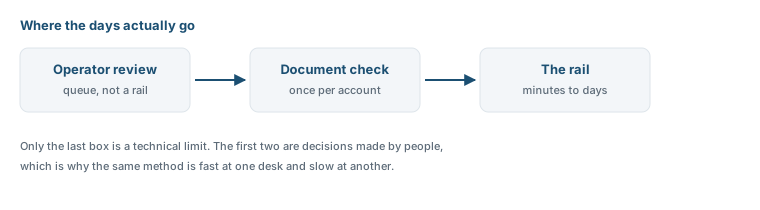
Settlement credits the balance, not your bank. From there the usual sequence applies: the operator's review, the identity check if it has not been done, and then the payment rail. People consistently blame the rail for the wait, when most of the delay belongs to the first two stages.
Clearing the paperwork before you ever win is the one lever a player actually controls. The document check happens once per account, and doing it on a quiet evening is far better than doing it while staring at a balance you want to move.
Only the last stage is a technical limit; the first two are decisions made by people, and a finished bonus round does not skip them.
Live rounds and bonus turnover rarely get on well
If a bonus is open on the account, the question is not whether you can play a live wheel but how much a pound staked there counts towards the condition. Live products commonly contribute at a reduced rate, and they are often excluded outright. Both arrangements are normal and both are written down.
Getting this wrong has two different costs. Playing an excluded game can breach the terms and void the balance; playing a reduced-rate game simply means the turnover moves more slowly than you expected, which costs time and stake rather than the whole balance. The terms distinguish between the two and it is worth reading which one you are under.
The arithmetic itself is simple once the two inputs are known — the base the requirement multiplies and the rate each game contributes at. Both live in the turnover rules of the offer, and a figure taken from a welcome offer's headline is not a substitute for them.
Connection, latency and dropped rounds
A live table is less forgiving of a weak connection than a reel game, because the betting window will not wait. On a patchy mobile signal the practical failure is not a frozen video but a stake that never registers, and the round then resolves without you while your screen still shows chips on the layout.
The defences are dull and effective: place bets early in the countdown rather than in its last seconds, keep the stream quality low if the signal is marginal, and read the round history rather than the video when something looks wrong. The history is the operator's record of what was accepted and what was paid.
If a bet was taken and the session then dropped, the settlement still lands in the balance and you will find it when you log back in. If the bet was never taken, there is nothing to settle — and either way the table's dispute route runs through the operator rather than the studio.
Where this game's own figures are written
You will notice that this page quotes no multiplier values, no segment counts and no return figure. That is deliberate. Those numbers belong to a specific build on a specific table, and the game is offered in more than one form — the live studio version and adapted versions that are not built the same way underneath.
The information panel on the table you are about to play is the authoritative source for all of it: the segment layout, the bonus round rules, the stake range, the return band and any caps on a single win. It opens from the table interface in a couple of taps and it takes a minute to read.
If a figure matters enough to bet on, it matters enough to read in the place where it is binding. A number from a video, a forum or a review describes somebody else's table, and the same caution applies to every title covered here, including the other live tables in the lobby. The same habit pays off on reel games, where a title such as Nitropolis 4 ships in several builds and only the panel in front of you describes the one you are playing.
Keeping a round-based game inside a budget
Wheel rounds arrive on a timer, which makes them feel slower than reels and makes the hourly turnover easy to underestimate. The betting window is short, the pauses are filled with a presenter talking, and a player can sit through a great many rounds without the sense of having pressed anything repeatedly.
So count in rounds and in time rather than in spins. A fixed total layout per round, decided before you sit down, does more for a budget than any decision taken during a countdown. Spreading chips across the layout to avoid missing a bonus round is the habit that quietly multiplies a session's cost.
Account-level controls are stronger than intentions. A ceiling set in the cashier applies regardless of what the evening looks like, and if a session stops feeling like a cost and starts feeling like a way back, the right tool is a time-out rather than a smaller stake. Free, confidential help is on 0808 8020 133 and through BeGambleAware.
Questions people ask
When exactly can I no longer change a bet?
At the moment the countdown ends. The layout locks, the presenter spins and the round is closed to any change — nothing can be added, moved, reduced or taken back, and there is no cash out on a wheel round. A stake that was still being confirmed when the window shut does not take part, so place bets early in the countdown rather than in its final seconds.
Can I bet on more than one segment in a round?
Yes, and each placement is a separate bet with its own stake. Only the segment the marker stops against is settled in your favour; the other chips are lost. Your exposure for the round is therefore the total of everything on the layout, which is the figure to decide in advance rather than during the countdown.
What happens if the wheel stops on a bonus segment I did not back?
The bonus round is played out and you watch it. Entry is conditional on having had a stake on that segment when the window closed, so a round you did not back owes you nothing and the next round does not make up for it. This is the rule most often mistaken for a fault in the game.
Why did a big multiplier pay me nothing?
Because a multiplier is a factor, not a payment. It needs a stake on the bet type it attached to, and without one there is nothing for it to multiply. The broadcast treats a large figure as an event regardless of who was on it, which is why the screen can look dramatic while your balance does not move at all.
Does the history strip help me pick the next segment?
No. It is a record of past rounds and carries no information about the next one, because the wheel has no memory and the equipment is tested specifically so that it has no exploitable tendency. Betting a segment because it is overdue, or avoiding one because it just landed, changes your stake pattern and nothing else.
Why is my stake refused when the balance is clearly enough?
Most often a table limit rather than a money problem. Live tables carry a minimum and a maximum per bet and frequently a cap on the total across the layout, and those limits belong to the table rather than to the game. Both are in the table's information panel. The other common cause is an open bonus that excludes live products.
Is this the same game as the versions I see in other lobbies?
Not necessarily. The live studio product and adapted non-live versions share a name and a look without being built identically underneath, and limits differ by table even within one site. Treat the information panel on the table in front of you as the only description that applies to your round.
What happens to my bet if my connection drops mid-round?
If the bet was accepted before the window closed, the round resolves without you and the settlement is applied to your balance; you will see it in the round history when you return. If the bet had not been accepted, nothing was staked and nothing is owed. The round history, not the video stream, is the record of what actually happened.
Does playing a live wheel count towards a bonus?
Sometimes partly, often not at all. Live products are commonly set to a reduced contribution rate and are frequently excluded from offers altogether. The difference matters: a reduced rate costs you time, while playing an excluded game can void the balance under the terms. The offer terms state which applies before you start.
How long after a win can I have the money?
The settlement reaches your balance as soon as the round and any bonus round have finished. Getting it out of the balance is a separate process: the operator's review, an identity check if one is outstanding, then the payment rail. No reliable duration can be quoted for that here because the first stage is a human queue rather than a technical limit.
 UK Cash DeskOpen the cashier



 100% up to £100 on your first deposit