18+. The welcome offer shown here is the one the partner gives the site owner; availability depends on your country and your eligibility. Bonus size, qualifying deposit, wagering, eligible games, maximum bet, expiry and withdrawal limits are set out in the operator’s own terms and are not repeated here. We do not promise payout times. Offshore operator, not licensed by the Gambling Commission of Great Britain. Gambling involves financial risk — free confidential help at begambleaware.org, 0808 8020 133.
Short answerA live table is a physical place with a dealer, a shared round and limits that belong to the table rather than to the game. The dealer sets the pace, your connection decides whether a bet arrives in time, and the contribution a live stake makes towards a bonus is usually different from a reel stake.
Our top pick
22BET — 100% up to £100 on your first deposit
Regulator
Gambling Commission of Great Britain
Credit cards
Banned for gambling since April 2019
Minimum age
18
Tax on winnings
None for the player
Self-exclusion
GAMSTOP, free and nationwide
A live table is a place, and places have house rules
The useful mental model is not software with a video attached. It is a seat in a room. A dealer runs the round, cards come out of a shoe or a wheel is spun, several people are playing the same hand of events, and the room has rules about how much may be staked and how long anyone has to decide.
Every difference that follows comes out of that. A machine is a private product you control entirely; a table is a shared one, scheduled by somebody else. The arithmetic of the game may be the same as a software version of it, and the practical experience of funding, staking and withdrawing is not.
If you have mostly played reels, the adjustment is mainly about control. On a reel you choose when the round happens and how much it costs within a range set by the game. At a table, the control a reel gives you over timing is handed to the dealer, and the stake range is handed to the operator.
The dealer owns the clock
Rounds open, accept bets for a fixed window, close and resolve. The window is short by design, because a table with twenty people in it cannot wait for any of them. There is no pause, no step back, no holding the round while you check a balance in another tab.
This changes the shape of a session rather than its price. Hourly turnover at a table is usually lower than on reels, because dealing and paying take real time, but it is far more consistent: you cannot slow down during a bad stretch, and you cannot speed up when you feel like it. The game arrives at the same rate regardless of mood.
The practical consequence is that a budget at a table should be set in rounds and minutes, not in a figure you hope to notice crossing. An account ceiling does that job properly, and a limit entered in the cashier cannot be argued with by a version of you who is losing.
One round, many players, one result
At a table the event is public. The same card, the same wheel result and the same dealer decision settle every player who had a stake on that outcome. Nothing about the round is generated for you individually, which is a genuinely different model from a machine where each round is produced on request for one account.
Two things follow that surprise newcomers. A round continues whether or not your bet arrived, because it belongs to the table and not to you. And the number of people at the table has no effect on the outcome or on what you are paid, however it may feel when a busy table runs badly.
It also means the house edge is applied to the table's rules, not to your seat. Where those rules vary between tables of the same game — and in a wheel game they do — the difference is written in the rules panel, which is why the zero rule on a roulette table matters more than any choice you make while sitting at it.
What the stream shows and what is actually settling your bet
What you watch is a camera feed. What settles the round is the result captured by the studio's equipment — card readers at the shoe, sensors around a wheel — and passed to the operator, who applies it to every stake taken. The video exists so that you can see it happen; it is not the mechanism.
That is why a stuttering feed does not change your settlement, and why the round history in the interface is a better source of truth than your eyes. It is also why a round can be voided: if the equipment cannot read an outcome cleanly, or the dealer makes a procedural error, the published table rules decide whether the round stands or stakes are returned, and the same decision applies to everyone at the table.
None of this is discretionary at a licensed site. Studio procedure, equipment and the handling of a misdeal all sit inside the operator's licence conditions, and the holder of that licence appears on the Gambling Commission public register under the name you can look up yourself.
Limits belong to the table, not to the game
On a reel game the bet range travels with the game. At a live table the minimum and maximum are attributes of that table, chosen by the operator, and a popular game will be offered on several tables precisely so that different stake appetites are separated. Two tables can be identical in rules and nothing alike in ceiling.
The consequences are practical. A stake can be refused on a perfectly funded account because it sits under the table minimum or over the table maximum. A table can also be full, or closed, at the exact moment you want it. And a limit that suited you an hour ago can stop suiting you if you move seats.
Read the limits before the first stake, in the table's own information panel, and read them again if you switch tables. The same panel carries the rules variant in force, which is the figure that actually changes the arithmetic of the game you are about to play.
What is in question
Machine round
Live table round
Who sets the stake range
The game, in its own panel
The operator, per table
Who sets the pace
You
The dealer and the betting window
Who the round belongs to
Your account alone
Everyone seated at the table
What happens if your connection drops
The round is restored or voided on return
The round resolves without you and is settled
Contribution towards bonus turnover
Usually the highest rate in the terms
Usually reduced, sometimes excluded
Where the rules in force are written
The game's information panel
The table's rules panel
The same stake at a machine and at a table
Side bets are bets, with their own limits and their own losses
Most live tables offer extra markets alongside the main one. They are not a decoration on the main stake: each is a separate bet, debited separately, settled separately and subject to its own minimum and maximum. A seat can therefore carry several stakes in one round without any of them looking large.
Treat the total on the layout as the figure that matters, because that is the figure the cash desk debits. Side bets are also where the arithmetic of a table is usually least favourable, and that is not a secret — it is in the paytable on the table itself, stated per market.
If you are used to one stake per round from reels, this is the habit to build first: look at what the layout adds up to before the window closes. The same discipline carries over to a wheel game where chips spread across segments, where covering more of the board is the standard way a session quietly gets expensive.
Why your mobile signal matters more here than on reels
A reel game is forgiving about connection. The round is yours, it waits for you, and an interrupted spin is restored or voided when you come back. A table waits for nobody, so a weak connection converts directly into money: either a stake does not reach the operator before the window closes, or it does and you cannot see what happened to it.
The failure most people describe as a crash is usually latency. Chips appear placed on your screen while the confirmation never arrives, the round resolves, and the interface catches up afterwards. The record of what was accepted is in the round history, which is produced by the operator rather than drawn by your app.
Simple habits remove most of it: bet early in the window, lower the stream quality on a marginal signal, prefer a stable network to a fast one, and avoid joining a table while a payment is still settling. A wallet that confirms instantly helps here too, which is one of the few places where a wallet payment on a phone has a genuine operational advantage over a slower rail.
Bonus turnover is where live play and reels part company
If an offer is open on the account, the first question is not whether live tables are allowed but at what rate they count. Reels are typically set at the top of the contribution scale; tables and live products are typically set well below it, and plenty of offers exclude them completely.
Those two cases carry very different risks. A reduced rate costs time and turnover: the same requirement takes far more staking to clear, and the extra staking is where the edge collects its fee. An exclusion is a terms breach waiting to happen, and the standard remedy in the terms is voiding the bonus and anything it produced.
Both the rate and the exclusion list sit in the turnover rules attached to the offer, not in the table panel, and the two documents never mention each other. Read the offer first, then pick the table. The step from a free round to a paid one works the same way away from the tables: on a reel game such as Mystery of Eldorado the first real stake is also the moment the account starts being checked.
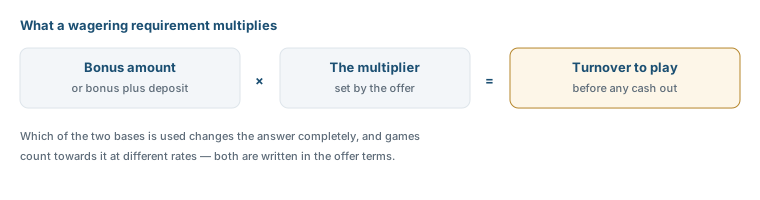
The requirement is the same for everyone; what changes at a live table is the rate at which each pound staked is allowed to count towards it.
A no-deposit offer and a live table rarely mix
Offers that hand over playable funds without a deposit are the most tightly conditioned products in the cashier, and live tables are usually the first thing their terms remove. That is not arbitrary: a table lets a player cover most of an outcome cheaply, which is exactly what an operator giving away stake money is trying to avoid.
So expect any funds from an offer that needs no deposit to be restricted to specific reel games, and expect the restriction to be enforced rather than warned about. The same is true of spin packages: rounds granted as free spins exist on one named game and have no existence at all at a table.
None of this is a reason to avoid offers. It is a reason to decide, before accepting one, whether you intend to spend the evening at a table. If you do, a plain deposit with nothing attached leaves the balance free to move the moment it is a balance.
Inactivity, reservations and being moved on
Tables manage seats, and that produces rules a machine never needs. Sitting without betting for a set number of rounds will usually remove you from the seat; a table at capacity will queue you or refuse entry; and a session left open on a phone in a pocket can be closed by the operator rather than left running.
None of that touches the balance. Being removed from a seat does not forfeit anything, and bets already settled stay settled. The practical annoyance is losing a table you had chosen for its limits and having to find another with the same ones, which is a good reason to note what those limits were.
Where it does interact with money is a pending withdrawal. Some sites will treat continued play as a reason to reverse a pending payout, and some will not allow a withdrawal request while a round is open. Both behaviours are in the terms, and the caps that apply to a payout are worth reading before a good session rather than after it.
Where a live table states its own rules
Every licensed table has a rules panel reachable from the interface. It carries the variant in force, the paytable for the main market and every side market, the stake range for that table, and the procedure for a misdeal or a voided round. That panel is the binding description; nothing else is.
It matters because variants are not cosmetic. The rule applied when a particular outcome lands, whether a market pays at one rate or another, whether a dealer stands or draws in a given position — these change the arithmetic of the game while the table still looks identical to its neighbour. Two tables, one lobby, different games underneath.
This site therefore quotes no payout figures for individual tables, and no return percentages. Where a figure is needed, the instruction is always the same: open the panel on the table in front of you. Published aggregate numbers are a different kind of statement altogether, as the way return figures are compiled sets out.
If a round goes wrong, the operator is the address
The studio may be a separate company from the site you deposited with, but your contract is with the site. Complaints about a misdeal, a disputed settlement or a round that resolved while your bet was in flight go to the operator's complaints process, and the operator is the party required to resolve them.
Build the evidence while it is easy. The round history gives the round reference, the accepted stakes and the settlement. A screenshot of the balance before and after costs nothing. Those two things turn a conversation about what you remember into a conversation about a record.
Where a payout rather than a round is the problem, the sequence is the same but the stages are different, and the identity check is the usual culprit. Clearing the document check early removes the most common reason a live win sits still, and it does more for the speed of a payout than the choice of method does.
Budgeting a game whose pauses are not yours
The honest difficulty with a table is that it feels slower and costs steadily. Rounds come at a fixed rate, the stake is easy to repeat without a decision, and the social texture of a dealer and other players makes a long session feel like an evening out rather than a sequence of priced bets.
Two numbers keep it in proportion: the total you put on the layout each round, and the number of rounds you intend to sit for. Decide both before you join, because the table will not give you a quiet moment to decide them later. A ceiling on the account is the version of that decision which survives the evening.
If the seat starts to feel like a place you have to stay, that is the point to leave rather than to adjust the stake. The controls that close an account to you work immediately, the National Gambling Helpline is on 0808 8020 133, and BeGambleAware is free and independent of any operator.
Questions people ask
Why is the minimum stake at this table higher than at the same game elsewhere?
Because the limit belongs to the table rather than to the game. Operators run several tables of a popular game precisely so that different stake levels are kept apart, and they choose the ceiling and the floor for each one. If a table does not suit your stake, the answer is usually another table of the same game in the same lobby, with its limits shown in its own panel.
Does a live table pay better than the software version of the same game?
The arithmetic comes from the rules in force, not from whether a human is dealing. A live table and a software table can be the same game or meaningfully different ones, depending on the variant and the side markets offered. The rules panel on the table states which variant you are playing, and that is the only place the comparison can honestly be made.
What happens if my internet drops in the middle of a round?
Any stake already accepted stands, the round resolves without you and the settlement is applied to your balance. There is no restoration of the round as there would be on a machine, because the round belongs to the table. When you reconnect, read the round history rather than trying to reconstruct it from the video, as the history is the operator's record of what was accepted.
Can I play live tables while a bonus is open?
Often yes, but at a reduced contribution rate, and a good number of offers exclude live play completely. The two cases are not equivalent: a low rate makes the requirement slower and more expensive to clear, while playing an excluded game can void the bonus and whatever it produced. The offer terms list both the rate and the exclusions.
Are side bets worth taking?
They are separate bets with their own limits, their own settlement and usually the least favourable arithmetic on the table. Each one's paytable is stated on the table itself, so the information is there to read before staking. The practical risk is not any single side bet but the total: several small markets in one round add up to a stake much larger than the main bet looks.
Why was my bet rejected when the balance was sufficient?
Three ordinary causes before anything unusual: the stake sat outside the table's range, the betting window closed before the confirmation arrived, or an open offer excludes the table. A fourth is a payment still settling, which leaves the lobby showing a figure that is not yet stakeable. The round history will show whether the bet was ever accepted.
Is the dealer able to influence the result?
Studio procedure exists to make that impossible, and it is one of the things a licence imposes: how cards are handled, how a wheel is spun, how an outcome is captured by equipment rather than judged by a person, and what happens when something is misread. If equipment cannot read an outcome cleanly, the published table rules decide whether the round stands, and that decision applies to everyone seated.
Can I be removed from a table?
Yes, usually for sitting through several rounds without betting, and sometimes because a table is closing or at capacity. Nothing happens to your balance and settled rounds stay settled. The inconvenience is losing a table chosen for its limits, so it is worth noting what those limits were before you go looking for another seat.
Do I pay tax on money won at a live table?
A player in the United Kingdom does not pay tax on gambling winnings; the duty falls on the operator. That is separate from whether the money can leave the account today, which depends on the identity check, any withdrawal cap and any open offer. The two questions get mixed up because both end in a wait before the money is usable.
Does playing on a phone put me at a disadvantage at a live table?
Only through the connection. The round, the limits and the settlement are identical on any device, but a short betting window punishes latency, and a stake that does not reach the operator in time simply does not exist. Betting early in the window and lowering the stream quality on a weak signal removes most of the problem.
 UK Cash DeskOpen the cashier



 100% up to £100 on your first deposit