18+. The welcome offer shown here is the one the partner gives the site owner; availability depends on your country and your eligibility. Bonus size, qualifying deposit, wagering, eligible games, maximum bet, expiry and withdrawal limits are set out in the operator’s own terms and are not repeated here. We do not promise payout times. Offshore operator, not licensed by the Gambling Commission of Great Britain. Gambling involves financial risk — free confidential help at begambleaware.org, 0808 8020 133.
Short answerNothing in a cashier knows it is dealing with Revolut. It sees a card number, and the answer to its request comes from whoever issued that number under the rules the app has been told to apply. That is why the same account pays one desk and is refused by the next, and why the switch in your own settings matters more than the logo.
Our top pick
22BET — 100% up to £100 on your first deposit
Regulator
Gambling Commission of Great Britain
Credit cards
Banned for gambling since April 2019
Minimum age
18
Tax on winnings
None for the player
Self-exclusion
GAMSTOP, free and nationwide
Two things in one app, and why the question gets muddled
Most of the confusion about this account comes from treating it as a payment method. It is not one. It is an account that holds money, plus software that issues cards against that money and applies rules to how they are used. When somebody asks whether it works at a cash desk, three separate questions have been folded into one, and they have three different answers.
The first question is whether a card issued from the account will be accepted. The second is whether the app itself will permit a payment it recognises as gambling. The third is whether the account can receive a payout afterwards. You can get a yes to the first and a no to the second on the same afternoon without anything having changed at the cash desk.
Which part of the account you are holding also matters, and it is worth checking once. Money kept as a bank deposit and money kept as safeguarded electronic funds are protected by different mechanisms, and your own app states which applies to you. The protection is not a gambling question, but it is the kind of thing people assume rather than read.
The question
The part that actually answers it
Will the card be accepted here?
The issuer behind the card and the desk's acquirer
Will the app let a gambling payment through?
The gambling control in your own settings
Can a payout come back to me?
Whether the card can receive a scheme refund
Why does the amount differ from what I typed?
Whoever performed the currency conversion
Three questions that get asked as one
The card is the rail; the app is the control panel
Keep these two apart and everything else falls into place. The rail is a card pull: the desk sends a request towards a card number, the issuer answers, and money is set aside before it is taken. That machinery is identical to the one behind any other card and is described from first principles under how a debit card payment is actually processed.
The app is a layer of policy that sits in front of the issuer's decision. It decides which of your cards exist, whether a given card is frozen, which currency pocket a payment draws from, and whether gambling is permitted. None of that is visible to the cash desk. The desk receives an approval or a refusal and a short code, and the code rarely distinguishes between a bank saying no and a setting saying no.
This separation is also why support at a cash desk cannot help you much here. They are looking at one end of a conversation whose other end is in your pocket. The app is the only place where the real reason is written down.
Virtual cards, and what a fresh number buys you
A virtual card is a second card number against the same money. It exists in the app, it has its own expiry and security code, and it can be frozen or deleted without touching the plastic in your wallet. For a cash desk you are trying for the first time, that is a genuinely useful thing to hand over: if the number later turns up somewhere it should not, you delete it and the rest of your banking is untouched.
What it does not buy you is any change in the rules. The same issuer answers, the same merchant category is attached to the request, and the same gambling control applies. People sometimes reach for a virtual card hoping it will slip past something, and it will not, because the thing doing the deciding sits behind all the numbers rather than inside any of them.
The practical benefit is containment rather than permission. One number, one purpose, deletable. If you want containment taken further, the voucher family does it with physical limits rather than software ones, and the overview of rail families sets out what that costs you at payout time.
Disposable numbers and the refund they cannot see
A disposable number goes one step further: it regenerates after it has been used, so the digits the merchant captured are dead by the time anybody could reuse them. For ordinary one-off shopping that is close to ideal. At a cash desk it introduces a problem that only appears later.
A payout on a card rail is aimed at the original transaction rather than at a number you type in again. The scheme keeps a reference, the money follows it, and it lands in the account that issued the dead number. So in mechanical terms the refund still reaches you. The trouble is procedural: a cashier that checks the card before releasing a payout, or that asks you to confirm the last digits, now has a number that validates against nothing, and the request stalls in a queue while somebody decides what to do about it.
The fix is boring and effective. Use a durable virtual card for a desk you intend to withdraw from, and save the disposable ones for places you will never be paid by. The general reasons a request sits still rather than failing outright are gathered under what happens between asking and being paid.
The gambling switch in your own settings
The app carries its own control for gambling payments, kept with the security settings rather than with the card ones. Turned on, it refuses payments the app can identify as going to a gambling merchant, and it does that before the request is approved, so the money is never set aside at all. The cash desk sees a refusal with no detail and will tell you, accurately as far as it knows, that the payment was declined by your bank.
Turning it on is immediate. Turning it off is deliberately not quite as easy: there is a confirmation step, and depending on your account there may be a wait before it lifts, with the app telling you how long. The asymmetry is the point of the whole feature. A control you can switch off in one tap at the moment you most want to switch it off is not a control.
What it covers is narrower than people assume, and the limit is structural rather than a flaw. It can only act on payments it can recognise. Money leaving the account by a route that does not look like a gambling merchant will not be caught, which is the subject of the page on bank gambling blocks and the single most important thing to understand about every version of this feature.
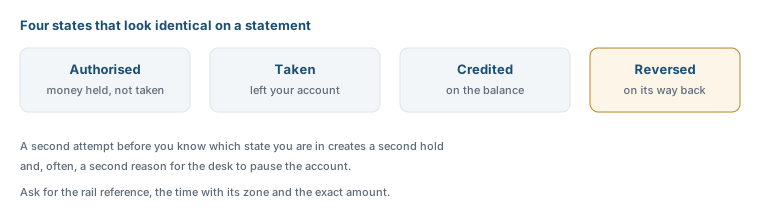
A refusal, a hold and a reversal look almost identical in an app. Find out which one you are looking at before trying again.
Three routes out of the same app, and only one is covered
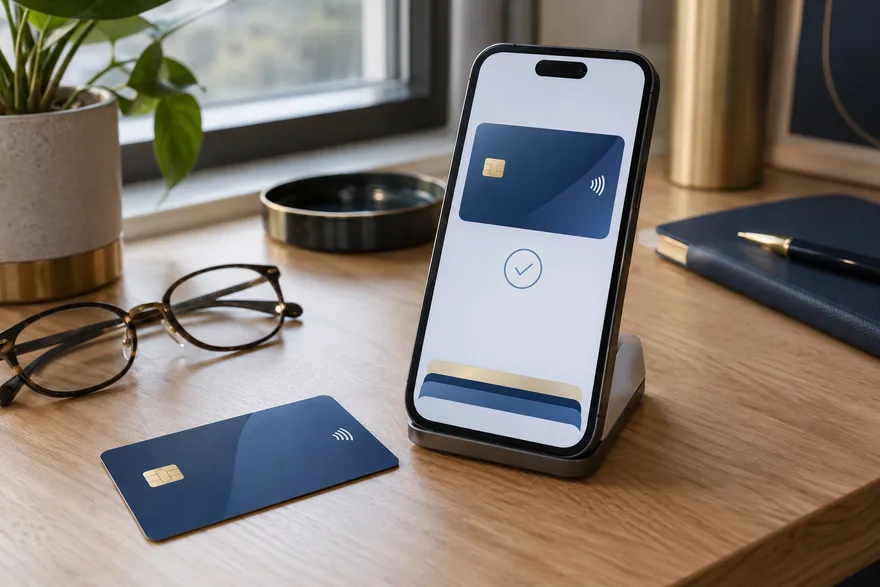
Here is the detail that undoes most people's assumptions. The same account can reach a cash desk by more than one route, and the gambling control does not govern all of them equally. A direct card payment to the desk is the clear case: it is recognisable, it is caught. A payment made through a device wallet that is presenting the same card is still a card payment and is normally caught too, because the merchant category travels with the request, whether the wallet is the one built into an iPhone or its Android counterpart.
A transfer out of the account to somewhere that is not a gambling merchant is a different matter. The app has nothing to recognise, because the recipient is not one. Money moved to another wallet, another account or another instrument and spent from there has left the perimeter of the control, and the control was never designed to follow it.
So if you hold the switch on for a reason, the thing to avoid is not a particular button but a particular shape of transaction: a hop. Topping up a wallet that pays the desk for you is a hop. So is sending money to an account at another bank and paying from there. The switch is a fence, not a net.
Route to the desk
Rail underneath
Seen by the in-app control
Route back
The card, entered at the cashier
Card pull
Yes, by merchant category
To the same card
The card inside a device wallet
Card pull with a substitute number
Normally yes
To the card underneath
Account top-up of another wallet, then pay
Transfer, then a second pull
No, the recipient is not a desk
Into that wallet, not here
Transfer to an account elsewhere, then pay
Transfer, then whatever follows
No
Wherever that second rail ends
Routes from the same account and what each one meets on the way
Why 'does it work' is the wrong question
Acceptance is not a property of a brand. It is the outcome of a negotiation between two parties neither of whom you have met: the issuer behind your card and the payment processor the cash desk uses. Either can have a rule about the other. An issuer can decline a whole class of merchants; a processor can decline cards from particular issuing programmes, often because of fraud history that has nothing to do with you.
That is the mechanism behind the single most common complaint on this rail: it worked at one desk and not at the next, on the same day, with the same card, for the same amount. Nothing about your account changed between the two attempts. The counterparty did.
It also means the answer cannot be looked up in advance and cannot be given to you honestly by anybody, including this page. What you can do is establish quickly which side refused, and the symptoms are different enough to tell apart once you know what to look for.
Reading a refusal: which side said no
If the app shows nothing at all, no declined entry and no held amount, the request did not reach your issuer. The cash desk, or the processor in front of it, stopped it. You will see this as an instant failure that happens before any authentication step appears.
If the app shows a declined payment with a reason, your side answered and the reason is the truth of the matter. Gambling control, insufficient funds in the pocket the card draws from, a frozen card, a card the app has quietly replaced after a security event: all of these look to the cash desk like a generic decline, and all of them are plainly labelled in the app.
If the app shows a pending or held amount and the cash desk shows nothing, you are in the gap between an authorisation and a credit. That is the state to stop and look at rather than retry, and it is the same state that produces most of what is described under a deposit that has not arrived.
Several currencies, two conversions, one quiet cost
Holding more than one currency is the headline feature of this kind of account, and at a cash desk it is where money goes missing without anybody charging you a visible fee. The cost is not a fee. It is the gap between the rate used to convert and the rate at which the currencies actually trade, and it is taken on the way in and taken again on the way out.
The sequence that costs the most is the one nobody notices choosing. You hold pounds. The desk charges in another currency. Your pounds are converted to pay it. You win, and the payout is made in the desk's currency and converted back. Two conversions, two margins, on the full amount rather than on your net result.
Avoiding it is simple once seen: pay a desk in the currency it charges in, from a pocket already held in that currency, or pay a desk that charges in pounds. The app will also apply a different rate at times when markets are closed, and it tells you that it is doing so at the moment of payment, which is the only place a current figure exists.
Topping up the account is not the same as paying from it
One more distinction that matters more than it sounds. Putting money into the account is a separate transaction from spending it, and the two can be governed by different rules. A top-up from an external debit card is a card pull aimed at your own account and has nothing to do with gambling, so no gambling control touches it.
This is why an account can be funded freely and then refuse to pay a desk, which feels contradictory and is not. It also means a credit card cannot be laundered into this rail by topping up with it. Funding a gambling payment from credit is barred in Britain regardless of how many accounts sit between the credit line and the desk, and the reasoning behind that is on the page about the credit card ban.
Where the account is funded by a push from your main bank, that push is governed by your main bank's controls rather than by this app's. Two sets of settings, two perimeters, and the weaker one determines what actually happens.
Getting a payout back into the account
A payout to a card issued by this account behaves like any other card payout. It is aimed at the original transaction, it arrives as a credit rather than as a transfer, and it lands in the pocket the card is tied to. Where the card drew from a currency pocket other than the desk's, the credit is converted on arrival, which is the second margin described above.
Two things make this rail slightly more fragile than a high street bank account on the way out. The card may have been replaced or regenerated since the deposit, which the scheme usually handles and a cashier sometimes does not. And a cash desk that cannot recognise the issuer may insist on paying by another route entirely, which means registering an account and verifying it.
If a clean landing in a current account is what you actually want, a push rail is the simpler answer and paying straight from a bank account sets out what that costs you in speed at the front door.
The name on the account and the name at the desk
Identity work on this rail has one wrinkle and it is worth knowing before a balance depends on it. The account was opened with its own checks, often entirely in the app and sometimes years ago. The cash desk runs its own checks and cannot inherit any of that work, because its licence obliges it to do the checking itself.
What the desk wants is a chain in which the payment instrument, the account on the site and the identity document all name the same person at the same address. An account opened under a former name, or held jointly, or registered at an address you have since left, breaks the chain quietly, and the break is discovered at the exit rather than the entrance.
Statements are the other wrinkle. A desk asking for proof of the instrument wants a document showing your name, the account and the transaction, and an app-only account issues those as exports rather than as posted statements. Generate one before it is urgent. What is being asked for and why is set out on the page about identity checks.
What to check before you blame the rail
Four looks, in this order, resolve nearly everything on this rail. Look in the app for a declined entry: if it is there with a reason, you have your answer and nothing at the cash desk will change it. Look at the gambling control: if it is on, it is working as designed, and the lift takes as long as the app says it takes.
Look at the pocket the card draws from, because a balance in the wrong currency is not a balance for this payment. Then look at the card itself: frozen, expired, replaced after a security event, or disposable and already used once. Only after all four is it reasonable to conclude the desk's processor refused you, and at that point another rail is the quicker route than another attempt.
One last thing that is not a mechanical check at all. If you are reaching past your own gambling control to make a payment, the control is doing exactly what you asked it to do when you set it. The way another app-based bank builds the same feature is worth a look, because its version makes the asymmetry harder to talk yourself out of, and that is a feature rather than an inconvenience.
Questions people ask
Is a Revolut card treated as a debit card at a cash desk?
Yes, which is why it is available at all. Cards issued against money you already hold are debit instruments, and debit is the only card type permitted for gambling in Britain. If a desk refuses it, the refusal is about the issuer or the processor rather than about the card type.
Why did one cashier take the card and another refuse it?
Because acceptance is decided by two parties and either can have a rule. Your issuer can decline a merchant category, and the desk's processor can decline cards from particular issuing programmes. Neither tells the other why, and neither tells you, so the practical answer is to establish which side went quiet rather than to retry.
Can I use a disposable card and still be paid out?
The money can find you, because a payout follows the original transaction rather than a number you re-enter, and it lands in the account behind the dead digits. The risk is administrative: a cashier that verifies the card before releasing funds has nothing to verify, and the request waits in a queue. Use a durable virtual card where a payout is likely.
Does the in-app gambling block stop every route to a cash desk?
No. It acts on payments it can recognise as going to a gambling merchant, so it catches direct card payments and normally catches the same card inside a device wallet. It does not follow money that leaves the account to somewhere ordinary and is spent from there, because at the moment of the transfer there is nothing to recognise.
How long does it take to turn the gambling control off?
There is a confirmation step and, on some accounts, a wait before it lifts; the app states the period that applies to you and that is the only accurate source. The delay is intentional rather than a technical limitation, because the value of the feature comes precisely from not being instant.
Why is the amount that left the account different from the amount I typed?
Because a conversion happened somewhere. If the desk charges in a currency you do not hold, the card draws from a pocket and converts, and the rate plus the margin produces a figure slightly different from the one on screen. The rate in force is shown at the moment of payment and nowhere else in advance.
Can I top the account up with a credit card and pay from it?
No, and the barrier is the rule rather than the plumbing. Funding gambling from credit is not permitted here no matter how many accounts the money passes through, and providers enforce it on their own side. Expect the refusal to arrive at the top-up or at the payment, depending on whose check runs first.
Is money in the account protected if something goes wrong?
That depends on whether your balance is held as a bank deposit or as safeguarded electronic money, and the two are protected by different mechanisms. Your own app states which one applies to your account. It is worth reading once, because it is unrelated to gambling and people tend to assume rather than check.
Do I owe tax on winnings that land in this account?
A player in the United Kingdom owes no tax on gambling winnings, and nothing about the account or the rail changes that. A credit arriving in an app is a record of money moving, not a taxable event. The duty in this market is charged to the operator instead.
I am on the self-exclusion register but my card still works. Has something failed?
Nothing has failed. The register works at the operator rather than at your bank, so a functioning card tells you nothing about it. Every licensed site will refuse the account itself. Seeking one that would accept it means stepping outside British licensing, which removes the rules and the body that would hear a complaint; the National Gambling Helpline is on 0808 8020 133.
 UK Cash DeskOpen the cashier

 100% up to £100 on your first deposit