18+. The welcome offer shown here is the one the partner gives the site owner; availability depends on your country and your eligibility. Bonus size, qualifying deposit, wagering, eligible games, maximum bet, expiry and withdrawal limits are set out in the operator’s own terms and are not repeated here. We do not promise payout times. Offshore operator, not licensed by the Gambling Commission of Great Britain. Gambling involves financial risk — free confidential help at begambleaware.org, 0808 8020 133.
Short answerApple Pay is not a payment method of its own. It is a wrapper that sends a token instead of your card number and a biometric confirmation instead of a signature, which is why winnings return to the card rather than to the phone.
Our top pick
22BET — 100% up to £100 on your first deposit
Regulator
Gambling Commission of Great Britain
Credit cards
Banned for gambling since April 2019
Minimum age
18
Tax on winnings
None for the player
Self-exclusion
GAMSTOP, free and nationwide
A wrapper, not a wallet with money in it
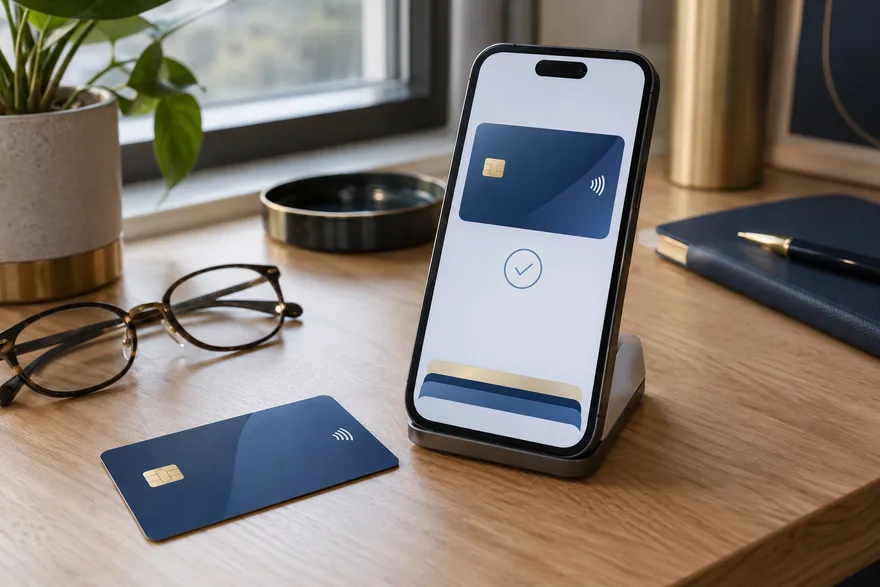
The word wallet is misleading. Nothing is stored in Apple Pay in the sense of value: there is no balance, no top up and no account number belonging to it. What it stores is a stand in for a card you already hold, and every payment is made by that card.
Once you see it as a wrapper, most of the awkward questions answer themselves. Limits belong to the card. Refusals belong to the bank that issued the card. Payouts go to the card. The wrapper changes how the details travel and who confirms the payment, and nothing else.
It is worth placing it correctly among the routes into a cash desk. Several of them are genuinely separate rails with their own rules; this one is a card payment with better handling of the card number.
The token that stands in for your card number
When a card is added to the wallet, your bank issues a separate number for that card on that device. The number printed on your plastic stays where it is. What leaves your phone is the substitute, together with a cryptogram that is valid for one payment only.
That is a real security improvement and not a marketing line. A merchant database holding a token from your device is of no use to anybody: the token works only from that device, only with a fresh cryptogram, and it can be cancelled without touching the card itself.
For a gambling deposit this matters more than usual, because it means the business never stores the card number you use everywhere else. If keeping card details away from an operator was the reason you were considering prepaid vouchers, the wrapper achieves something similar while keeping the dispute rights a card gives you.
The token is also revocable in a way a card number is not. Remove the card from the wallet, or lose the device and wipe it remotely, and that token stops working while the card in your pocket carries on as normal. No comparable move exists once a card number itself has been handed to a merchant.
What your face actually authorises
The biometric step is not sending your face anywhere. It unlocks the wallet locally so the device will release a payment token, and the only thing that travels is the token and the cryptogram. Your bank sees that a cardholder verification took place on the device; it never sees the image.
Practically this replaces typing a card number, an expiry date and a security code with one gesture. It also replaces the weakest part of a card payment, which is the part where somebody who can read your card can pretend to be you.
Where it changes behaviour is speed. A deposit that takes one gesture is a deposit made before you have thought about it, which is the uncomfortable half of the convenience. A limit set in advance is a better answer than relying on friction that the wrapper has deliberately removed.
It is also worth knowing what the gesture does not do. It does not check anything about the gambling account, it does not confirm the amount is one you can afford, and it does not involve your bank making a judgement about the payment. Those decisions happen afterwards, somewhere else, and the gesture has no bearing on them.
The wrapper releases a token; the card underneath is what actually pays.
Why your money comes back to the card
There is nowhere else for it to go. The wallet is not an account, holds no balance and has no details a payout could be addressed to. So when a site pays you, it pays the card that sat underneath the deposit, or another instrument you have added and proved.
This confuses people who expect a notification on the phone when the money lands. There will not be one, because nothing arrives at the wallet. The credit appears on the card account, in your banking app or on your statement, on the card scheme timetable rather than on the wallet.
It also means you may be asked for the card details in a form after all. A site that cannot identify which card a token belonged to will ask you to add the card properly before it pays, which is one of the reasons behind the stages a payout goes through taking longer than the deposit did.
Why the button is missing more often than you expect
Four things have to line up before the option appears, and any one of them missing removes it silently. The site has to support it. The payment processor the site uses has to support it for gambling. You have to be on a device and browser that can offer it. And you have to have a card in the wallet that is eligible.
Gambling is the link that breaks most often. Support for the wrapper is a decision made by the processor and by the card scheme rules for the sector, not by Apple and not by you, so a site can perfectly well offer it for other business and not for this one.
That is why there is nothing to troubleshoot when the button is absent. It is not a fault, a setting or a regional quirk you can work around, and the practical answer is to pay the card directly instead, which is covered under depositing with a debit card.
The card underneath makes the decision
Every refusal you see on this rail came from somewhere else. The wrapper has no opinion about your balance, your spending pattern or whether you should be gambling today. It passes a token to the processor and the processor asks your bank, exactly as it would for a typed card number.
So the limits that apply are your card limits, the controls that apply are your bank controls, and a gambling block you have switched on with your bank will stop a wrapped payment just as firmly as an unwrapped one. The token changes the plumbing, not the authority.
Four parties are involved and each holds a different piece. Nobody holds the whole picture, which is the design, and it also explains why a question asked of the wrong party gets an unhelpful answer.
The table shows what each one has.
Read down the last column and you have a map of who to ask about what. Almost every complaint about this rail that goes nowhere is a question put to the gambling site about a decision that was taken inside a bank, or put to a bank about a balance held by a gambling site.
Party
What it holds
What it cannot do
Your device
The token and the key that signs each payment
Authorise money without your face or passcode
Your bank
The real card, the limits and the controls
See which site the token was used on before it is asked
The gambling site
A token and a payment result
Learn the card number printed on your card
The processor
The route between token and bank
Override a refusal from your bank
What each party holds when a card is paid through a wrapper
A credit card cannot sit behind it
Paying for gambling with a credit card is prohibited in Great Britain, and wrapping the card in a token does not change what the card is. If the only card in your wallet is a credit card, the payment will be refused and the refusal is the rule working rather than a fault.
The checks happen at the card level, where the type of card is known, so there is no version of this that slips through. The background and the reasoning are set out under why credit cards are barred from gambling.
One trap is worth naming. Wallets usually hold several cards and quietly offer a default, so it is entirely possible to intend a debit payment and present a credit card. Check which card the screen is showing before you confirm, because the wrapper will not warn you.
Device, browser and the requirements nobody lists
On a phone or tablet the wrapper is available in the manufacturer browser and in apps that have built it in. On a desktop it needs the same browser and a nearby device to do the biometric step, which is where most desktop attempts quietly fail.
Private browsing, an outdated system version or a browser that is not the manufacturer one will all hide the button rather than explain themselves. The one useful diagnostic is to try the same cash desk on the phone itself: if it appears there, the issue was the desktop arrangement rather than the site.
None of this is specific to gambling, but it is more visible here because the alternatives are fewer. Where the wrapper is unavailable the fallback is the card itself, and the deposit floor is identical either way, since the floor belongs to the site rather than to the way the card is presented.
One further point about devices. The token belongs to the handset, not to your account, so a new phone means a new token even though the card is the same. Payments made from the old device stop working and the site cannot connect the two, which occasionally turns a routine payout into a request for the card details in writing.
Reading your statement afterwards
A wrapped payment appears on your card statement as an ordinary card transaction. The merchant descriptor belongs to the gambling business or its payment processor, so the name may be a company you have not heard of rather than the brand on the website.
What will not appear is any mention of the wallet, because the wallet is not a party to the money. Your banking app may show the device the token belonged to, which is occasionally useful when you are working out which phone made a payment.
Keep that in mind if you ever need to demonstrate a pattern of spending, whether to your bank, to a site complaints team or to yourself. The card statement is the authoritative record, it covers every site at once, and it describes these payments as the card transactions they always were.
If a deposit does not show in your playing balance but does show on the card, that is a crediting problem at the site rather than a payment problem, and tracing a deposit that has not arrived starts from exactly that distinction.
Where a wrapped deposit stops
In order: the device can fail to authorise, the token can be rejected as expired or unregistered, your bank can decline, or the site can refuse the deposit on account grounds. The messages tend to be vague because the site is reporting somebody else decision.
A failed biometric step means nothing was charged at all. A declined authorisation means your bank said no, and the reason sits with the bank, which can usually tell you in the app. Only the last of the four is a conversation worth having with the cash desk.
Repeating a refused attempt rarely helps and sometimes hurts, since a run of declines on one card is itself a risk signal. One retry is reasonable; a fifth is counterproductive, and it is a common first step towards a payout later being refused on an account that now looks irregular.
Verification looks at the card, not at the phone
A licensed British site has to establish who holds the account, and a biometric gesture on a device tells it nothing about that. What satisfies the requirement is documentary: your identity, your address and the instrument the money moves on.
Because the token hides the card number, the site may hold no usable record of the card you deposited with. Expect to supply it before a payout, which is why the identity check carried out before money leaves is better dealt with early than at the moment you have won.
The sequence that works is dull and quick: open the account, complete the checks, add and verify the card, then deposit however you like. How money comes back out becomes an administrative step rather than a negotiation.
When to take the wrapper off
Use it when you want the convenience and the card number kept out of a gambling business, and when you have already proved the card for payouts. In that arrangement it is strictly better than typing the card in, for no extra cost and no extra risk.
Take it off when the one gesture has become the problem. A payment that takes no effort is a payment made without deciding, and the honest remedy is a limit or a block rather than a resolution to be careful. The blocks you can ask your bank for stop wrapped payments exactly as they stop any other card transaction, and if the speed itself has started to worry you, free and confidential support is available from the national advice service on 0808 8020 133.
And take it off, at least mentally, when comparing sites. The presence of the button says something about which processor a site uses and nothing about whether it will pay you. That question is answered by the public register of licensed operators and by the terms attached to the account, not by the cashier screen. The equivalent wrapper on the other platform is covered under paying through Google Pay, where the differences are mostly about the device.
Questions people ask
Can winnings be paid into Apple Pay?
No, because there is no account there to receive them. A payout goes to the card that sat behind the deposit, or to another instrument you have added and verified, and it appears on that card account rather than on the phone.
Why is the button not showing on this site?
Most often because the site payment processor does not offer the wrapper for gambling, which is a decision above your account. It can also be your device, browser or the cards in the wallet. There is no setting that forces it to appear.
Does the gambling site see my card number?
No. It receives a token issued for that card on that device, along with a one time cryptogram. The number printed on your card stays with you and your bank, which is the main security benefit of paying this way.
Can I use a credit card through the wallet for gambling?
No. The prohibition applies to the card, not to the way it is presented, and the check happens where the card type is known. Make sure the card shown on the confirmation screen is a debit card before you approve anything.
Will my bank gambling block stop a wrapped payment?
Yes. The payment runs on your card, so your bank sees it as a gambling transaction and applies the same controls. The wrapper changes how the card details travel and gives you no way around anything your bank has set.
Is it faster than entering the card by hand?
Only by the time it takes to type. Crediting speed is identical because the same card authorisation is happening underneath. The real difference is that the card number never reaches the gambling business.
The payment failed but my bank shows nothing. What happened?
Then the device or the token step failed and no authorisation was ever attempted, so no money moved. Check that the wallet is unlocked and the card is still valid, try once, and move to the card directly if it fails again.
Do I still have to verify my identity?
Yes. A biometric gesture confirms that the device owner approved a payment, not who holds the gambling account. A licensed operator must establish that separately with documents, and it will do so before paying anything out.
Can I deposit on a desktop computer this way?
Sometimes, in the manufacturer own browser and with a nearby device to complete the biometric step. If it is not offered there, trying the same cash desk on the phone will tell you whether the problem was the desktop set up or the site.
 UK Cash DeskOpen the cashier

 100% up to £100 on your first deposit