18+. The welcome offer shown here is the one the partner gives the site owner; availability depends on your country and your eligibility. Bonus size, qualifying deposit, wagering, eligible games, maximum bet, expiry and withdrawal limits are set out in the operator’s own terms and are not repeated here. We do not promise payout times. Offshore operator, not licensed by the Gambling Commission of Great Britain. Gambling involves financial risk — free confidential help at begambleaware.org, 0808 8020 133.
Short answerWhen a payout turns up quickly, the usual reason is that every question about you had already been answered. Preparation buys more speed than any choice of payment route, and some of the remaining wait is a working week that no operator can remove.
Our top pick
22BET — 100% up to £100 on your first deposit
Regulator
Gambling Commission of Great Britain
Credit cards
Banned for gambling since April 2019
Minimum age
18
Tax on winnings
None for the player
Self-exclusion
GAMSTOP, free and nationwide
What a cashier means by instant
Read the claim closely and it almost always describes one short stretch of the journey: the moment the operator stops holding the request and hands it to a payment provider. That is a real thing to be good at, and some desks genuinely are. It is also the only part of the trip the operator controls, so it is the only part it can promise.
The claim does not cover the questions it has not asked you yet. It does not cover a document still sitting in your email, a payment method the desk has never seen before, an offer with conditions attached, or the moment your own bank chooses to post an incoming credit. Those are the four places time actually goes, and none of them is a payment network problem.
So the honest translation of a fast-payout badge is this: on an account with nothing outstanding, this desk does not make you queue. Everything on this page is about getting your account into that state, because that is the half you can change.
Speed is a property of your account, not of the site
Two players at the same desk, on the same method, in the same hour, can have completely different experiences, and the difference is usually paperwork. One has an account where identity, address and payment instrument were all confirmed weeks ago; their request can be released by a rule without anyone reading it. The other is asking a compliance team to look at a brand-new relationship for the first time, with money already on the table.
That is why advice that starts with which site pays fastest is the wrong way round. The rail matters, and the differences between payment routes are worth knowing, but they operate on the tail end of the journey. The head of the journey is a question about you, and you can answer it in advance at no cost.
It is also why your second payout from a desk tends to feel like a different company from your first. Nothing was improved. The questions were simply already answered.
The three clearances that have to be finished
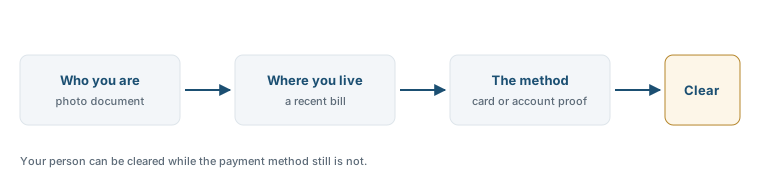
There are three separate things a desk needs to be satisfied about, and they clear independently. Who you are, usually from a photographic document that is in date and readable. Where you live, usually from a recent document showing the same address as the account. And whether the payment instrument belongs to you, which is a question about a card or an account rather than about a person.
People assume the third follows from the first two. It does not. A fully verified player who adds an unfamiliar card is in the odd position of being cleared while the destination is not, and the payment waits on the destination. Knowing the order of those steps is most of what the identity check involves, and it explains a delay that otherwise looks arbitrary.
Each of the three can also expire in effect. A document that has run out of date, or an address that has changed since you registered, puts a cleared account back into the queue, so the cheapest maintenance job on a gambling account is keeping its paperwork current.
Three clearances, not one. The method is checked separately from the person.
Do the paperwork on the day you open the account
The single most effective thing you can do for payout speed costs nothing and happens before you have won anything. Upload documents while the account is empty and quiet, when nobody is under pressure and you are not watching a balance. A desk that asks for them at registration is not being obstructive; it is moving the slow part to a moment when it does not cost you anything.
A short list covers almost every case. A photographic identity document that is in date and photographed in full, with all four corners in the frame. A document showing your current address that matches what you typed into the account, not the address you had when you moved. A payment instrument in your own name, since money cannot be sent to somebody else's card or account. And the name on your bank account spelled exactly as it is on the gambling account.
If you expect to use a transfer into a bank account as your payout destination, prove that account early as well. Doing it on the day of your first win is what turns a reasonable wait into a frustrating one.
Automatic release, and why small payments fly
Most desks release some payments by rule rather than by hand. Below a figure the operator sets, on a method already cleared, with no flags on the account, the request can go out with no human involvement at all. That is where genuinely quick payouts come from, and it is why the first fast payment somebody receives is so often a modest one.
Above that figure the request is routed to a person, and the clock changes character: it is now a queue position rather than a rule. The same thing happens to a balance larger than the operator will release in one go, where the payment is split into stages on its own schedule. Those caps are published in the cashier terms, and the ceilings an operator puts on payouts explain long waits far better than any complaint about the rails.
Nothing about this is sinister. A business that pays out automatically has to draw a line somewhere, and the line is drawn where a mistake would be expensive. What is unhelpful is that the figure is almost never advertised, so the only way to learn it is to notice which of your own payments went out without anybody touching them.
Part of the journey
Can the desk promise it?
What actually decides it
Releasing the request
Yes, this is the claim
The operator's automation and staffing
Your identity and address check
No
Whether you sent documents before there was money waiting
Clearing the destination
No
Whether that card or account has been accepted before
An offer with play-through left
No
The terms you accepted when you took it
A balance above the release cap
No
The operator's ceiling and the schedule it pays in stages on
The rail, and your bank posting it
Partly
The scheme, and your own bank or card issuer
What a promise of instant payouts can and cannot include
Larger sums invite a wider question
Identity answers who you are. A separate kind of enquiry asks where the money came from, and it is triggered by patterns rather than by any single payment: unusual deposit behaviour, a balance out of keeping with the account's history, a method that does not fit the picture. A licensed operator is obliged to make that enquiry when the circumstances call for it, which is a condition of holding a licence rather than a choice.
Two things follow. First, this kind of review is slower than a document check by its nature, because somebody is reading rather than matching. Second, it is unusual, and it is not what is happening to most people whose payout is taking longer than they hoped. Understanding what a British licence obliges an operator to do makes the difference between an awkward but legitimate request and a desk inventing reasons.
If such a request arrives, answering it completely the first time is faster than answering it in instalments. Partial answers restart the reading, and each restart puts the file back at the bottom of somebody's pile. It is also worth keeping the correspondence in writing inside the account rather than over a chat window, because a written trail is what an adjudicator can later look at.
One desk, one method, and a track record
Payment history is worth more than any feature. An account that has deposited and been paid out on the same instrument several times is, from the desk's point of view, a solved problem: the destination is known, the pattern is familiar, and the automatic rule can apply. Spreading the same activity across several methods keeps every one of them new.
This is the practical argument for picking a route and staying on it. Where that route is also the one you deposit with, the closed loop is satisfied by default and nothing has to be set up at the moment of a payout. Players who use the same debit card in both directions rarely have anything to prove after the first time.
Switching has a cost, and it is paid once per method. That cost is reasonable if the new route is genuinely better for you, and wasteful if you are simply chasing the promise of a quicker rail. Where a route sits directly on your bank account, as with an open banking payment initiated from your own bank, the destination is proven by the deposit itself, which is the closest thing to a shortcut that exists here.
Unfinished offers hold a request where it stands
Money taken from a promotion is not immediately yours in the way a deposit is. Until the condition attached to it has been satisfied or given up, part of your balance is conditional, and the cashier cannot release a payment without first working out which pounds fall on which side of that line. Where the condition is still live, the request waits regardless of how quick the desk is.
The way to keep this out of the picture is to decide before you request, not after. Either finish the condition or abandon the offer and whatever it contributed, which most desks let you do from the account. Reading how play-through conditions are counted before accepting an offer is the only reliable protection, because the terms differ in ways that are not obvious from the headline.
A balance with no promotional component attached is the simplest thing a cashier can process, and simple is fast.
Banking hours did not disappear
Some of the remaining wait is not about you or the operator. Payment files are built by people in working hours, receiving institutions reconcile on their own cycles, and public holidays reduce staffing on both sides at different times. A request made against a weekend has more opportunities to sit still than the same request mid-week, and this is true at desks that pay very quickly indeed.
The part worth noticing is that this wait sits after approval, not before it. If the status has moved past review and the money is in transit, you are waiting on institutions rather than on a decision, and asking support to hurry achieves nothing. If the status has not moved, the working week is not your problem; the queue is, and the holding state has its own rules worth understanding before you touch anything.
A desk that pays through the night is a real advantage. It is an advantage over a queue, not over a bank.
No verification, no payout: why that search should worry you
There is a steady demand for casinos that pay without asking questions, and it is worth being blunt about what that would mean. An operator with a British licence cannot do it. Establishing identity and age before paying out is not a policy the desk chose and could waive for a good customer; it is part of the permission it holds to operate at all.
So a site advertising payouts with no checks is telling you something about its licensing rather than about its service. Without a British licence there is no obligation to segregate your money, no required complaints procedure, no independent adjudicator above it and no regulator to escalate to. You can confirm whether a desk is licensed, in a minute, on the public register at gamblingcommission.gov.uk.
The same reasoning applies to anything sold as a way around the self-exclusion register. Stepping outside the licensed market does not remove a check; it removes the rules and the address you would complain to, and a desk that simply stops paying is exactly the situation those protections exist for.
What a realistic best case looks like
Strip out everything avoidable and the picture is clear. An account whose documents were accepted long ago, a method that has been paid before, no promotional money on the balance, an amount within the operator's automatic release, a request made during a working week. In that state the operator adds very little, and what is left is the rail plus your own bank.
That is the ceiling on speed, and it is not a feature anybody can sell you. It is a state you arrive at by doing four boring things once. Any promise that goes beyond it is talking about a leg of the trip the promiser does not own, which is why the way a payout is assembled is more useful to understand than any badge on a homepage.
Measured honestly, the reward for all this preparation is not a dramatic number. It is the absence of a bad surprise at the one moment when a delay is hardest to take calmly. Winnings that are already on their way are also easier to leave alone than winnings still sitting on a balance, which is a quieter argument for getting the paperwork done than any of the ones above.
Speed is the wrong thing to choose a desk on
Payout speed is not regulated, which means it cannot be enforced, which means it is a marketing surface. What can be enforced is whether the operator is licensed, whether its terms are clear, whether it handles complaints and whether it is signed up to an independent adjudicator. Those are the things to check before an account exists, and they are the things that matter on the day something actually goes wrong.
It is also worth watching what the search for a faster payout is doing to you. Opening another account because this one takes a day longer is a decision about the speed of losing as much as the speed of winning, and it is a common step on an unhappy path. Help that costs nothing and stays private is at begambleaware.org, and the National Gambling Helpline can be rung on 0808 8020 133.
If the cash desk is becoming too easy to reach, the control sits with your bank rather than with the operator, and a bank-side block on gambling payments is an instrument you hold and they cannot override.
Questions people ask
What is the fastest way to get a casino payout?
Have nothing left to check. An account with accepted documents, a payment method that has been paid before and a balance with no promotional strings is the state in which a desk can release a payment by rule rather than by hand. The choice of rail only affects what happens after that.
Can I upload documents before I have won anything?
Yes, and it is the best use of ten minutes on a new account. The checks are the same whenever they happen, so doing them while the account is empty removes the one delay that reliably adds days to a first payout. Some desks ask at registration for exactly this reason.
I am verified, so why is my payout to a new card held up?
Because the person and the destination are cleared separately. Your identity being accepted says nothing about whether a card or account you have just added belongs to you, and the desk checks that before sending money to it. Sticking to one instrument avoids repeating the exercise.
Why do small withdrawals arrive quicker than large ones?
Many operators release payments below a figure they set automatically, while anything above it goes to a person to approve. A balance larger than the operator pays in one go is also split into stages on its own schedule, so the total takes longer even when each payment is quick.
Are casinos with no verification safe to use?
A desk holding a British licence cannot pay out without establishing who you are, so an offer of no checks tells you it is not licensed here. That matters when something goes wrong: there is then no required complaints procedure, no independent adjudicator and no regulator above the operator. The public register shows who is licensed.
Does an instant withdrawal badge mean money in minutes?
It means the operator intends not to make you queue once there is nothing left to check. It cannot cover a document you have not sent, a destination nobody has verified, an unfinished offer, or the moment your own bank posts the credit. Those are the parts that usually account for the wait.
Will asking support speed anything up?
It helps if something is outstanding and nobody has told you, and it does nothing once the payment has left the operator. If the status still shows the request as under review, ask what is missing. If it shows the payment as sent, ask for the reference and the timestamp instead.
Does the day of the week really matter?
It matters to the parts people do. Payment files are prepared in working hours and receiving institutions reconcile on their own cycles, so a request made against a weekend has more chances to sit still. This affects the stretch after approval and is not something an operator can remove.
Why might a casino ask where my money came from?
A licensed operator has to make that enquiry when a pattern calls for it, and it is separate from confirming your identity. It is slower, because somebody has to read rather than match, and it is uncommon. Answering it fully the first time is quicker than answering it in pieces.
Is a faster payout a sign of a better casino?
Not on its own. Speed is unregulated and therefore a marketing claim, while licensing, clear terms, a working complaints route and an independent adjudicator are obligations that can be enforced. Check those first; they are what you will need if a payment genuinely goes wrong.
 UK Cash DeskOpen the cashier



 100% up to £100 on your first deposit