18+. The welcome offer shown here is the one the partner gives the site owner; availability depends on your country and your eligibility. Bonus size, qualifying deposit, wagering, eligible games, maximum bet, expiry and withdrawal limits are set out in the operator’s own terms and are not repeated here. We do not promise payout times. Offshore operator, not licensed by the Gambling Commission of Great Britain. Gambling involves financial risk — free confidential help at begambleaware.org, 0808 8020 133.
Short answerA cap on a payout is either the payment system's or the operator's, and they behave differently. Working out which one you have hit decides whether the fix is a different rail or a different amount.
Our top pick
22BET — 100% up to £100 on your first deposit
Regulator
Gambling Commission of Great Britain
Credit cards
Banned for gambling since April 2019
Minimum age
18
Tax on winnings
None for the player
Self-exclusion
GAMSTOP, free and nationwide
Two different things are called a withdrawal limit
Ask about limits and you will be answered twice, by two parties who do not coordinate. One answer comes from the payment system: a wallet, a card scheme, an open banking provider or a bank, each of which caps what it will carry in a single movement and over a period, for every merchant it serves. The other comes from the operator, whose terms cap what it will release from your account. Neither party knows what the other has set.
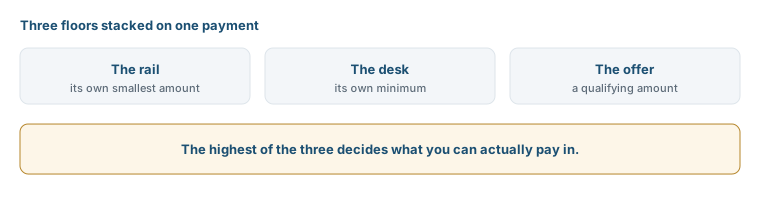
Because they are independent, they stack rather than combine, and the smaller of the two is the one you experience. That is the whole practical content of the subject: you are never subject to one limit, you are subject to the tightest one currently in play. It also explains why the same requested figure can go through on one method and come back on another with nothing about your account having changed, and why generic advice about how a payout is processed never predicts your own ceiling.
The rail's cap belongs to the payment system
Payment rails are built for an enormous range of customers, and each publishes its own ceilings as part of its own product. A wallet caps what one account may send or receive and tiers those ceilings by how fully the wallet is verified. A card scheme limits what may be pushed back to a card in one go. An open banking payment is bounded by what the sending or receiving bank permits for that kind of instruction. None of these were written with gambling in mind; they apply identically whether the money is coming from a casino or from a refund on a kettle.
So the rail's cap travels with you between sites. If a wallet you already hold sits at a low tier because you never finished its own checks, that tier applies everywhere and no operator can lift it. The same is true of an account held with an app bank and of a payment made straight from your bank. Where the cap is the rail's, the remedy is on the rail: complete its verification, or choose a different one.
The site's cap belongs to its terms
The operator's ceiling is a contractual figure rather than a technical one. It is written into the withdrawal terms and shown, at least partly, on the cashier page, and it exists for reasons that have nothing to do with the plumbing: managing how much money leaves at once, spreading large payments out, and keeping the obligations on licensed operators about checking who is being paid workable in practice.
Being contractual, it can be tiered in ways a rail would never bother with. It can differ by method, by how long the account has existed, by whether checks are complete, by account status, and by whether a bonus was involved in producing the balance. It is the ceiling most likely to look arbitrary from outside, and it is also the one the operator can explain to you if you ask the narrow question. If a request comes back for being too large, it is worth knowing whether a cap was the cause at all before assuming it, because a refused payout has several other causes that look identical on screen.
Which of the two bites first
Find out by changing one thing. Request a figure well under both candidates on the method you were using. If it goes, the ceiling was the operator's and you now know roughly where it sits. If a comfortably small figure still fails on that method but works on another, the ceiling was the rail's. One pair of tests, done in that order, usually settles it without a single message to support.
Reading beats testing where the numbers are published, and they often are: the operator's figure is in the withdrawal terms, and the rail's is in the wallet or bank's own limits page. Neither can be guessed from anything written on a guide, including this one, because both are set per account and change without notice.
One detail saves a lot of confusion here. The figure shown on the cashier beside the amount field is the operator's, filtered through what it knows about the method you have selected — so it already reflects some of the rail's constraints but not the parts the rail keeps to itself, such as a ceiling tied to your own verification tier with that provider. When the cashier accepts an amount and the payment then comes back anyway, that gap is the explanation.
Source
What it applies to
Where it is written down
The operator's terms
Your account at that one site
Withdrawal terms and the cashier page
The payment system
Every payment on that rail, everywhere
The wallet, scheme or bank's own limits
The receiving bank
Credits arriving into your account
Your bank's account terms
A bonus condition
Money derived from that bonus
The bonus terms you accepted at the time
A limit you set yourself
Your own activity, by choice
The responsible play settings on the account
Where a cap on your payout can come from
Why a large payout arrives in instalments
A sum above the per-instruction ceiling does not fail; it gets served in portions. The cashier releases what fits, and the remainder stays on the account waiting for the next window, whether that window is the next day, the next week or the next month depending on which ceiling is doing the work. From the inside this looks like a drip, and it is frequently mistaken for reluctance.
The mechanism is duller than that. Each instruction is a separate payment with its own checks and its own settlement, so a ceiling on one instruction is a ceiling on one payment, and a large total simply becomes several payments. This is also the main reason a big win takes longer in total than a small one: not because each payment is slower, but because there are more of them, which is a different thing from how the clock on one payout runs.
What splitting changes, and what it does not
Splitting changes the timetable and nothing else. The total stays on the account, the balance is still yours, and each instalment goes through the same route as a single payment would have. What it does cost you is attention, because the remainder sits in a gambling balance rather than in a bank account, and a balance that stays where it can be staked sometimes gets staked.
What splitting does not do is reduce what you are owed, trigger a fee by itself, or mark your account as a problem. Nor does it help to break a request up by hand when the cashier would have done it for you; manual fragments below the floor get refused for being too small, and a run of failures is worth avoiding. Choosing the destination well matters more than the arithmetic: a transfer into your bank usually carries the highest single-payment ceiling of the common routes, even when it is not the fastest.
Per transaction, per day, per month
The three windows are easy to confuse and behave quite differently. A per-transaction cap never resets, because it is not a budget — it applies to every instruction you ever send. A daily cap is a budget, and the question that matters is whether it runs on a rolling day from the moment of your last payment or on a calendar day that resets at a fixed hour. A monthly cap is the same question at a larger scale, and it is the one that actually governs a very large total.
Where they overlap, all three apply at once, and so does the rail's version of each. A payout can therefore fit the per-instruction ceiling perfectly and still wait, because the day's allowance has gone. That is not a second refusal; it is the next window not having opened.
Window
What resets, and when
What it actually controls
Per transaction
Nothing resets; it applies every time
The size of one single instruction
Per day
A rolling or a calendar day, depending on the term
How much in total may leave within a day
Per month
A rolling or a calendar month
The ceiling on a very large total
The three windows a cap can sit in
What raises a cap
On the rail side, almost everything turns on the provider's own verification tier. Wallets and app banks start new accounts low and raise them once identity, address and sometimes source of funds have been established, and that is a process you run with the provider directly. Nothing you do at a casino affects it.
On the operator side, the reliable lever is finishing the checks. A completed identity check is what most often moves an account off its starting tier, because an unverified account is the one the terms treat most cautiously. Account age and a settled payment history point the same way. Some operators also tier by account status, and some handle genuinely large payments individually rather than by rule, which is a conversation rather than a setting.
What does not raise a ceiling is asking repeatedly, and neither does depositing more. A tier responds to what has been established about the account holder, not to turnover, so a large balance on an unverified account sits behind exactly the same ceiling as a small one. The order of operations is therefore worth getting right before a big win rather than after it: documents accepted first, destination registered second, request made third.
What pulls a cap down
An open bonus is the commonest cause. While a condition is live, the terms frequently treat the balance as restricted, and a ceiling can apply to what may ever be taken from bonus-derived money regardless of what the figure on screen reached. That ceiling lives in the bonus terms, not in the withdrawal terms, so the turnover condition attached to it is where to look for it.
A check reopening pulls a cap down too, and so does a change of destination, since a newly registered account is new to the operator even if it is old to you. Being behind on documents has the same effect. None of these are punishments; they are the cautious tier reasserting itself until the account looks settled again.
A win above the cap does not disappear
This is the fear that drives most of the questions, so it is worth stating plainly: a ceiling on a payment is not a ceiling on your balance. Money above the per-instruction figure stays on the account and leaves in the next window. Nothing is forfeited for being too large, and no cap has an expiry attached to it that quietly removes the remainder.
The genuine exception is not a withdrawal cap at all. A maximum win or maximum conversion clause inside a bonus is a limit on what the bonus can ever produce, applied at the point the bonus settles rather than at the point you request a payment. That is a bonus term doing what it says, and it is the reason the two kinds of ceiling should never be read as the same thing. If you are ever told that a legitimate balance has shrunk because of its size, ask which clause says so in writing, and if the answer does not hold up, that is a dispute about non-payment rather than a limits question.
Two independent ceilings stack; the tighter one is the only one you feel.
A bonus can carry a ceiling of its own
Bonus terms routinely add caps that the withdrawal terms never mention: a maximum stake per round while the condition is live, a maximum amount convertible from free rounds, and a maximum that may be withdrawn from the whole bonus. They are enforced by the bonus engine rather than by the cashier, which is why they surprise people at the end instead of at the start.
Read all three before accepting anything, because they interact. A large notional win on a free round can be reduced by a conversion cap before it ever reaches your withdrawable balance, and the figure you then try to take out is governed by the ordinary ceilings on top of that. This is also where the smallest deposits deserve a careful eye: at the lowest deposit steps the bonus attached is small, and a cap on it can bite long before any withdrawal limit does.
Where your own caps are written down
Four places, and they are all readable without asking anyone. The cashier page shows the per-instruction range for the method you have selected, usually as a floor and a ceiling beside the amount field. The withdrawal terms give the full version, including the daily and monthly windows and any tiering. The bonus terms you accepted hold the bonus-specific ceilings. The rail's own limits page holds everything the payment system imposes.
Read them in that order and ask support only about what is genuinely missing, which is normally one thing: the tier your account currently sits in. Published general figures and your own applicable figure are not the same, and the gap between them is almost always the check status. Speed and ceilings are separate axes too, so the quickest route out is not automatically the one that moves the most in a single payment.
Limits you set yourself are a different tool
Everything above is a constraint imposed on you. Licensed operators also offer constraints you impose on yourself, and they belong in a separate mental box. A ceiling you set on your own deposits, losses or time is designed to be awkward to loosen — typically immediate to tighten and slow to relax — and that friction is the feature rather than a flaw.
They are worth using precisely because a withdrawal cap works in the opposite direction from your intentions: it leaves money sitting in a gambling balance for longer than you planned. Setting a limit on what goes in keeps the two decisions apart, so a slow payout does not quietly become a new deposit. If money is being moved in a way that no longer feels like a choice, free and confidential support is available at begambleaware.org and on 0808 8020 133, and whether an operator is bound by any of these rules at all is a question for the public register at gamblingcommission.gov.uk.
Questions people ask
Which limit applies if the rail and the site disagree?
The lower one, always. They are set by parties that do not consult each other, so they stack rather than average out. That is why reading only the operator's terms can leave you surprised by a wallet's ceiling, and reading only the wallet's can leave you surprised by the terms.
Can an operator raise a limit if I ask?
It can move its own tiering, and finishing the identity check is usually what prompts that. It cannot touch a ceiling imposed by a wallet, a card scheme or a bank, because that figure belongs to the provider. Ask the narrow question of each party separately rather than asking the site about everything.
Does a split payout cost me more?
Splitting by itself does not reduce the total or create a charge. What it changes is the timetable, and the hidden cost is that the remainder waits in a gambling balance where it can be staked. If that is a risk for you, the honest fix is a self-imposed limit rather than a faster rail.
I won more than the stated maximum. Have I lost the difference?
Not because of a withdrawal cap. A per-instruction ceiling only governs how much leaves in one movement, and the rest stays on the account for the next window. The genuine exception is a maximum win or conversion clause inside a bonus, which is a bonus term applied when the bonus settles.
Why is my daily limit full when I only made one request?
Most likely because the window is rolling rather than calendar-based, so it measures backwards from your last payment instead of resetting at midnight. The terms say which model is in use. A per-instruction cap and a daily allowance can also be consumed by the same single payment.
Do limits differ by payment method?
Yes, on both sides. The rail's ceiling is a property of the method itself, and operators often tier their own ceilings by method as well. Bank transfers tend to carry the largest single payments among the common routes, which is why a big total often ends up going that way even when something else is quicker.
Does verification actually change my ceiling?
It is the most reliable thing that does. An account that has not been verified is the one the terms treat most cautiously, and completing the check is what normally moves it off the starting tier. Wallets and app banks tier their own ceilings the same way, by their own verification rather than the casino's.
Is there a limit on how much I can withdraw in total, ever?
The windows in the terms are per transaction, per day and per month rather than lifetime figures, so a large total is normally a scheduling question rather than an absolute wall. Where a hard overall ceiling does exist, it usually belongs to a bonus rather than to the cashier, so read the bonus terms for it.
Can I set my own cap on withdrawals?
Self-imposed tools generally cap what goes in and how long you play rather than what comes out, since limiting your own payouts would work against you. Deposit, loss and time limits are the relevant instruments, and they tighten immediately while taking longer to relax.
 UK Cash DeskOpen the cashier



 100% up to £100 on your first deposit