18+. The welcome offer shown here is the one the partner gives the site owner; availability depends on your country and your eligibility. Bonus size, qualifying deposit, wagering, eligible games, maximum bet, expiry and withdrawal limits are set out in the operator’s own terms and are not repeated here. We do not promise payout times. Offshore operator, not licensed by the Gambling Commission of Great Britain. Gambling involves financial risk — free confidential help at begambleaware.org, 0808 8020 133.
Short answerA dispute begins only once a decision has been made and stated. A balance sitting in a queue is not a dispute, and treating it as one spends your effort on the wrong stage.
Our top pick
22BET — 100% up to £100 on your first deposit
Regulator
Gambling Commission of Great Britain
Credit cards
Banned for gambling since April 2019
Minimum age
18
Tax on winnings
None for the player
Self-exclusion
GAMSTOP, free and nationwide
Not paying out describes two unrelated situations
The phrase gets used for both halves of something that splits cleanly in two. In the first half, a request has been accepted and is moving slowly: it sits in a queue, or in a review, or behind a check that has not closed. Nobody has decided anything, nothing has been taken away, and the balance is still shown as yours. In the second half, somebody has decided. A term has been applied, a sum has been voided or reduced or simply refused, and there is a statement to that effect.
Only the second is a dispute, and the distinction is not academic. A dispute has an escalation route built for it, with named stages and named parties. A wait has no route, because there is nothing yet to review; every message you send into it goes to a support queue that can only repeat the status. Sorting which half you are in is therefore the first piece of work, and getting it wrong is the commonest way people burn weeks. Note also that this page is about a decision you disagree with, not about a payout handed back by the cashier over a mismatched name or an unfinished check — that is a mechanical fault with a mechanical fix.
What a refusal looks like when you read it closely
A real refusal has three features. It states an outcome rather than a status. It cites something — a clause, a condition, a rule about accounts or stakes or bonuses — even if it cites it vaguely. And it changes the balance: a figure is removed, reduced, voided or reclassified, and the account reflects that change rather than holding the money in suspense.
The citation is the load-bearing part. Operators refuse under terms, and the term they picked tells you what the argument will actually be about. Breach of a stake cap while a bonus was live is one argument. Duplicate accounts is another. Irregular or abusive play patterns is a third, and it is the vaguest of the lot. A failed check on who holds the account is a fourth, and that one often turns out to be about the documents on your identity rather than about anything you did while playing. Each leads somewhere different, so writing a complaint before you know which one you are answering is writing to nobody.
What a wait looks like, and why it is not a dispute
A wait shows a status and no outcome. The sum is still on the account, often flagged as processing or in review, and nothing has been cited against you. Sometimes the cause is visible — a check in progress, a weekend, a rail that settles in batches — and sometimes it is not visible at all, which feels identical to being refused and is not the same thing.
The useful test is whether anything has been decided. If no term has been named and the figure is intact, you are waiting, and the productive moves are finishing whatever is open and leaving the request where it stands. Cancelling and resubmitting a queued instruction usually sends you to the back of that queue. It is worth knowing how a pending payout actually clears before you decide that silence means refusal.
What you are looking at
A refusal
A wait
An outcome is stated
Yes, in writing
No, only a status
A term is cited
Usually one clause in particular
None, because nothing was decided
The balance
Removed, voided or reduced
Intact, marked as processing
What helps
A written complaint, built on the record
Time, plus closing any open check
What makes it worse
Sending the same message repeatedly
Cancelling and resubmitting the request
Telling a decision apart from a delay
A hold over identity is a different argument from a hold over conduct
Refusals divide again once you have one. Some rest on what the operator says you did: a stake above a cap, accounts it considers linked, a bonus used in a way the terms disallow. Others rest on what the operator cannot yet establish about you: who holds the account, where the account is being used from, or where the money funding it came from. The second kind feels like an accusation and usually is not one — it is an obligation the licence places on the operator, which it has to discharge before it can pay anyone.
Separating them changes what you do next. A conduct refusal is answered by disputing the application of a clause to facts, which is the route this page sets out. An identity hold is answered by satisfying the request, and the frustration there is almost always about which document in which format rather than about the decision itself. Before escalating, establish which of the two you have, because taking an unfinished check to an independent reviewer as though it were a refusal gets you an answer about the wrong question. If no term has been cited and the operator is still asking for paperwork, you are in the second category.
Find the clause the decision rests on
Before anything else, get the operator to say in writing which term it relied on. Ask for it plainly: name the clause and the conduct it applies to. This single request does more work than any amount of argument, because it converts a mood into a proposition that can be right or wrong. An operator that will not identify the term has already weakened its own position in front of anyone reviewing it later.
Then read that term as it stood when you deposited, not as it reads today. Terms get edited, and a condition that appeared after your money went in is a different thing from one you accepted. If the clause is about turnover, the maths is in the bonus turnover rules and the contribution rates attached to them. If it is about ceilings, check whether the decision is really about the site's own caps, which is a limit question rather than a refusal. Reading before writing keeps you from complaining about the wrong thing.
The record you need is already in the account
Nearly every fact that matters is logged by the operator and visible to you: account history, transaction history, bonus history, game rounds, the documents you uploaded and when. That record is stronger evidence than anything you can assemble from memory, because both sides are reading the same ledger. Export or save it early, while the account is still open to you, rather than after it has been closed.
Build the complaint out of that record in order. State what you deposited and through which of the methods on the cashier. State what you did next. State what you requested and when. State what the operator said, quoting it. Then state what you want, which should be one concrete thing rather than a grievance. A complaint written in that shape can be checked line by line; one written as a narrative of how unfair it felt cannot.
What to attach, and what never to send
Attach what is specific to the decision: the screenshots of the refusal, the clause as quoted to you, the relevant stretch of transaction history, and the dates of any documents you submitted. Keep it to what the dispute turns on. A reviewer reading a focused file reaches the point; a reviewer handed everything you have reaches the end of their patience first.
Never send full card numbers, security codes, online banking passwords or one-time codes to anyone, at any stage, however the request is phrased. Nothing in a legitimate payout dispute requires them, and a request for them is a reason to stop rather than to comply. Be careful with open channels too: social media and public forums are not places to post documents, and an operator asking you to move a complaint into a direct message is not creating a record you can later rely on. Everything that matters should sit in email or in a ticketing system that keeps a copy on both sides.
The first address is the operator's own complaints function
Every licensed British operator must run a complaints process separate from day-to-day support, and your complaint has to start there. That is not a courtesy step. The stages above it will generally not look at anything that has not been through the operator first, so skipping it does not accelerate the process, it resets it.
Practically, that means getting out of live chat and into the complaints route the site publishes, in writing, as a single document with a stated outcome you are asking for. Keep it dated and keep your copy. The function's job is to review the decision against the operator's own terms and its own licence obligations, and it does sometimes overturn things, usually where the original decision was made by a rule running automatically and nobody had looked at the account as a whole.
Step two: independent dispute resolution
If the operator's answer does not settle it, the next stage is a body that is not the operator. A British licence requires the operator to name an alternative dispute resolution provider and to make that route available to customers, so the provider's identity is published rather than something you have to negotiate. It sits outside the business and reviews what happened between the two of you.
What it reviews is narrower than people expect: whether the terms were applied correctly and fairly to the facts, not whether the terms are ones you would have chosen. That is why the earlier work of pinning down the clause matters so much — the whole stage turns on it. Its findings carry weight with the operator, and the process is run as part of the licensing framework rather than as a favour. What nobody can tell you in advance is how it will come out; any page that promises you an outcome is selling you something.
Stage
Who considers it
What they can look at
Account enquiry
The operator's support team
Status, documents, bonus state, payment history
Formal complaint
The operator's complaints function
Its own decision measured against its own terms
Independent dispute resolution
An ADR provider named by the operator
Whether those terms were applied correctly to the facts
Report to the regulator
The Gambling Commission
Whether the licence conditions are being complied with
No British licence
Nobody in this chain
Nothing, because the chain does not exist
Who looks at what, stage by stage
What the Gambling Commission does
The regulator issues licences, sets the conditions attached to them, and supervises whether operators keep to those conditions. It collects information about conduct, and patterns in that information shape enforcement: conditions, penalties, and in serious cases the loss of a licence. Reporting what happened to you contributes to that picture, and the register of who holds a licence is public at gamblingcommission.gov.uk.
It is also the reason the rest of this page has any teeth. Licence conditions are what oblige an operator to run a complaints function, to name an independent reviewer, to check who holds an account, and to follow the rules on how money is handled. Everything that gives you a route exists because a licence requires it, which is why confirming the licence first is the cheapest thing you can do before any of this starts.
What the Gambling Commission does not do
It is not a court and it is not an ombudsman for individual balances. It does not adjudicate your particular case, order a specific sum to be paid to you, or act as the next appeal after the independent reviewer has finished. Expecting it to return your money is the single most common misunderstanding about how this works, and acting on that expectation means skipping the stage that actually could.
It also does not give you legal advice, and neither does this page. If a decision turns on a point you want argued as a matter of law rather than as a matter of terms, that is a question for a qualified adviser, and the independent route and a legal route are separate things. One other thing worth knowing while you are reading about money: in Britain a player's gambling winnings are not taxed, so the tax position on winnings is never a legitimate reason for an operator to hold a payout back.
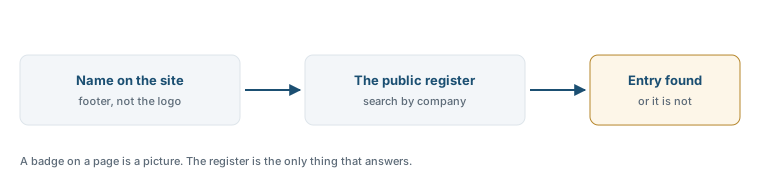
A site with no British licence has no addressee
Every stage above assumes something: that there is a licensed business at the other end with obligations attached to it. Remove the licence and the stages do not become slower, they stop existing. There is no complaints function the operator must run, no independent provider it must name, and no regulator supervising it that your report would mean anything to. You are left writing to a company whose only incentive to answer is goodwill.
This is the practical reason to check before depositing rather than afterwards, and it is also the honest answer to anyone looking for a way around the self-exclusion register. Stepping outside the licensed market to carry on playing does not just remove the register. It removes the identity checks, the rules on how your money is held, the complaints route and the independent reviewer at the same time, which is a bad trade in exactly the situation where it is most tempting. If that is where you are, the help at begambleaware.org and on 0808 8020 133 is free and confidential, and the tools for stepping back work without asking anyone's permission.
Each stage of a complaint exists because a licence condition requires it.
How to behave while a complaint is open
Keep the account intact. Do not close it, do not ask for it to be deleted, and do not request erasure of your data while a dispute is running, because the record you would be destroying is the record you are relying on. Keep your own copies of everything regardless; access can be withdrawn at any time, and a saved file does not depend on the operator's goodwill.
Keep playing out of it. Depositing again mid-dispute muddies which money is being argued over, and so does chasing the disputed sum with new stakes. If stopping is hard, a block at bank level is an instrument you control rather than one the site controls, and a block set with your bank does not need the operator's agreement. Finally, be realistic about what the process can deliver: a review of a decision, measured against terms. It cannot compensate you for the waiting, speed up a future payout, or guarantee a result, and no legitimate route promises any of those. Once it is settled, how quickly money leaves is a separate mechanical question about which rail pays out soonest.
Questions people ask
How do I know whether I am being refused or just waiting?
Look for a stated outcome and a cited term. If a clause has been named and the figure on the account has changed, a decision exists and you have a dispute. If the sum is intact and all you have is a status, nothing has been decided and the escalation stages have nothing to review yet.
Can I go straight to the regulator?
You can report an operator at any point, but reporting is not the same as having your case decided. The stages that review your particular decision are the operator's complaints function and then the independent provider, and they generally expect the operator to have answered first. Going out of order resets the process rather than shortening it.
Will the regulator get my money back?
That is not what it does. It licenses operators and supervises their conduct, so what you tell it feeds into enforcement against the business. Deciding your individual claim is the job of the independent dispute resolution provider the operator is required to name.
Does independent dispute resolution cost me anything?
The route has to be made available to you as a condition of the operator's licence rather than as a paid service you buy. What it will cost you is preparation: a clear statement of the facts, the clause being relied on, and the record from the account. Check the provider's own published process for how it handles cases.
What should I never include in a complaint?
Full card numbers, card security codes, banking passwords and one-time codes, to anybody, at any stage. Nothing in a payout dispute needs them. Also keep the complaint out of public forums and social media, and keep it in a channel that leaves both sides holding the same written record.
The operator says my play was irregular. What does that mean?
It is a broad category in most terms, usually covering things like stake patterns while a bonus was live, coordinated play across accounts, or use of a bonus in a way the operator says it was not designed for. Because it is broad, insist on the specific conduct and the specific clause. A vague accusation is harder to defend and also harder to sustain in front of a reviewer.
Should I close my account if a site will not pay?
Not while a complaint is live. Closing it, or asking for your data to be erased, can cut off your access to the history that your case depends on. Save your own copies now, keep the account dormant rather than deleted, and stop depositing into it.
How long does a complaint take?
No honest page can give you a figure, because it depends on the stage, the provider and how much is in contention. What you can control is the number of rounds: a complaint that names the clause, states the facts in order and asks for one specific outcome tends to need fewer exchanges than one that does not.
What if the site has no British licence at all?
Then there is no complaints function it must run, no independent provider it must name, and no regulator your report would carry weight with. That is the whole difficulty: the stages are licence conditions, so without a licence they do not exist. The register is public, which makes this worth checking before you deposit rather than after.
 UK Cash DeskOpen the cashier



 100% up to £100 on your first deposit