18+. The welcome offer shown here is the one the partner gives the site owner; availability depends on your country and your eligibility. Bonus size, qualifying deposit, wagering, eligible games, maximum bet, expiry and withdrawal limits are set out in the operator’s own terms and are not repeated here. We do not promise payout times. Offshore operator, not licensed by the Gambling Commission of Great Britain. Gambling involves financial risk — free confidential help at begambleaware.org, 0808 8020 133.
Short answerGoogle Pay carries a card you already own, so the wallet never refuses anything on its own account. What changes between devices is where the token is kept and whether the button is offered at all.
Our top pick
22BET — 100% up to £100 on your first deposit
Regulator
Gambling Commission of Great Britain
Credit cards
Banned for gambling since April 2019
Minimum age
18
Tax on winnings
None for the player
Self-exclusion
GAMSTOP, free and nationwide
The wrapper principle, seen from the device
There is no money inside the wallet. It holds a reference to a card you already have, and the card does the paying. Where this wrapper differs from the one on the other platform is not the principle but the hardware and software it depends on, and that dependency is where almost all the practical questions come from.
Android handsets vary enormously in manufacturer, system version and how recently they were updated, and all three affect whether this rail is available to you at a given cash desk. Among the ways money gets into a cash desk it is the one whose availability has least to do with your bank and most to do with the phone in your hand.
So the useful mental model is a device question followed by a card question. The device decides whether the payment can be presented; the card decides whether it goes through.
Keeping those two apart saves a great deal of wasted effort. People troubleshoot a card problem by reinstalling an app, or a device problem by ringing their bank, and both conversations end with somebody politely explaining that the matter is not theirs. Work out which half you are in before you ask anyone anything.
Where the token is actually kept
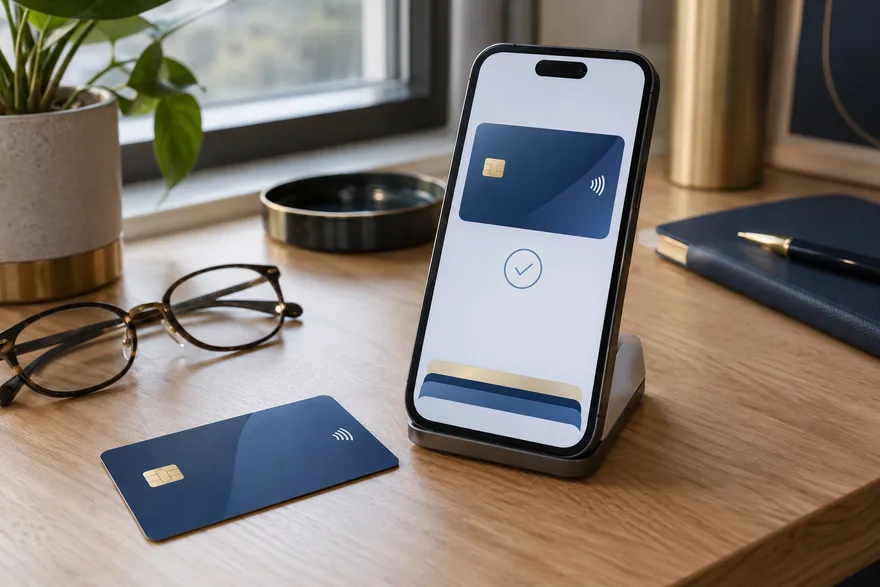
Adding a card does not copy the card number into the wallet. Your bank issues a substitute number for use through that wallet, and payments are signed so that each one is valid once. The gambling site receives the substitute and a signature, never the digits on your card.
Where that substitute sits depends on how you are paying. A tap at a terminal uses something held on the handset itself, protected by the device security. A payment in a browser can instead use a card saved to your account with the wallet provider and tokenised when you confirm, which is why the same wallet behaves slightly differently on a phone and in a browser window.
The distinction matters for one reason: a token tied to a handset dies with the handset, while a card saved to an account follows you to the next device. Neither is better, but knowing which you are using explains why a payment that worked last month stops working after you change phones.
Platform and browser decide whether you see the button
Four conditions have to hold at once. The cash desk has to offer the wrapper. Its payment processor has to permit it for gambling. The browser has to support it. And the wallet has to be set up on the device with an eligible card in it.
The second condition is the one that fails most often, and it fails invisibly. Sector rules and processor policy decide whether gambling payments may be accepted this way, which means a site can offer the wrapper for other things and not for its cash desk, with no explanation on screen.
Because of that, the absence of the button is not a fault to diagnose. Nothing in your settings will produce it, and the sensible response is to pay the card directly, which is covered under depositing with a debit card.
A refusal in the wallet is a refusal from your issuer
This is the single most misread thing about the rail. The wallet does not hold funds, does not assess risk and does not know what you are buying. When a payment is refused, the decision was made by the bank that issued the card, and the wallet is merely the place you happened to be standing when the answer arrived.
That changes who you should be talking to. A message on the cash desk screen is a relay. A notification in the wallet is also a relay. The party with the reason, and the only party able to do anything about it, is your bank, and it will usually tell you in its own app within seconds of the attempt.
It follows that gambling controls your bank holds apply here in full. A block you have switched on will refuse these payments as reliably as it refuses typed card numbers, and the blocks your bank can place for you covers how each one behaves and how long it takes to come off.
The message reaches you from the cash desk; the decision was taken at your bank.
Reading a decline that names the wrong party
Decline wording is written by whoever is furthest from the decision, which is why it is so unhelpful. A short generic failure usually means the issuer said no without a reason it was willing to share. A message naming the wallet usually means the token step failed before any bank was asked.
The quickest way to tell them apart is your banking app. If the attempt appears there as a declined transaction, the issuer saw it and refused it. If nothing appears at all, the payment never reached your bank and the problem is on the device.
Resist repeating a refusal. A run of declines against one card is a risk signal in its own right, and it can leave an account looking irregular at exactly the wrong moment, which is a quiet contributor to a payout being refused later on.
Who refused, and how to tell
Four parties can end the payment and each leaves a different fingerprint. The table is worth reading before you contact anybody, because it will usually save you the first conversation.
In every row, note which party can explain itself. Only two of the four can, and only one of those two has any obligation to you.
There is a pattern in the third row worth dwelling on. A processor refusal is the only one with no remedy at all: it is a policy decision about a sector, applied to you in passing, and no amount of correspondence will move it. Recognising it quickly is the difference between a minute wasted and an afternoon.
Who refused
How you can tell
What to do
The device or wallet
Nothing appears in your banking app at all
Check the wallet is set up and the card still valid
Your card issuer
A declined transaction shows in your banking app
Ask your bank, which holds the reason
The payment processor
An unfamiliar company name inside the error text
Nothing useful; use the card or another rail
The gambling site
A specific message about your account or a limit
Deal with it in the cash desk, it is the one party talking to you
Telling the four refusals apart on a wrapped card payment
Cards you can add and cards you cannot use here
A wallet will happily hold cards you are not allowed to gamble with. Credit cards are prohibited for gambling in Great Britain, and presenting one through a wrapper changes nothing, because the card type is known where the authorisation is decided. The reasoning is set out under the ban on gambling with credit cards.
The trap is the default. Wallets preselect a card, usually the one you use most, and a confirmation screen glanced at rather than read is how people present a credit card without meaning to. The refusal that follows looks like a technical fault and is simply the rule holding.
Prepaid cards occupy a grey area that varies by issuer and by processor, and the only way to find out is to try once. If it fails, it has failed for a policy reason nobody will explain, and there is nothing to adjust.
If you share a household and the wallet holds more than one person card, the default becomes a genuine hazard rather than an inconvenience. The wrapper authorises on the device, not on the cardholder, so a handset that can reach somebody else card can spend from it with one gesture and no typing.
Money out does not come back to the wallet
A payout has to land in an account, and the wallet is not one. It holds no balance, has no details to be paid into and receives no notification when a site pays you. The money reaches the card account the token pointed at, and it shows up in your banking app rather than on the phone.
One consequence surprises people. Because the token hides the card number, a site may not hold enough detail about the card to pay it without asking, so you can be asked to add the card as a destination in the ordinary way. That is a paperwork step, not a refusal.
Where that step is likely, it is better done early. How money comes back out of a cash desk sets out what has to be in place first, and an account with a verified destination already attached turns a payout into a queue rather than a negotiation.
Screen locks, new devices and a token that stops working
The wrapper depends on the device being able to prove it is yours. Remove the screen lock and the wallet stops being able to authorise payments. Replace the handset and the token for the old one is no longer usable. Reset the device and the card has to be added again.
None of these produce a clear message. What you see is the button working as normal and the payment failing, or the button disappearing, which sends people to the cash desk support queue for a problem that lives on the phone.
If a deposit does go through but your playing balance does not move, that is a different animal entirely: the money has left and the crediting failed. Tracing a deposit that has not arrived starts by separating those two cases, because only one of them is anything the site can fix.
What the cash desk receives when you tap
Very little about you and quite a lot about the payment. The site gets a token, a signature, an amount and, depending on how the wallet is configured, a name and a billing address drawn from your wallet profile rather than from your bank.
That last detail is worth checking once. Details saved in a wallet are often older than the ones your bank holds, and an address that no longer matches is a small discrepancy that can surface later during the identity check a licensed site must complete. Correcting it in the wallet takes a minute and saves an exchange of messages.
What the site does not get is the card number, which stays with you and your bank. That is the genuine benefit of the whole arrangement and the reason it is worth using where it is available.
It is also a short list compared with what a cash desk learns from a typed card payment, and shorter still than what it learns when you fund an account from a bank. Less information travelling is not the same as less accountability: the card behind the token is fully traceable, which is precisely why the rail is acceptable to a regulated operator.
Statement lines and matching a charge
A wrapped payment appears on your card statement as an ordinary card transaction, described by the gambling business or by its payment processor. The wallet is invisible in that record, because it never held the money.
If the description is a company you do not recognise, that is normal and not a sign of anything wrong. Match by date and amount against the deposit history in the cash desk, and treat the descriptor as a label that belongs to whoever processed the payment.
Your banking app may also note which device a payment came from, which is occasionally the fastest way to work out who in a household made a charge, and a more honest answer than anybody memory of the evening.
The limits that live outside the wallet
Three sets of limits apply and none of them belongs to the wallet. Your bank sets what the card may spend. The cash desk sets a floor and, where you have asked for one, a cap. And the site own risk rules can refuse a deposit regardless of either.
The one that does the most useful work is the one you set yourself. A deposit limit held inside your gambling account counts every rail together, so it cannot be sidestepped by switching from the wallet to the card or to a transfer, which is exactly why it is the control worth bothering with.
If you want the amount decided before you sit down rather than policed afterwards, the alternatives are a rail that exposes the payment to your bank controls, such as paying from your own internet bank, or one that cannot exceed what you prepared, which is the argument for instructing a transfer yourself.
When the wallet earns its place
Keep it when you want card payments without the card number travelling, and when you have already proved a destination for payouts. In that configuration it costs nothing, exposes less than typing the card in, and behaves identically to a card in every way that matters.
Pay the card directly when the button is absent, when you are not sure which card the wallet has preselected, or when you need the deposit to be traceable to a particular card for a verification question. None of those is a defect in the wrapper; they are simply jobs it was not built for.
And keep the comparison honest. The presence of a wallet button tells you which processor a site uses, not whether it will pay you, and that question is settled on the public register of licensed operators. The equivalent wrapper on the other platform is described under paying through Apple Pay, where the differences are mostly about where the token lives. If the ease of a single tap has become the reason you are depositing, free and confidential help is available from the national advice service on 0808 8020 133.
Questions people ask
Why was my payment declined when the wallet looked fine?
Because the wallet does not make that decision. Your card issuer refused the authorisation and the wallet simply displayed the answer. Open your banking app: if the attempt shows as declined there, your bank holds the reason and can explain it.
Can winnings be paid into Google Pay?
No. There is no account inside the wallet for money to arrive in. A payout goes to the card account that sat behind the deposit, or to another verified instrument, and it appears in your banking app rather than on the phone.
Why does the button appear on one site and not another?
Because each site payment processor decides whether to accept wrapped payments for gambling, and that varies. Your device and browser matter too. There is no setting on your side that makes the option appear where it is not offered.
Does my card number reach the gambling site?
No. The site receives a substitute number and a signature valid for one payment, which is the main reason to use the wrapper at all. The digits printed on your card remain between you and your bank.
Can I use a credit card through the wallet?
Not for gambling in Great Britain. The prohibition attaches to the card, and the card type is known where the payment is authorised. Check which card the confirmation screen has preselected, because wallets default to the card you use most.
My payment stopped working after I changed phone. Why?
Because a token issued for a handset does not transfer to a new one. Add the card to the wallet on the new device and it will be tokenised again. A site that had recorded the old token may also need the card added as a payout destination.
Will removing my screen lock stop payments?
Yes. The wallet relies on the device being able to prove it is yours, so a handset with no lock cannot authorise a payment. You will usually see the payment fail rather than a message explaining why.
Does a bank gambling block stop these deposits?
Yes, because the payment runs on your card and your bank sees it as a gambling transaction. The wrapper provides no route around any control your bank has applied, which is a point in its favour rather than a limitation.
Is this different from Apple Pay in any way that matters?
The principle is the same wrapper over a card. The differences are practical: the platform and browser conditions that make the button appear, and whether the token lives on the handset or with a card saved to your wallet account.
 UK Cash DeskOpen the cashier

 100% up to £100 on your first deposit