18+. The welcome offer shown here is the one the partner gives the site owner; availability depends on your country and your eligibility. Bonus size, qualifying deposit, wagering, eligible games, maximum bet, expiry and withdrawal limits are set out in the operator’s own terms and are not repeated here. We do not promise payout times. Offshore operator, not licensed by the Gambling Commission of Great Britain. Gambling involves financial risk — free confidential help at begambleaware.org, 0808 8020 133.
Short answerChoosing pay by mobile asks your mobile network to collect a small amount on a gambling site behalf and add it to your line. The handset is only where you agree, which is why the rail carries money in one direction and why the ceiling belongs to the network.
Our top pick
22BET — 100% up to £100 on your first deposit
Regulator
Gambling Commission of Great Britain
Credit cards
Banned for gambling since April 2019
Minimum age
18
Tax on winnings
None for the player
Self-exclusion
GAMSTOP, free and nationwide
What the phrase pay by mobile hides
The wording suggests your handset is doing something clever with money. It is not. Picking this option at the cash desk tells the site to ask your mobile network to collect a small amount on its behalf, and the network agrees because it already sends you a bill. The phone is simply the place where you say yes.
That one arrangement explains nearly everything readers find odd about the rail: the low ceiling, the traffic running one way, the unfamiliar name that turns up later and the fact that two people on the same site are offered different buttons. Set it beside the other routes into a cash desk and you will notice this is the only one where the party holding the debt is not a bank at all.
Everything below follows from that. If you remember only one thing, remember that your network is a lender here, and lenders behave differently from banks moving your own balance around.
The handset confirms, the network bills
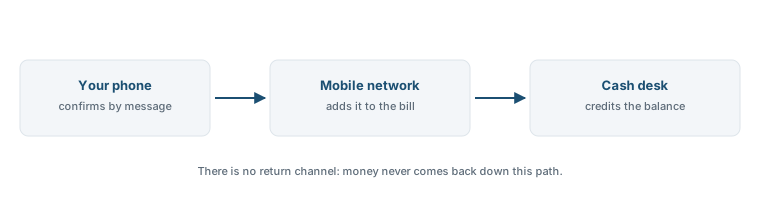
Two separate actions sit inside what feels like a single tap. The first is confirmation: you give your mobile number, a code arrives, you send it back, and the site now has reason to believe the line is in your hands. The second is billing, and it happens out of sight between your network and the company that collects on the site behalf.
Confirmation feels instant because a text message is all it is. Billing is not instant in any useful sense. The charge is recorded against your mobile account and settles on your network own cycle, so the money leaves you later than the moment you agreed to it. That delay is the whole reason the rail feels lighter than paying from a current account, and the reason it deserves more attention rather than less.
When a deposit does not land, the useful question is which of the two actions broke. A code that never arrives is a confirmation fault. A code accepted with no change to your playing balance points at billing or at crediting inside the cash desk, and a deposit that has gone missing is chased in a different order depending on which half failed.
The handset agrees; the network carries the charge until it bills you.
Why nothing comes back down this rail
A mobile account is a billing relationship, not a place where value is stored. Your network can add to what you owe. It has no mechanism for paying you an arbitrary sum on demand, and no regulated route for handing you somebody else winnings as credit on a phone bill.
So the rail runs one way. Value moves from the network towards the site and never the other direction. Any site taking mobile deposits pays out somewhere else entirely, and that is not a rule a particular brand invented to be awkward. It is the shape of the plumbing.
In practice this means you pick your exit before you use the entrance. If the only route out you could actually complete is a card you no longer hold, the deposit was a mistake no matter how smoothly it went through. Settle how money leaves a cash desk first; for most people who deposit by phone the answer turns out to be a debit card in your own name or a transfer back to your bank.
Who sets the ceiling on a single payment
The small per-payment limit on this rail comes from your mobile network. Networks carry the risk of bills nobody pays, so they cap what a third party may charge to a line, both for one transaction and across a billing period. No amount of history with a gambling site will shift that cap, because the site is not the party exposed to it.
That inverts the usual arrangement. On most rails the site states a floor and your bank states a ceiling. Here a company you probably did not think of as part of the payment has the last word, and the site can only pass on the refusal. You will find the real figures in your network own terms or in the app where charges to your line are itemised. Nobody else can quote them honestly for you, and numbers copied from a comparison table are out of date the moment the network reviews them.
Because the ceiling sits low, mobile payments live at the bottom of the ladder. If you are looking at the smallest sum a cash desk will take, or specifically at a three pound deposit, this rail will usually clear it and will usually refuse anything substantial.
On a contract the approval is a credit decision made in advance
On a monthly contract nothing is checked against a pot of money when you confirm. Your network looks at the limit it has already set for your line and at whether the account is in good standing, accepts the charge and files it for the next bill. The approval you receive was decided weeks earlier, when the network judged how much credit your line could carry.
This is why a contract line can wave through a mobile payment at a moment when your current account would turn one down. The two sit in different places and never consult each other. It is also why controls you have put on the account where your money actually lives do not touch this rail at all.
What still applies is anything counted inside the cash desk rather than inside the payment. A deposit limit held by the site is enforced after the money arrives, so it bites regardless of which rail brought it.
On pay as you go the credit goes first
A prepaid line works the opposite way round. The amount comes out of credit already sitting on the line, so there has to be enough of it and the deduction happens there and then. If the balance is short the payment fails cleanly and you owe nothing, which is a genuinely useful property.
Prepaid tariffs often carry stricter third party charging rules than contracts, and some do not allow this type of charge at all. The effective ceiling also becomes whichever is lower: the network cap or the credit you are holding. Someone who tops up in small amounts has given themselves a limit without meaning to.
One detail surprises people. If a charge is later reversed, the value goes back onto the line as credit rather than to a card or a bank account. It stays inside the mobile world, which is the same one way logic looked at from the other end.
The four places a mobile payment can stop
A refusal on this rail is nearly always silent about its origin. The message on screen comes from the cash desk, because the cash desk is the only party you are talking to, but the decision was usually taken further up the chain. Knowing the order of the checks tells you who to ask.
Read the table from the top. Each row can end the payment on its own, and only the last two are anything a site can discuss with you.
Check
Who decides
What you tend to see
Code to your handset
Your network messaging
No text arrives, or the code is rejected as expired
Third party charging allowed on the line
Your network
A flat refusal with no explanation
Limit for the transaction and the period
Your network
Small sums pass, a larger one does not
Prepaid credit on the line
Your network
Refusal that clears as soon as you top up
Risk rules at the collecting company
The payment intermediary
A name you do not recognise appears in the refusal
Cash desk rules and account state
The site
A message about limits, verification or your account
Order of checks on a mobile deposit and who owns each one
What the cash desk learns about you
Very little, and that is the appeal. The site receives a mobile number and confirmation that somebody holding the handset agreed to a charge. It does not receive a card number, a sort code or an account number, because none of those took part.
The trade is that you learn very little in return. You cannot see the network decision, you cannot see the collecting company risk rules, and you have no document to hand to a bank if something goes wrong. A rail where the whole decision happens somewhere you can log into and review is a very different proposition, even when the amounts are identical.
It also means the site cannot match the payment to a bank account in your name at the moment of deposit. The matching simply moves later, to the point where you want money back, which is where it becomes your problem rather than the site one.
Keep that asymmetry in mind when you read reassuring language about privacy on this rail. Your details are indeed kept away from the gambling business. They are also kept away from you, in the sense that the parties who made the real decisions owe you no explanation and have no customer service desk pointed in your direction.
Identity checks are not skipped because the rail is quick
A quick entrance does not buy you a quick exit. A licensed British site has to know who it is dealing with, and a mobile number proves only that somebody had a handset in their hand. Identity work is done on documents and on the account, never on the rail that happened to bring the first deposit.
In practice the identity check a site must run is often triggered before any payout and sometimes before the first deposit clears. If it lands after you have played, the mobile deposit is already spent and you are negotiating from a weaker position than if you had sorted the paperwork first.
There is a mismatch worth planning around. The rail that let you in needs a phone; the rail that lets you out needs a bank account or a card with your name and address attached. Those are two different sets of facts, and only one of them was tested when you tapped.
Why a credit card cannot hide behind a phone bill
Paying for gambling with a credit card is not allowed in Great Britain. People reasonably ask whether a phone bill is a way round it, since the network effectively advances the money and you settle up later. The answer is that the rail is not the point. The rule bites on the payment made to the gambling business, and a mobile charge is not a credit card payment.
What the rail does do is reproduce the feel of credit without being it. You decide now and pay later, the amount is invisible until a bill arrives, and the discipline of watching a balance fall is removed. The reasoning behind the credit card ban applies to that sensation even where the letter of the rule does not.
If you want to know what a particular site is actually permitted to do, the licence is a matter of public record rather than a claim in a footer. The public register of licensed operators is the primary source, and it will tell you which company holds the permission and what that permission covers. A site that offers this rail without appearing there is offering you a payment with nobody standing behind it.
Who the line belongs to
The rail assumes the handset and the account are the same person. Family plans, business lines and handsets handed down to someone else break that assumption quietly, and nothing in the payment flow asks about it.
Two problems follow. The person who receives the bill may not be the person who played, which is a conversation nobody wants to have. And when the site later needs the account holder name to match the route out, a line registered to somebody else gives you nothing to match against.
If the line is not yours, this is the wrong rail, and the cleanest alternative is the one where the name is on the instrument from the start. That is the quiet argument for understanding what a phone bill deposit really is before using either variant of it.
Controls that reach this rail and controls that do not
Here is where the independence of the mobile account turns from convenience into a real gap. A gambling block placed with your bank stops card and account payments. It does not and cannot stop a charge your mobile network adds to your line, because the bank is nowhere near that transaction.
So anyone relying on bank side controls should know the rail goes round them. The matching instrument is a bar placed with your network on third party charging, and the blocks available to you and where each one sits is the page that lists them side by side. Blocks are a tool you hold, not an obstacle put in your way.
If the pattern you recognise is deposits made because they were easy rather than because you had decided to make them, that is worth taking seriously on its own terms. Free and confidential help is available from the national advice service and on the helpline 0808 8020 133, which is open to anyone whatever stage they are at.
There is also a sequencing point. A bar at the network takes effect on the line, not on an account you can open again elsewhere, so it travels with you between sites rather than needing to be set up again each time. That is a different quality from a setting inside one cash desk, and the difference matters most on exactly the days you would rather it did not.
When pay by mobile is the wrong tool
It is the wrong tool whenever the amount matters. The ceiling makes larger deposits impossible, and splitting one into several charges to get round it is both tedious and the sort of pattern risk systems notice.
It is also the wrong tool if you expect to take money out soon. You will have to produce a second instrument anyway, verify it, and wait for the site to accept it, so you may as well have come in on that instrument and saved a step.
Where it earns its place is a small, deliberate, occasional payment made by someone who does not want a card number travelling anywhere and who has already arranged a route out. Used that way the hard ceiling is the feature, not the compromise.
Questions people ask
Can I withdraw winnings to my phone bill?
No. Your mobile account can take on a charge but cannot be paid an arbitrary amount, so there is no return channel. Every site that accepts mobile deposits pays out by another route, and you will need to add and verify that route before the first payout clears.
Who decides how much I can deposit in one go?
Your mobile network. It sets a cap per transaction and across a billing period because it carries the risk of the bill going unpaid. The cash desk only relays the answer, so asking the site to raise the figure achieves nothing.
Does a mobile deposit show up on my bank statement?
Not as a gambling payment. On a contract it reaches your bank as part of the usual payment to your network, bundled with calls and data. On a prepaid line it does not appear at all, since the credit was bought earlier.
Why can I not see the option on some sites?
The site has to have an agreement with a company that collects through mobile networks, and that agreement has to cover British networks and gambling. Where either part is missing the button is absent rather than hidden, and no setting on your side brings it back.
Is this allowed if credit cards are banned for gambling?
Yes. The ban applies to credit card payments made to a gambling business, and a charge collected by a mobile network is not one. It does imitate credit in the way it feels, which is worth bearing in mind even though the rule does not reach it.
Will a gambling block from my bank stop these payments?
No, because your bank is not part of the transaction. To close this route you ask your mobile network to bar third party charging on the line. That bar sits in the same place as the charge, which is why it holds.
My code never arrived. What now?
That is a messaging failure rather than a money failure, and nothing has been charged. Check that the number was typed correctly and that your line can receive short code messages, then try once. Repeated attempts usually produce a temporary lock rather than a code.
Can somebody else pay with my number?
Only if they can read the code sent to your handset, which is why a shared or unlocked phone is the real risk here. If a charge appears that you did not make, raise it with your mobile network, since the network is the party that recorded the debt.
Do I pay tax on anything I win after a mobile deposit?
No. A player in the United Kingdom does not pay tax on gambling winnings, and the rail that carried the stake makes no difference to that. How winnings are treated for tax sets out what the position rests on.
Is a prepaid line safer than a contract for this?
Safer in one specific sense: the money has to be on the line already, so a failed payment costs you nothing and the balance you hold is a hard ceiling. It is no safer in any other respect, and it still gives you no way out.
 UK Cash DeskOpen the cashier

 100% up to £100 on your first deposit