 UK Cash Desk
Short answerA gambling block is a setting inside your own bank, not a restriction imposed on you. It refuses an entire category of payment at the moment of authorisation, and it is designed to come off slowly rather than instantly.
- Our top pick
- 22BET — 100% up to £100 on your first deposit
- Regulator
- Gambling Commission of Great Britain
- Credit cards
- Banned for gambling since April 2019
- Minimum age
- 18
- Tax on winnings
- None for the player
- Self-exclusion
- GAMSTOP, free and nationwide
A switch inside your own bank
Most British banks and card issuers now offer a setting that refuses gambling payments from your account. It usually sits among the card controls in the app, next to things like freezing a card or turning off contactless. Where there is no app, the same thing can normally be arranged by asking the bank directly.
The first thing worth being clear about is whose tool it is. Nobody imposes this on you, no operator can see that you have used it, and turning it on is not a flag on your name. It is a preference you set about your own money, in the same category as a spending alert or a card freeze.
The second is that it is a payments tool, not a treatment and not a legal arrangement. It changes what your account will do. It does not close a gambling account, cancel anything you have agreed to, or do the work that talking to somebody does.
What the bank is actually refusing
Card payments carry a code describing the kind of business being paid, and gambling has its own. When the block is on, your bank looks at that code during authorisation and declines anything carrying it. This is why the setting takes effect immediately and why it needs no list of websites: it is not blocking companies, it is blocking a type of transaction.
That mechanism has a useful consequence. A new site, a renamed brand, an unfamiliar cashier — none of them need to be known to anybody in advance. If the payment is categorised as gambling, it is refused on sight. The same code is what makes gambling spend visible on a statement in the first place, as described on the page about paying for gambling by card.
It also explains the occasional strange refusal. Categories are applied by the business's payment provider, not by your bank, and a mixed business can end up carrying a code you did not expect. If a payment you did not think was gambling is declined, the category is where to look, and your bank can tell you what the transaction was classified as.

Where in the chain the decline happens
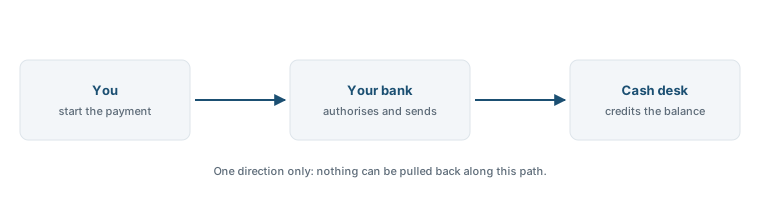
A card deposit is a push: you start it, your bank authorises it, and the money arrives at the cashier. The block sits in the middle box. Your bank refuses the authorisation, so nothing is ever sent, and the cashier sees a failed payment without being told why.
That is worth knowing because the message you see comes from the desk rather than from the bank. A cashier cannot distinguish a gambling block from an expired card, an address mismatch or a technical fault, so it shows whatever generic wording it has. The real reason is on your side of the chain, and only your bank can confirm it.
Nothing about the refusal is recorded on the gambling side either. The operator logs a failed attempt in the ordinary way, with no explanation attached, and it has no means of discovering that a block exists. People sometimes hesitate over the setting because they imagine it marking their account somewhere; the chain simply does not carry that information in that direction.
Why a blocked payment can look like a technical fault
Declines are confusing in both directions. A refusal at authorisation means no money moved, but some banks still show a pending line briefly, and some cashiers invite you to try again as though the problem were temporary. Repeating the attempt achieves nothing except more declined entries on the statement.
The pattern to recognise is a payment that fails instantly and identically every time, on a route that has worked before. That is a rule firing, not a glitch. A payment that leaves your account and then fails to appear on a balance is the opposite case and belongs with a deposit that has not arrived, which has nothing to do with blocks.
Where the two genuinely overlap is in reversals. If a payment was authorised before the block was switched on and settles afterwards, you can see a charge appear and then come back. Reading those states apart is the only way to know whether anything actually left.
Switching it off is slow on purpose
Here is the part that makes the tool worth anything. Turning the block on happens immediately. Turning it off does not: banks apply a waiting period before gambling payments are allowed again, and during that period the setting cannot be talked down, escalated or rushed. The length differs between banks and is stated where the setting lives.
The reasoning is behavioural rather than bureaucratic. The impulse to gamble is often sharp and short-lived, and a boundary that yields the moment it is tested is not a boundary at all. A delay turns a single decision made in a calm moment into a decision that has to be remade later, when the urge has passed. Almost all of the tool's value is in that gap.
This is also why support staff cannot override it. A bank that let an adviser lift the block on request would be selling a boundary and keeping the override, and the override is the only part that matters at two in the morning. If your bank's waiting period feels too short to be useful, that is a reason to add another tool rather than to switch this one off.

Three boundaries that are often confused
People use the words interchangeably and then discover the differences at the worst moment. The three tools overlap but nothing about them is the same: different owner, different reach, different way of coming off.
| Who controls it | What it reaches | Coming off | |
|---|---|---|---|
| Bank gambling block | You, in your bank | Payments carrying the gambling category, from that account | After a waiting period set by the bank |
| Limit at a gambling account | You, inside the account | One account at one operator | A reduction applies at once; an increase waits |
| Self-exclusion | You, with the operator or the scheme | Accounts at the operators covered, including new sign-ups | Only when the chosen term has run |
How it differs from a limit set at the desk
A limit inside a gambling account is a ceiling on that account: how much can go in over a period, sometimes how much can be staked or lost. It is precise, it is enforced by the operator, and it is invisible to your bank. What it does not do is reach any other account, which is its structural weakness as a boundary.
The two tools are built for different jobs. A limit shapes behaviour where you already play, which is why it belongs with the mechanics described on caps on money going in. A bank block decides whether this kind of payment can happen from your account at all, regardless of where it is pointed.
One detail is shared by both and is worth remembering: a reduction takes effect quickly while an increase waits. Licensed operators apply that asymmetry to account limits for the same reason banks apply it to the block, and in both cases the wait is the mechanism rather than an inconvenience bolted on afterwards.
How it differs from self-exclusion
Self-exclusion is an instruction to the gambling side rather than to the payments side. With an operator it closes your account for a chosen term and bars you from opening another with that company. The national scheme for online gambling, GamStop, extends the same request across operators licensed in Great Britain, so one registration covers accounts you have and sign-ups you might attempt.
The difference in reach runs both ways. Self-exclusion stops accounts existing but says nothing about your bank card. A bank block stops a category of payment but leaves accounts open and untouched. Used together they cover each other's gaps, which is why services that help people stop usually suggest both rather than choosing between them.
On the question that always follows: a self-exclusion is not something to look for a way around. Anything that accepts a player who has excluded themselves from licensed operators is, by definition, outside the British licensing system — and with that system go the complaints route, the rules about customer money and every obligation to offer any control at all. The public register of licensed companies is the plainest way to see the difference between a company that answers for itself and one that does not.
What the block cannot do
Honesty about the limits is part of using it well. It refuses a category of payment from the account it is set on. It is not a wall around your money and it was never sold as one: cash exists, other accounts exist, and no payment control can supervise what happens outside the payment it is looking at.
That is precisely why nobody treats it as a complete answer. It is the fastest boundary to put in place, it costs nothing, and it is the one that works while you arrange the rest. Pairing it with self-exclusion, with blocking software on your devices and with somebody who knows what you are doing turns a single refusal into something that holds.
It also does nothing about a balance that is already sitting at a gambling account. The block governs money leaving your bank, not money already on the other side, which is a gap worth closing deliberately rather than discovering later.
Money coming the other way is not blocked
Withdrawals are credits into your account, not gambling payments out of it, so the block does not refuse them. If you have a balance to recover, switching the block on does not trap it, and this is one of the most common worries people have before using the setting.
What can hold a payout up is entirely separate: the desk's own review, document checks, or a cap on how much can leave at once. Those stages are described in a payout sitting in pending and in the ceilings applied to money leaving, and none of them involves your bank's gambling setting.
There is one narrow exception to be aware of. If the destination card or account has been closed or frozen for an unrelated reason, a credit can bounce back to the sender, which looks like a refusal and is not one. That is a case for a payout that came back rather than for the block.
Turning it on says nothing about you
A good number of people who use this setting have never gambled. It removes a whole category of fraud risk from a card, it is useful on an account a household shares, and it is a sensible default on a card held by someone who would rather not have the option. None of that requires a story about why.
Nor is it reported anywhere that affects you. It is not a credit marker, it is not visible to operators, and it does not appear on an application. Gambling payments that have already happened are visible on statements because of the transaction category, and that visibility exists whether or not the block is on — the detail sits on the page about how gambling money is treated.
Thinking of it as a seatbelt rather than a confession is closer to the truth. Cheap, instant, slightly inconvenient to remove, and worth having before the moment you need it.
It is also reversible in the ordinary sense, just not immediately. Nothing about switching it on is permanent or recorded against you; if your circumstances change, the setting comes off after the bank's waiting period and the account behaves as it always did.
If a gambling payment goes through while the block is on
It happens occasionally, and it is almost always a categorisation problem rather than a failure of the setting. A business whose payments are coded as something else will not be caught, because the block reads the code it is given. Report it to your bank with the date, the amount and the name on the statement; that is how a miscoded merchant gets fixed.
Keep your own note of the same details. If the payment is disputed later, or if you want to show a pattern to someone helping you, the record does the work that memory will not. The same habit matters when an account is being verified, since the identity and payment checks described in the document process at a desk lean on exactly these details.
What not to do is treat a payment that slipped through as evidence that the tool is pointless. One miscoded transaction out of many refusals is a gap in a system that is still refusing everything else, and the right response is to report it and add a second layer.
Where to get help, and what this page is not
A payments setting is a boundary, not support. If gambling is costing more than money — sleep, work, honesty with people close to you — the thing that changes outcomes is talking to somebody who does this for a living. The National Gambling Helpline is free and confidential on 0808 8020 133, and BeGambleAware lists the services available, including online chat and local treatment.
The companion page on this site, limits, pauses, self-exclusion and getting help, sets out each tool and what it does and does not cover. Neither page carries advertising, and that is deliberate.
This site is an independent guide to how casino payments work, written from the cashier's side; who we are is on our about page. We are not a treatment service, we cannot see your accounts, and nothing here is a substitute for advice from your bank or from a support organisation.
Questions people ask
How do I turn on a gambling block?
It is a setting in your bank's app, usually among the card controls alongside freezing a card. If your bank has no app, ask them to apply it to the account. It takes effect straight away and costs nothing.
How does the bank know a payment is gambling?
Every card payment carries a code describing the kind of business being paid, and gambling has its own. The block refuses anything with that code at the moment of authorisation, so it catches sites nobody has heard of as readily as familiar ones.
Why can I not switch it off immediately?
Because the waiting period is the point. The urge to gamble tends to be sharp and brief, and a boundary that gives way as soon as it is tested does nothing. The bank sets the length and shows it where the setting lives.
Can I ask staff to lift it early?
No, and a bank that allowed it would be selling a boundary while keeping the override. Advisers cannot shorten the period. If it feels too short to help, the answer is to add another layer rather than remove this one.
Is a bank block the same as GamStop?
No. GamStop is self-exclusion on the gambling side: one registration covers accounts and new sign-ups at operators licensed in Great Britain. A bank block refuses a category of payment from your account and leaves accounts open. They cover different gaps.
Will the block stop me withdrawing a balance I already have?
No. A payout is a credit into your account rather than a gambling payment out of it, so the setting does not refuse it. Delays to a withdrawal come from the operator's review, document checks or a cap on how much can leave at once.
Does using it affect my credit file or show up on applications?
It is a preference on your own account, not a marker. Operators cannot see it and it does not appear on a credit file. Gambling payments already made are visible on statements because of the transaction category, with or without the block.
A gambling payment went through anyway. Is the block broken?
Almost always it is a miscoded merchant: the block reads the category it is given, and a business coded as something else slips past. Report the date, amount and statement name to your bank so the classification can be corrected.
Does the block cover every account I hold?
Only the account or card it is set on. If you hold accounts at several banks, each one has its own setting, and a block in one app says nothing about the others. People who want a real boundary switch it on everywhere rather than in one place.
Is turning it on an admission that I have a problem?
No, and plenty of people who never gamble use it to remove a category of fraud risk or to settle a shared card. It is closer to a seatbelt than a confession, and nobody outside your bank is told about it.