18+. The welcome offer shown here is the one the partner gives the site owner; availability depends on your country and your eligibility. Bonus size, qualifying deposit, wagering, eligible games, maximum bet, expiry and withdrawal limits are set out in the operator’s own terms and are not repeated here. We do not promise payout times. Offshore operator, not licensed by the Gambling Commission of Great Britain. Gambling involves financial risk — free confidential help at begambleaware.org, 0808 8020 133.
Short answerWith open banking you are sent into your own banking app to authorise a payment, and the gambling site receives a result rather than your details. That is why the same rail can carry money out as well as in.
Our top pick
22BET — 100% up to £100 on your first deposit
Regulator
Gambling Commission of Great Britain
Credit cards
Banned for gambling since April 2019
Minimum age
18
Tax on winnings
None for the player
Self-exclusion
GAMSTOP, free and nationwide
Open banking moves the payment inside your bank
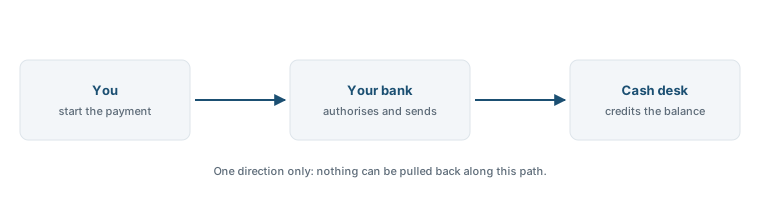
On a card payment you hand details to a merchant and the merchant asks your bank for money. Open banking inverts that. You are handed to your bank, you instruct the payment there, and the merchant is told only whether it worked.
The service in the middle is licensed to initiate payments on your instruction. It builds the instruction, passes you to your bank to approve it, and reports the outcome back to the cash desk. It never holds your money and never acquires the ability to move it again without you.
That structure is what separates it from the rest of the routes into a cash desk. The decision sits in the one place you can log into, audit and complain to, which turns out to matter far more than the speed everybody advertises.
British players meet this rail under several names, because the brand on the button belongs to whichever payment initiation service the site has signed with. The name changes; the mechanism does not. Anything that sends you into your own banking app to approve a payment and reports the result back is doing the same thing in the same order.
What the gambling site receives, and what it never sees
The site gets a confirmation that a payment of a stated amount has been initiated from an account, usually together with the account holder name as your bank holds it. It does not get your sort code, your account number, your card details or your login.
The name is the interesting part. On most rails a site has to take your word about who you are until documents arrive. Here it is handed a name straight from a regulated bank, which is a far stronger piece of evidence than anything you could type in.
That does not replace the formal check, but it does make it smoother. The identity work a licensed site must complete starts from a position where the funding account already matches the account holder, which removes the most common reason for a payout to stall.
You push the payment from your bank; the same rail can carry the payout back.
The consent screen is the whole mechanism
Everything that matters happens on one screen in your banking app, and it is the screen people skip. It names the payee, states the amount, and asks you to approve a single payment. Read those three things and you have understood the transaction completely.
Pay attention to what the screen is asking for. A one off payment of a stated amount is the normal case. A request for ongoing access to your account information, or permission to take future payments without asking again, is a different thing wearing similar clothes, and a deposit does not need either.
If the amount or the payee on that screen is not what you expected, the correct action is to cancel, not to approve and sort it out afterwards. Once you have authorised a push payment it has left, and unwinding it is a request for goodwill rather than an exercise of a right.
Why this rail runs in both directions
Bank accounts can both send and receive, which is why open banking is one of the few routes that works for payouts as well as deposits. The site already knows the account the money came from and already has a matching name, so paying back to it raises none of the questions a new instrument would.
That is a genuine advantage over anything prepaid or mobile, where the entrance and the exit are different instruments and the exit has to be built from scratch. Here the first deposit quietly does half the work of the first withdrawal.
It is also why this rail turns up whenever payouts that move quickly are discussed. Nothing about it shortens the checks a site runs, but it does remove the waiting that comes from adding and proving a destination after the fact.
A payout is not something you authorise in your bank
Here is the asymmetry worth memorising. Money leaving your account requires your approval. Money arriving in your account does not, and never has. A credit lands without you doing anything at all.
So a withdrawal from a cash desk involves no action inside your banking app. You request it on the site, the site processes it, and at some point the credit appears. Nobody needs a code from you, nobody needs you to confirm anything, and nobody needs you to approve a payment in order to receive one.
If a payout is slow, the reason is in the site queue, in its checks or in the banking day, and what a pending payout is actually waiting for goes through the possibilities. None of them is solved by approving something.
The one screen you should close instead of confirming
Because real open banking payments feel so smooth, a fake one feels plausible. The pattern to recognise is any screen that asks you to approve a payment out of your account as a step towards receiving money. There is no legitimate version of that request.
It can be dressed in several ways: a fee to release winnings, a verification payment that will be refunded, a small transfer to prove the account is yours, a deposit required before a payout can be processed. All of them are asking you to push money to somebody while calling it a withdrawal.
Note how well the dressing fits this particular rail. Because a genuine open banking deposit does involve a real approval screen in a real banking app, the fraudulent version can borrow the same shape and feel equally legitimate. The protection is not the look of the screen, it is knowing that incoming money never requires one.
The rule is one sentence long and it has no exceptions. Never approve a payment leaving your account in order to receive a payment. If a site tells you otherwise, the question has become whether it intends to pay at all, and what to do when a site will not pay out is the right page to read next.
Why the name on the account has to be yours
A licensed British operator must pay winnings to the person who holds the gambling account, and must not accept stakes from somebody else on your behalf. Open banking enforces that almost by accident, because the account name travels with the payment.
So paying from a joint account where you are a named holder is usually fine, and paying from an account belonging to a partner, parent or friend is not. The mismatch will be visible immediately rather than discovered at payout, which is the kinder of the two outcomes.
The same rule is why money cannot be sent onward to somebody else account when you withdraw. The destination is fixed by whose name is on the gambling account, not by where you would like the money to go.
People occasionally treat this as officiousness. It is not: it is the mechanism that stops a gambling account being used to move other people money around, and it is also what protects you if somebody else ever tries to use yours. The inconvenience and the protection are the same rule seen from two sides.
The same rail, read in both directions
Deposits and payouts on open banking share the plumbing and almost nothing else. What you do, who decides and what can go wrong are different at each end, and most frustration comes from expecting symmetry that was never there.
The table puts the two directions side by side.
The bottom row is the one to remember, because it is the row that scams rely on you not knowing. On the way in you approve exactly one payment. On the way out you are asked for nothing whatsoever, and any deviation from that is a signal rather than a formality.
Deposit
Payout
Where you act
Inside your banking app
Inside the cash desk, then nowhere
Who authorises
You, with your bank security
Nobody: a credit needs no approval
Who can refuse
Your bank, on balance, limits or blocks
The site, on checks, limits or account state
What it waits for
Your approval and the bank response
The site queue, its checks and the banking day
What you should be asked for
Approval of one payment, once
Nothing at all
Open banking in and open banking out
When your bank is not on the list
Coverage is good across British high street banks and the larger app based ones, but it is not universal. Smaller institutions, some building societies and most business accounts may be missing, and a missing bank means the option simply does not work for you.
If your bank is absent, the fallback is a payment you instruct yourself. A plain transfer from your account does the same job with more typing and no middle party.
Strong authentication and the device in your hand
British banks have to authenticate you properly for a payment like this, which means something you have and something you know or are: the banking app on a device registered to you, plus a passcode, fingerprint or face. There is no way to complete an open banking deposit without the thing your bank uses to identify you.
That is a protection, and it is also the most common point of failure. A new phone, a reinstalled app, an expired card reader or a login you have not used for months will stop the payment at the authentication step rather than at the money step.
It is worth noticing what that means practically. This rail cannot be used by somebody who merely knows your details, and it cannot be used by you in a hurry on a device your bank does not recognise. The first half is the reason to prefer it, and the second half is a small, occasional and entirely acceptable price for the first.
Where an open banking deposit stops
The deposit can fail in four places and the messages are usually clearer than on other rails, because your bank is talking to you directly. Authentication can fail. The payment can be refused for insufficient funds. Your bank can decline it under its own gambling controls. Or the site can reject it on account grounds after the money arrives.
That last case is the awkward one. A push payment that has been made cannot be unmade by the site refusing to credit it, so the money sits with the operator until it is returned, and the return is a manual process on somebody else timetable.
This is a specific argument for sorting out account state before you fund anything. A payment pushed into an account that is restricted, unverified or over a limit is money you then have to ask for back, and how long money takes to come back out applies to returns as much as to winnings.
Bank side controls reach this rail, and that is the point
Unlike anything funded through a telecoms account, an open banking payment goes straight past your bank front door, so every control your bank offers applies to it. A gambling block will stop it. A payment limit will cap it. A freeze on the account will end it.
This is a feature rather than a nuisance. A rail your own bank can see is a rail you can govern, and the controls sit with an institution that has no interest in you depositing. The blocks you can ask for and what each one covers explains how they differ and how long they take to lift.
One practical note: because your bank can see these payments plainly, they are categorised as gambling in your statements and in whatever spending breakdown your app offers. If you would rather know what you have spent, that visibility is worth more than the privacy other rails sell.
When a plain transfer is the better answer
Open banking is better than a manual transfer when you want the payment credited quickly and matched to your account without anyone typing a reference. It saves you from the classic mistake of a transfer arriving at a cash desk with nothing on it to say whose account it belongs to.
A manual transfer is better when your bank is not supported, when the amount is large enough that you want to control the instruction yourself, or when you are moving money back out and the site offers an account as a destination. In practice people end up using both, one for topping up and one for anything unusual.
There is also a reason to keep the two straight in your head rather than treating them as interchangeable. A payment you instructed yourself leaves a record you wrote; a payment initiated for you leaves a record somebody else wrote. When you are reconstructing what happened weeks later, that difference turns out to be the whole difference.
A card still has one thing neither of them has, which is a dispute process behind it. If that matters more to you than the privacy of your account details, a debit card deposit is the more conservative choice, and the way money comes back out will look much the same either way. Whichever rail you choose, check the company against the public register of licensed operators first, and if the ease of paying from your bank is becoming the problem, free and confidential help is available from the national advice service on 0808 8020 133.
Questions people ask
Does the gambling site see my bank details?
No. You authorise the payment inside your own bank, and the site is told the outcome along with the account holder name your bank holds. Your account number, sort code and login never reach the gambling business.
Can I withdraw through open banking as well?
Often yes, which is unusual among the alternatives to cards. The account is already known to the site and the name already matches, so paying back to it is straightforward where the operator supports it as a destination.
The site says I must approve a payment to receive my winnings. Is that right?
No. Money arriving in your account never needs your approval, so any request to authorise a payment out in order to be paid is an attempt to take money from you. Close the screen and do not complete it.
Can I pay from an account that is not in my name?
No. The account holder name travels with the payment, and a licensed operator may not take stakes from a third party or pay winnings to one. A joint account you are named on is normally acceptable; somebody else account is not.
My bank is not in the list. What now?
Then the option will not work, and nothing on your side changes that. Instruct the payment yourself as an ordinary transfer, or use a debit card, both of which work regardless of whether your bank supports payment initiation.
Will my bank gambling block stop these payments?
Yes. The payment leaves your account directly, so your bank sees it as a gambling transaction and applies whatever controls you have set. That is the main reason to prefer this rail over anything billed through a phone account.
Is it faster than a card?
Crediting is usually immediate in both cases, so the difference shows up at the other end. Having a verified bank account already attached removes a step before your first payout, which often matters more than the speed of the deposit.
Does this count as a credit payment?
No. The money comes from the balance in your current account, so there is no borrowing involved and the credit card prohibition is not engaged. If the account has an overdraft, that is a matter between you and your bank.
Can the service take money again later without asking me?
Not from a single payment approval, which authorises one amount once. Be careful on the consent screen though: a request for continuing account access or for future payments is a different permission, and a deposit does not require it.
Do I pay tax on winnings paid into my bank account?
No. A player in the United Kingdom owes no tax on gambling winnings, and a credit arriving from a licensed operator does not change that. The payment appearing in your account is not taxable income.
 UK Cash DeskOpen the cashier



 100% up to £100 on your first deposit