18+. The welcome offer shown here is the one the partner gives the site owner; availability depends on your country and your eligibility. Bonus size, qualifying deposit, wagering, eligible games, maximum bet, expiry and withdrawal limits are set out in the operator’s own terms and are not repeated here. We do not promise payout times. Offshore operator, not licensed by the Gambling Commission of Great Britain. Gambling involves financial risk — free confidential help at begambleaware.org, 0808 8020 133.
Short answerA statement cannot tell you whether money has been held, taken, credited or sent back, and three of those four look exactly alike from your side. The work is to identify the state before doing anything, because the right action is different in each one.
Our top pick
22BET — 100% up to £100 on your first deposit
Regulator
Gambling Commission of Great Britain
Credit cards
Banned for gambling since April 2019
Minimum age
18
Tax on winnings
None for the player
Self-exclusion
GAMSTOP, free and nationwide
What a banking app is actually telling you
A banking app shows a list of amounts and a list of names, and it is tempting to read that as a record of where your money is. It is not. It is a record of messages the bank has received and decisions it has taken, compressed into one line each. A line saying the money has gone can mean it has gone, or that it has merely been set aside, or that it went and is already on its way back. The line looks the same in all three cases.
Apps built around instant notifications make the illusion stronger, because the alert arrives with the first message, long before anything has settled. That is a feature rather than a fault: a notification exists to say something has happened on the account. Customers of app-first banks notice it most, which is why questions about payments from an app bank so often turn out to be questions about what a pending line actually means.
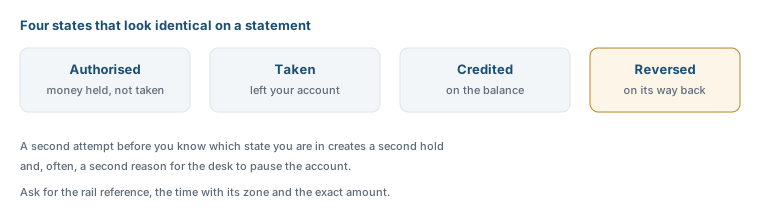
Four states that look identical on a statement
A deposit can be in four states, and your statement distinguishes none of them reliably. The first is authorised: the bank has agreed to the amount and ring-fenced it, but nothing has moved. The second is taken: the money has left the account and sits with the payment provider or the desk. The third is credited: the desk has it and has put it on the balance. The fourth is reversed: the payment failed somewhere after the money moved and it is travelling back to you.
Three of the four produce precisely the same visible result — an amount missing and nothing at the casino. Only the last eventually produces a second line, and that line is a credit rather than the quiet removal of the debit, which is why a reversal gets reported as being charged twice. Working out which of the four you are in is the whole task, and nearly everything useful follows from the answer.
Three of the four look the same from your side. Only one of them needs you to do anything quickly.
A hold is not a payment
An authorisation is a question and an answer. The desk's payment provider asks whether the amount is available; your bank says yes and ring-fences it. No money has moved. The ring-fence is there so the same amount cannot be spent twice while the payment completes, and it falls away by itself if nothing completes. It also reduces your available balance immediately, which is exactly why it feels like a payment that has gone through.
Holds release on a schedule set by the scheme and the bank rather than by the casino, and that is the single most common reason a desk says nothing has been received while the bank says the money is gone. Both are telling the truth. On a payment made by debit card this is the usual explanation when the cashier shows no deposit, no error message appears anywhere, and there is no obvious failure to point at.
Taken but not credited: where that money is sitting
The second state is the uncomfortable one. The money has genuinely left your account and the balance has not moved, which means the payment stopped between the rail and the account record. That happens for unglamorous reasons: a session that timed out before the desk received its confirmation, a mismatched reference, a check that interrupted the crediting step, or a payment that arrived against an account the desk could not match it to.
In every one of those cases the money exists somewhere and is traceable, because each rail issues an identifier for each payment. Routes that confirm the payer at the bank, such as a payment via open banking, tend to leave the clearest trail, since authentication and payment are a single event. The poorer the trail, the longer the trace takes, but a trail always exists. Payments do not evaporate.
A reversal that looks like a second charge
A reversal is a payment in the opposite direction. The original debit stays where it is and a credit appears beside it, which is ordinary bookkeeping and reads appallingly: two entries for one attempt, pointing opposite ways, often days apart. On a statement sorted by date the pair can be separated by a screenful of other activity, and that is how one failed deposit turns into a firm belief that money was taken twice.
The timing of the credit belongs to your provider, not to the desk. Accounts that post entries instantly show the pairing sooner and more clearly, which is one reason questions about payments through a card app cluster around reversals. The useful test is to hunt for the matching credit before concluding anything at all, and the two lines should carry the same amount down to the penny.
State
What you see
Where the money is
What it needs
Authorised
Money gone, balance unchanged
Still in your account, ring-fenced
Time; the hold falls away by itself
Taken
Money gone, balance unchanged
With the payment provider or the desk
A trace by reference, opened with support
Credited
Money gone, balance moved
On your balance at the desk
Nothing at all
Reversed
Money gone, then a credit appears
On its way back to your account
The matching credit, which you look for
Four states, and what each one needs from you
Why a second attempt is the worst first move
The instinct is to try again and it is the wrong instinct. If the first payment was authorised, a second creates a second hold, and two holds reduce your available balance by twice the amount for as long as both survive. If the first was taken but not credited, the second may credit perfectly, leaving a successful deposit beside an untraced one and making the trace harder, because there are now two near-identical payments to tell apart.
A third effect goes unmentioned. Repeated attempts in quick succession are a pattern risk systems exist to react to, so an account that was waiting for one payment is now waiting for a review as well. And if the first attempt failed because the amount sat below a floor, repeating it changes nothing whatsoever: that is what the floors a deposit must clear describes, and no quantity of attempts shifts it.
Three details that let support find a payment
Support cannot search for an experience. It can search for three things, and a message carrying all three gets answered in one reply instead of four. The first is the identifier the rail gave the payment — a transaction reference, an authorisation code, a payment identifier, depending on the route. The second is the time, together with the zone you are quoting it in. The third is the amount to the penny, including anything added or converted along the way.
Nearly everything else people put into these messages is noise: the make of handset, the browser, how long they have held the account, how disappointing the entire business has been. None of it narrows a search by a single record. A message leading with the reference, the time and the exact amount hands the person at the other end something they can type into a system, which is the only thing that moves the matter along.
Where the reference lives on each route
The identifier exists on every route; what differs is where it is kept and how long it stays visible. Cards put a reference on the statement line and sometimes an authorisation code in the app's detail view. Wallets keep their own history, so a payment with Apple Pay leaves an entry in the wallet as well as on the card it drew from, and the same is true of a deposit through Google Pay. That matters, because the two records are often worded differently and only one of them will match the desk's.
Other routes keep it elsewhere again. Charges to a phone account leave a confirmation message on the handset and a line on the bill, and the message is the thing to keep, since the bill arrives much later. With a prepaid voucher the code itself is the record, along with the receipt from the shop. Photograph whichever applies before chasing anything, because references are the first thing to disappear and the first thing you are asked for.
Route
What to keep
How long it stays easy to find
Debit card
The statement line and any authorisation code
Until the statement is archived by the bank
Wallet on a phone
The wallet's own entry, plus the card line
The wallet history keeps it; wording differs
Phone account
The confirmation message on the handset
Until the handset deletes old messages
Prepaid voucher
The code and the shop receipt
Only as long as you keep the paper
Where to look for the identifier, by route
The time, and why the zone is half the answer
A time without a zone is barely a time. Payment systems log in whatever zone they are configured for, and the people reading those logs are not necessarily in yours. Quote the time as it appeared to you, say which zone that is, and the search narrows to a window rather than a day. Without the zone, the search runs across an interval wide enough to contain other payments, which is how the wrong payment gets investigated while the right one waits.
British clocks shift twice a year, which adds an hour of ambiguity at precisely the point where precision pays. The sturdiest habit is to quote the time from the device where the attempt was made, name the zone explicitly, and give the date as well, because an attempt made late at night falls on a different day in a different zone and will be looked for there.
One more habit pays for itself here. If the attempt was made on a screen that showed a confirmation, capture it at the time rather than reconstructing it afterwards. A screenshot carries the time, the amount and frequently the reference in a single object, and it removes any argument about what was actually on the screen. Memory is the weakest of the three details and the easiest one to dispute.
The amount to the penny, and what conversion does to it
Rounded figures are the third way a trace goes wrong. A payment described as roughly ten pounds cannot be matched against a log full of exact amounts, and a payment that passed through a conversion is not the figure you typed in. If the account the money came from is held in another currency, the amount that left was converted at a rate your provider chose, and the figure in the desk's records is whatever arrived afterwards.
So quote both numbers when there are two: the amount you entered and the amount that actually left the account. Where a charge or a conversion margin applied, say so plainly, because the person searching is matching figures rather than interpreting them. Pence matter here in a way they matter almost nowhere else in a cashier, and an amount given to the penny often resolves a trace on its own.
The order to do things in
First, stop. Make no further attempts until the state of the first one is known, because every attempt adds a line to the thing you are trying to read. Second, look for the matching credit, which settles whether this is a reversal. Third, gather the three details and send one message to support asking which state the payment is in, rather than asking for the money. Fourth, and only then, take it to your bank if the desk reports that nothing arrived.
A fifth step is worth taking once the matter closes, because a stalled payment is a good moment to think about pace. Setting a cap on your own deposits removes the temptation to try again while something is unresolved, since the account will not accept more than the figure you chose. It is the only control in this story that belongs to you rather than to a bank or a desk.
One thing not to do at any stage is open a dispute with the card issuer while the desk is still tracing the payment. A chargeback raised against a payment under investigation tends to end with the account suspended while two enquiries run into each other, and it does not make the money arrive any sooner. Keep that lever for a desk that has stopped answering.
What the desk can see, and what it cannot
A cashier is not a bank. The desk sees what reached its payment provider and what its own system did next. It cannot see a hold your bank is applying, it cannot release one, and it cannot say when one will expire. That boundary explains most of the unsatisfying answers in this situation: when a desk states it has no record of a payment, that is usually a true statement about its own records rather than a claim about your account.
It also tells you whom to ask for what. Holds, conversions and inbound charges are questions for your provider. Crediting, matching and the state of the account are questions for the desk. If you need to establish which company the desk actually is before writing to it, the public register of licensed operators holds that, searchable at gamblingcommission.gov.uk.
When this stops being a cashier problem
Most of these cases close within a few exchanges, because the payment was in one of four states and the state could be identified. A small number do not, and they split in two. The first is a payment the desk acknowledges and does not credit, which is a complaint about the cashier. The second is a credited balance the desk then refuses to pay out, which is a different complaint with its own route: the way a refused payout is handled has little in common with a missing deposit.
Either way the escalation has the same shape: the operator's formal complaints procedure, in writing, with the reference, the time and the amount attached, and then the independent route its licence requires if that leads nowhere. Where a desk simply stops replying, the pattern set out under a desk refusing to pay is the relevant one. And if chasing a payment has turned into chasing losses, free and confidential help is at begambleaware.org, or on the National Gambling Helpline, 0808 8020 133.
Questions people ask
The money left my account and the balance is empty. Is it lost?
Almost certainly not. The payment is in one of four states, and three of them resolve without anybody losing anything. Identify the state before doing anything else, because the action needed is different in each case.
How long does a hold last?
That is set by your bank and the card scheme, not by the casino, and the desk has no way to release one. If the money was only ring-fenced it returns to your available balance by itself. Your bank is the only party able to say when.
Should I simply try the deposit again?
Not until the state of the first attempt is known. A second attempt can produce a second hold, or a successful deposit sitting beside an untraced one, and a quick run of attempts can trigger a review on top of that. Nothing is gained and the trace becomes harder.
What exactly should I send to support?
The rail's reference for the payment, the time with its time zone, and the amount to the penny. Ask which state the payment is in rather than asking for money back. One message carrying those three details is answered faster than four messages without them.
Where do I find the payment reference?
On a card, the statement line and sometimes an authorisation code in the banking app. In a wallet, its own transaction history. On a phone account, the confirmation message and later the bill. For a voucher, the code itself and the receipt from the shop.
Why does my statement show the payment twice?
Because a reversal is posted as a credit rather than by deleting the original debit. Two entries pointing opposite ways for one attempt is the normal appearance of a refund. Check that both carry the same amount to the penny before raising anything.
The desk says nothing was received. Who is wrong?
Probably neither party. The desk can only see what reached its provider, and a hold applied by your bank never reaches anyone. Both statements can be true at the same time, which is why the state of the payment matters more than either party's reassurance.
Does the time zone really matter?
Yes, because logs are searched by time window. A time quoted without a zone widens the search enough to take in other payments, and the wrong payment then gets investigated. Quote the time from the device you used and name the zone with it.
My deposit was converted from another currency. What do I quote?
Both figures: the amount you entered and the amount that actually left the account. A conversion means the desk's record and your statement will not match exactly. Saying so at the start saves an exchange of messages later.
What if nothing gets resolved?
Use the operator's formal complaints procedure in writing, attaching the reference, the time and the amount, and then the independent route its licence requires. Keep every reply you receive. A missing deposit and a refused payout are separate complaints and should not be bundled together.
 UK Cash DeskOpen the cashier



 100% up to £100 on your first deposit