18+. The welcome offer shown here is the one the partner gives the site owner; availability depends on your country and your eligibility. Bonus size, qualifying deposit, wagering, eligible games, maximum bet, expiry and withdrawal limits are set out in the operator’s own terms and are not repeated here. We do not promise payout times. Offshore operator, not licensed by the Gambling Commission of Great Britain. Gambling involves financial risk — free confidential help at begambleaware.org, 0808 8020 133.
Short answerRoulette comes in three forms and the whole difference is the treatment of zero. The house edge is a division you can do on paper rather than a figure anyone has to supply, a staking system changes how your results are spread and not what they average, and a balance carrying an open bonus cannot leave until the turnover on it is finished.
Our top pick
22BET — 100% up to £100 on your first deposit
Regulator
Gambling Commission of Great Britain
Credit cards
Banned for gambling since April 2019
Minimum age
18
Tax on winnings
None for the player
Self-exclusion
GAMSTOP, free and nationwide
Three wheels, and the difference is the zero
Roulette looks like one game with cosmetic variations. It is closer to three games that share a layout. The European wheel carries the numbers one to thirty-six and a single zero, which is thirty-seven pockets. The American wheel adds a second zero and runs to thirty-eight. The French wheel is the European one with an extra rule attached to even-money bets.
Everything that matters about choosing a table is in that paragraph. The numbers you bet on are the same in all three. The payouts printed on the layout are, in the usual case, also the same. What differs is how many pockets exist that are not numbers, and what the table does with your stake when one of them lands.
So the honest advice about variants is unusually short: prefer the wheel with one zero, and prefer the version of it that gives something back on even-money bets when the zero arrives. Both facts are stated in the table's rules panel, exactly as a live table states its own limits, and neither needs to be taken on trust.
Wheel
Pockets
What happens to an even-money bet when zero lands
European, single zero
Thirty-seven
The stake is lost like any other losing bet
French, single zero
Thirty-seven
Half the stake is returned, or it is held for one more spin, where the rule is offered
American, double zero
Thirty-eight
The stake is lost, and there is one more pocket that can take it
The three wheels, read by the zero
What the zero actually does to a bet
The zero is not a thirty-seventh number you forgot to cover. It is the pocket that makes the payouts affordable. Red and black, odd and even, high and low all look like even propositions on the layout, and they would be if the wheel held only numbers. The zero is what sits outside those pairs, and it is the entire source of the house's margin.
Picture the layout as a set of fields you are dividing between yourself and the table. Every bet you can place covers a group of numbers. The zero belongs to none of those groups unless you back it directly, so whatever you cover, there is always at least one pocket that defeats the whole layout.
Add a second zero and you have added another such pocket without changing a single payout. That is why the American wheel is worse in a way no betting pattern can address, and why the first question at any table is how many zeros are on it rather than how the previous spins went.
The house edge is a division you can do yourself
This is the part worth being exact about, because it is arithmetic rather than a figure anybody has to disclose. Take the payout the table states for a bet. Add one to it, counting your returned stake, and you have the number of equally likely outcomes that payout would be fair for. Compare that with the number of pockets the wheel actually has. The shortfall, divided by the pocket count, is the house edge on that bet.
Two things fall out of the method immediately. On a single-zero wheel the division gives the same answer for nearly every bet on the layout, which is why covering more numbers does not improve the deal — it only narrows the spread. And on a double-zero wheel the same division gives a worse answer across the board, with one combination bet unique to that layout working out worse still.
Notice what the calculation did not need: no operator statement, no published return, no trust in anybody. The wheel's pocket count and the layout's own payouts are enough. That is the opposite of a published return figure for a whole site, which is an aggregate somebody else has compiled from data you cannot see.
French rules: half back, or held for one spin
The French version is the single-zero wheel plus a rule that applies only to even-money bets and only when zero lands. One form returns half the stake instead of taking all of it. The other holds the whole stake for one more spin: win the next spin and the stake comes back without a profit, lose it and it is gone.
Both forms reduce the edge on those bets specifically, and neither touches anything else on the layout. A straight-up number is unaffected. That makes the rule a reason to choose a table, not a reason to change what you bet, and it is the one structural difference in roulette that genuinely favours the player.
The catch is availability. Not every table that calls itself French offers the rule, and some offer one form rather than the other. It is written in the rules panel on the table, in the same place as the stake range, and reading it takes less time than placing a bet. Where it is absent, you are playing the European game under another name.
Inside and outside bets are the same deal in different clothing
A straight-up number is a rare large payout. An even-money bet is a frequent small one. Players describe the first as risky and the second as safe, and in terms of how a session feels they are right. In terms of what the bets cost, the division above gives the same answer for both on a single-zero wheel.
What changes between them is variance — the width of the range of outcomes you might see in an hour. A layout of outside bets produces many small movements and a slow drift. A straight-up habit produces long nothing and occasional jumps. Neither produces a different long-run price, because the price is charged on turnover and the turnover is whatever you staked.
This is the single most useful idea to carry away from the page, and it transfers to products that look nothing like a wheel. It is the same reason volatility on a reel game describes the shape of a session rather than its value.
Figure
Where it comes from
Can you check it yourself?
Pocket count on the wheel
The rules panel on the table
Yes, by counting the layout
Payout for each bet type
The layout and the paytable
Yes, it is printed
House edge on a bet
Division: payout plus one against pocket count
Yes, it is arithmetic
Whether a French rule is in force
The table's rules panel
Yes, before you stake
Minimum and maximum stake
The operator, per table
Only by reading the table
Bonus contribution and stake cap
The offer terms on your account
Only by reading the terms
Which figures you can derive and which you have to look up
Why a staking system moves the spread and not the expectation
Progressions are the oldest conversation in roulette, and the answer to all of them is one line of arithmetic. The expected result of a sequence of bets is the sum of the expected results of each bet. Each bet's expectation is its stake multiplied by the edge the division gave us. Adding them up does not create a term that cancels, whatever order the stakes are placed in.
Put plainly: there is no sequence of stakes whose total expectation is better than the worst bet in it, because the spins are independent and the edge is charged per stake. A progression can change how likely you are to finish a session ahead, how large the swings are and how long the balance lasts. It cannot change what the average outcome is.
It is worth saying explicitly that this is arithmetic and not a claim from an operator or a regulator. You do not have to believe a casino about it, and you do not have to believe this page. The derivation is three steps long and uses only the payouts printed on the table.
Where a progression meets the table maximum
The doubling systems fail for a second, more practical reason. They require an unbroken ability to increase the stake, and tables cap stakes. The cap is set per table by the operator, so the sequence runs into a ceiling long before it runs into anything theoretical, and it does so exactly when the losses are at their largest.
There is also a floor. A progression that starts at the table minimum has nowhere to go downwards, which is the direction people forget to plan for. Between the two limits a table offers a much shorter runway than a spreadsheet suggests.
Both figures are attributes of the table rather than the game, which means they change when you change seats and cannot be read off a review. The same is true of a studio wheel game's per-segment ceiling, and in both cases the refusal of a stake mid-session is a limit rather than a fault.
The wheel has no memory, and neither has the board
Tables display recent results because players like them, and the display carries no predictive information whatsoever. A colour that has not appeared for a while is not owed an appearance, and a number that has just landed is no less likely next time. Each spin is settled independently, and that independence is one of the things a licensed operator has to demonstrate to keep the entry it holds on the Gambling Commission public register.
The belief that a run must correct is the most expensive idea in the room, because it argues for raising a stake at the worst possible moment. The honest version is dull: every spin is priced identically, so the only variable you control is how many of them you buy.
At a live table you cannot even control that, because the dealer sets the rhythm. A software wheel hands the clock back to you, and the usual effect is more spins per hour rather than fewer, which raises turnover at a constant price per unit.
Live wheel or software wheel, seen from the cash desk
The arithmetic is identical if the rules are identical; that is the key sentence. What differs is everything around the spin. A software wheel has a bet range set by the game, runs at your pace, and usually counts towards bonus turnover at the table rate in the terms. A live wheel has a range set by the table, runs at the dealer's pace, and often counts for less or not at all.
Settlement differs too. On a software wheel an interrupted round is restored or voided when you return. At a live table a stake already accepted is settled whether or not your screen survived, and the round history rather than the video is the record of what happened.
Neither is better value as a game. They are different products at the cashier, and the choice between them should be made on limits, pace and bonus treatment rather than on the look of the wheel.
An open bonus puts a lock on the balance
Here is where good roulette arithmetic runs into terms and loses. While a bonus is live on the account the balance it sits in is restricted: a withdrawal request will either be refused or will cancel the bonus and whatever it produced, depending on which approach the site has written down. That choice is the most consequential sentence in any offer.
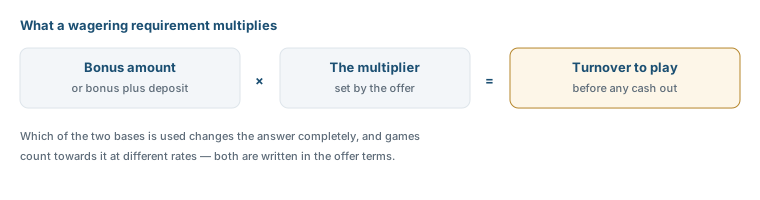
Two figures decide how heavy the lock is. The base the turnover multiplies — bonus alone, or bonus plus deposit — and the rate at which roulette counts towards it. Table games are habitually set low on that scale and are frequently excluded outright, which makes roulette one of the worst games to be holding a bonus on.
Both numbers are in the turnover rules of the offer rather than anywhere near the table, and a headline on a welcome offer is not a summary of them. If you intend to play a wheel, the cleanest position is a plain deposit with nothing attached.
Two inputs decide how long the lock lasts: the base the requirement multiplies, and the rate at which a wheel stake is allowed to count.
Covering most of the layout is exactly what the terms forbid
A player who understands the edge quickly notices that a bonus can be turned over cheaply by covering most of the numbers on a wheel. Operators noticed first. Bonus terms therefore carry rules against low-risk or opposing betting, against covering a high proportion of the layout, and against exceeding a stated maximum stake while a bonus is live.
The penalty for breaching those rules is not a warning. It is normally the voiding of the bonus and any balance built with it, and the clause is written to be applied at the operator's discretion. A player can be entirely honest, play a sensible spread, and still land inside it.
So the rule of thumb is blunt: do not try to engineer turnover on a wheel. If a balance has been held for review, the two pages worth reading are why a payout sits pending and what a refused withdrawal usually means, because this clause is behind a good share of both.
Getting money onto the table, and off it again
A wheel is undemanding about how it is funded, which means the cashier rules are the ordinary ones. Money has to be settled on the account before it can be staked, so a payment that has authorised but not posted leaves a figure visible in the lobby and a table refusing the chip. Credit cards are not an option for gambling in Great Britain at all, whether used directly, through a wallet or to buy a voucher.
Coming back out is the part worth planning. A balance built at a wheel is treated exactly like any other balance: the operator reviews it, the identity check has to be complete, and any cap on the size of a single payout applies. Several sites also refuse to open a withdrawal request while a round is still live at a table you are seated at.
The one preparation that pays for itself is the paperwork. Completing the document check before there is anything to withdraw removes the stage that most often holds a payout, and it has to be done only once for the account.
Counting a roulette budget in spins rather than in pounds
A wheel is the easiest game in the building to lose track of, because a chip is small, the layout invites several of them, and a round ends quickly enough that the next one feels like a continuation rather than a new purchase. The total on the layout is the stake, and it is the figure that should be decided before sitting down.
Spins per hour is the other half. Price per spin multiplied by spins is the cost of the evening, and the second factor is the one players never estimate. A software wheel at full speed buys a great many more spins per hour than a live table, at the same price each.
Account controls are stronger than resolve. A ceiling set in the cashier holds regardless of how the evening goes, and a block switched on at the bank sits under it as a second layer. Winnings themselves are not taxed for a player here, which the tax position on gambling wins explains, but an untaxed loss is still a loss. If the wheel stops being a cost and starts being a route back, the helpline is 0808 8020 133 and BeGambleAware is independent of every operator.
Questions people ask
Which roulette wheel should I choose?
The one with a single zero, and within that the one offering a French rule on even-money bets. A second zero adds a pocket that defeats every bet on the layout without changing any payout, so it makes every bet worse at once. The pocket count and the rule in force are both written in the table's rules panel before you stake anything.
How do I work out the house edge without trusting anyone?
Take the payout stated for the bet, add one to account for your returned stake, and you have the number of outcomes that payout would be fair across. Compare it with the pocket count on the wheel, then divide the shortfall by the pocket count. That is the edge, and it is arithmetic rather than information somebody has to give you.
Does the Martingale work if I have enough money?
No, for two separate reasons. The expectation of a sequence of bets is the sum of the expectations of each bet, so no ordering of stakes creates an advantage. And the table caps the stake, so the doubling sequence breaks exactly when the losses are at their largest. What a progression does change is the spread of outcomes, which is why it can feel like it works for a while.
Is red more likely after a long run of black?
No. Spins are settled independently, and the display of recent results carries no information about the next one. The belief that a run has to correct argues for raising a stake at precisely the wrong moment, which is why it is the most expensive idea at the table. The price of every spin is the same regardless of what came before it.
Are outside bets safer than betting a single number?
They produce smaller, more frequent movements, so a session feels steadier. The cost per pound staked is the same on a single-zero wheel, because the division that gives the edge returns the same answer for nearly every bet on the layout. The real difference is how much balance you need to see the long run, not what the long run is.
Can I clear a bonus by covering most of the numbers?
No, and attempting it is the fastest route to a voided balance. Offer terms carry clauses against low-risk and opposing betting, against covering a high proportion of a layout and against exceeding a maximum stake while a bonus is live. The remedy written into those clauses is forfeiture rather than a warning, applied at the operator's discretion.
Does roulette count towards wagering requirements?
Usually at a much lower rate than reels, and in plenty of offers not at all. Two figures decide the weight of the requirement: the base it multiplies, which may be the bonus alone or the bonus plus the deposit, and the per-game contribution rate. Both are in the offer terms, and nothing in the table panel refers to them.
Why is my stake refused at a table I have played before?
Stake limits belong to the table rather than the game, so a different table of the same wheel has a different floor and ceiling. Changing seats changes the limits. The other common causes are a betting window that closed before the confirmation arrived and an open offer that excludes table games altogether.
Is a software wheel fairer than a live one?
Neither is fairer; they are the same arithmetic when the rules match. The differences are operational: the stake range, who controls the pace, how an interrupted round is handled, and how much the stake contributes to a bonus. A software wheel usually lets you play far more spins per hour, which raises your turnover at an unchanged price per spin.
Do I owe tax on a roulette win?
A player in the United Kingdom does not pay tax on gambling winnings, as the duty sits with the operator. That is separate from whether the balance can be withdrawn, which depends on the identity check, any cap on the payout and any open bonus. The two are often confused because each ends in money you can see but cannot yet spend.
 UK Cash DeskOpen the cashier



 100% up to £100 on your first deposit