18+. The welcome offer shown here is the one the partner gives the site owner; availability depends on your country and your eligibility. Bonus size, qualifying deposit, wagering, eligible games, maximum bet, expiry and withdrawal limits are set out in the operator’s own terms and are not repeated here. We do not promise payout times. Offshore operator, not licensed by the Gambling Commission of Great Britain. Gambling involves financial risk — free confidential help at begambleaware.org, 0808 8020 133.
Short answerAn app-only bank gives you two things a cash desk cannot override: a gambling block you turn on in seconds and cannot turn off in seconds, and a merchant label it reads before deciding anything. Both mean a payment can be refused with the site entirely uninvolved and unable to tell you why.
Our top pick
22BET — 100% up to £100 on your first deposit
Regulator
Gambling Commission of Great Britain
Credit cards
Banned for gambling since April 2019
Minimum age
18
Tax on winnings
None for the player
Self-exclusion
GAMSTOP, free and nationwide
A bank with no counter, and what that changes
There is no branch, no telephone menu and no paper statement arriving in an envelope. Every decision the bank makes about your money is surfaced in an app, in near real time, with a note attached. For the specific business of funding a cash desk, that turns out to matter in two directions at once.
In your favour: you can see a refusal the moment it happens, with the bank's own reason beside it, which is more than a cashier will ever be able to tell you. Against you: the bank also sees every payment immediately and classifies it immediately, and it has built tooling on top of that classification which a bank working from overnight batches could not.
This page is about that tooling. Not as a list of features, but as a mechanism: what the bank is reading, when it decides, and why a cash desk can be entirely blameless for a payment that never arrives. The wider picture of how card rails behave is on the hub for payment routes.
Where the gambling control lives and what it is
The control is a setting in your own banking app, kept alongside the other account protections rather than with the card. Switched on, it instructs the bank to refuse payments it identifies as going to a gambling merchant. The refusal happens at the bank, before any money is set aside, so there is nothing to reverse and nothing waiting on a statement afterwards.
What makes it meaningful is who holds it. It is not a service the cash desk grants you, not a preference on a gambling site, and not something an operator can override to keep a customer. The bank is acting for its account holder, and no commercial pressure from the other end of the payment reaches it.
British banks were asked to build this and most of them have, in slightly different shapes. The differences matter more than the marketing, and the one worth understanding is how hard each version is to undo. The family as a whole, including the versions on offer at older banks, is covered on the page about bank gambling blocks.
Switching it on takes one tap and works immediately
There is no application, no wait and no explanation required. You find the setting, you turn it on, and the next qualifying payment is refused. This asymmetry at the start is deliberate too: the moment someone decides they want this is a moment worth capturing immediately, and a bank that made you wait for protection would be getting it exactly backwards.
Because it applies at the account, it covers every card on the account, including any virtual or replacement card, and it does not need to be set again when a card is reissued. A new card inherits the account's rules rather than arriving as a clean slate, which is the opposite of what people expect and the right behaviour.
One thing it does not do is reach backwards. A payment already authorised before the switch went on is already approved; the hold on it will become a debit in the normal way. If you have just turned it on and something still lands, that is the tail of an existing authorisation rather than a failure of the setting.
Why switching it off is slow, and why that is the point
Turning the control off is not a single tap. There is a confirmation, and then a cooling-off period during which gambling payments stay refused even though you have asked for them to be allowed. The app tells you how long that period is and when it expires, and that figure in your own app is the only one worth trusting.
The delay is the entire mechanism. A protection you can remove instantly protects you only against moods that last longer than a few seconds, and the moment people most want to remove this one is precisely the moment they should not. Putting hours between the decision and the effect means the decision has to survive the hours. Most of the time it does not, which is the feature working rather than failing.
Two consequences follow. First, you cannot use this as a day-to-day convenience toggle, and you should not try to; a control treated as a tap is not a control. Second, if the wait is frustrating you right now, that frustration is information about something other than the bank. The page on staying in control is a better place to be than a cashier, and it carries no advertising for the same reason.
What the control can see, and what it cannot
It works on recognition, so its reach is exactly as wide as what it can recognise. A card payment to a merchant labelled as gambling is recognised and refused. The same card presented through a device wallet is still that card and still carries the label, so it is normally refused too. Those are the clear cases and they cover most of what anybody does.
Outside that, recognition thins. Money moved to another account, another wallet or another instrument is a payment to something ordinary. There is no gambling merchant in the transaction, so there is nothing for the rule to catch, and spending from that second place is beyond the perimeter. Some banks extend the rule to transfers aimed at recipients they recognise as gambling businesses, which closes part of the gap and not all of it.
Say it plainly, because the honest version is more useful than the reassuring one: the control is a fence around one route, not a net over your money. It is excellent at stopping the easy payment and useless against a determined detour, and knowing which of those you are making is the whole of its value.
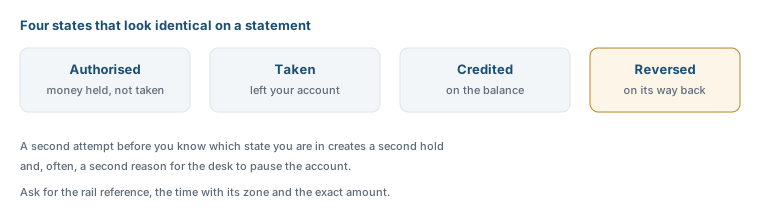
A bank refusal leaves nothing behind. A refusal further down the chain can leave a hold that looks exactly like a completed payment.
The category label your bank is actually reading
Nothing in a payment says the word gambling. What travels with the request is a short classification code describing the merchant's line of business, drawn from a standard list that every card payment in the world uses. One of those classifications is set aside for betting and wagering, and that is the thing a gambling control looks for.
This explains a great deal. It is why the control applies at the merchant level rather than the product level, and why it cannot distinguish between a deposit and, say, a subscription bought from the same company under the same classification. It is also why your bank can act in advance rather than guessing from the merchant's name, which would be hopeless.
The same label does work beyond blocking. Some issuers treat this classification as cash-like rather than as an ordinary purchase, which changes how the payment is handled internally and occasionally what it costs. The underlying mechanics of that are on the page about debit card payments, since they belong to the card rail rather than to any one bank.
Who assigns the label, and what happens when it is wrong
Here is the part almost nobody knows. Your bank does not choose the label and neither does the cash desk. It is assigned when the merchant is taken on by its own payment provider, and it describes the business as that provider has classified it. Your bank simply reads what arrives.
Which means mistakes are possible in both directions, and both directions produce complaints. A gambling business classified under something broader will not be caught by a gambling control, and the payment sails through while the account holder believes they are protected. A business classified as gambling when the particular transaction was something else gets refused, and the customer has no idea why.
Neither case is fixable at the point of payment. Your bank cannot relabel somebody else's merchant record, and the cash desk cannot see the label at all. If you find a route past your own control because of a label, the useful response is to treat the control as thinner than you thought rather than as a door that has been opened for you.
Piece of the mechanism
Who controls it
Can anyone else change it?
The gambling control on the account
You, in your own app
No, and no operator can override it
The cooling-off period before it lifts
Your bank
No, not on request
The merchant category on the request
The merchant's payment provider
Not by you and not by your bank
Whether the rail is offered at all
The cash desk
No, and it is unrelated to your bank
Who holds which piece of a blocked payment
A payment can fail with the cash desk uninvolved
Follow the sequence and the point becomes obvious. The cashier builds a request and hands it to its own payment provider. That provider passes it to the card scheme, which routes it to your bank. Your bank applies balance, authentication, fraud rules and your own settings, and answers yes or no. The answer travels back the same way and the cashier displays whatever it received.
At no point does the cashier learn which of those tests failed. It gets a refusal and a code, and the codes are coarse by design, because telling a merchant exactly why a bank refused would be telling it things about a customer it has no business knowing. So the generic message you see is not a cashier being evasive; it is a cashier reporting the whole of what it was told.
Which is why the app is the better place to look. If a refusal is listed there with a reason, that reason is authoritative and nothing on the site will change it. If nothing is listed there at all, your bank was never asked, and the problem sits upstream among the things described under a deposit that has not arrived.
Reading a refusal properly, in the right order
Open the app first, before support, before trying again. Three findings are possible and each one points somewhere different. A declined entry with a stated reason: your bank answered and you now know why. A held or pending amount with nothing on your gambling balance: the payment was authorised and the credit was lost on the way back, which is a reconciliation problem rather than a payment problem. Nothing at all: the request never reached your bank.
Then stop. The reflex to try again is the single most expensive habit on any card rail. A second attempt in an unresolved state can leave a second hold against your balance, and a run of attempts looks, to a compliance system that cannot read your intentions, exactly like somebody testing cards. Accounts get paused for that, and unpausing them takes documents.
What to send if you do need help is narrow and specific: the amount to the penny, the time with its time zone, and the reference the app shows for the entry. That triple identifies the transaction on both sides. The patterns behind refusals on the way out, which are a different animal, are gathered under a payout that was refused.
The card itself is an ordinary debit pull
Underneath all the tooling, this is a plain debit card and it behaves like one. The cash desk pulls, your bank sets money aside, the taking happens as a separate step, and a payout is aimed back at the original transaction. There is no special rail and no privileged route, and that is good news, because it means the well-understood card mechanics apply without modification.
Debit is also the only option available, and not as a limitation of the bank. Credit cannot fund gambling in Britain at all, which removes a whole class of problem from this rail before you encounter it; the reasoning is set out on the page about the credit card ban. An overdraft is a complication worth noticing, since money borrowed inside a current account does not change what the card is, and a payment that dips into one is still a debit payment made with money you do not have.
If you want a route that leaves no card in anybody's records, the push family does that instead, and paying straight from the account explains what you give up in convenience to get it.
Payouts into an account with no branches
A payout to a card from this kind of bank is unremarkable: it arrives as a credit against the original transaction and shows up in the app with a note, usually faster than the same credit would surface at a bank posting overnight. Faster to appear is not the same as released sooner, and the release is the part that takes time; that half of the process is described under how a payout is processed.
Where the rail is a bank transfer instead, the account works like any other, with sort code and account number, and the name on it is the name the cash desk will insist matches. There is nothing unusual here and no reason for an operator to treat the account differently.
The one genuinely different thing is that a payout landing in your app is loud. A notification arrives the moment it does. That cuts both ways, and if you have set yourself a ceiling on what goes back in, setting it at the site as well is worth the two minutes; a deposit ceiling the operator has to honour is a control that works on every rail rather than only on the ones your bank can see.
Getting documents out of a bank that posts nothing
Sooner or later a cash desk will ask you to prove the payment method, and the request assumes a world of posted statements. An app-only bank issues documents on demand instead: a statement for a chosen period, exported as a file, and in most cases a separate confirmation of account document that names you, the account and the address held on file.
Generate what you are likely to need before it is urgent, because the request always arrives at the worst moment, which is when a balance is waiting behind it. A screenshot is not a document and is routinely rejected; the exported file is, because it carries the bank's own formatting and reference.
The other half of the problem is the name. Instrument, site account and document all have to describe the same person at the same address, and an app account opened quickly years ago is a common place for that chain to break. What is asked for and the order it tends to be asked in is on the page about identity checks.
Item
Figure
Gambling control on card payments
Its strongest and clearest use
The same control on transfers out
Partial, depends on recognition
A deposit ceiling set at the cash desk
Works on every rail, including ones your bank cannot see
Deleting the app from your phone
Changes nothing about the account
How far each tool actually reaches, ranked against the others An ordinal ranking against each other, not a measurement: the bars carry no units.
Using the bank's tools rather than arguing with them
Everything on this page points the same way. The bank has given you one strong instrument and a handful of weak ones, and the strong instrument is strong precisely because it is inconvenient. Treating the inconvenience as a bug leads to detours, and the detours work, which is the problem with them.
If the aim is to keep gambling inside a size you chose, stack the controls rather than relying on one. The bank's block covers the easy route. A ceiling at the cash desk covers the rails your bank never sees. A separate account with only a set amount in it makes the ceiling physical. None of those three depends on willpower at the moment of paying, which is the only moment when willpower is scarce.
And if what you want is simply to know whether a given payment will go through, the answer sits in two places and neither of them is a cash desk: your own app for the refusal, and the operator's own payment terms for the rail, with its licence confirmed on the regulator's list at gamblingcommission.gov.uk. The way another app-based account builds the same switch is worth comparing, because the differences in how hard each is to undo tell you what each one is really for.
Questions people ask
Can a cash desk ask my bank to ignore the gambling block?
No. The control belongs to the account holder and the bank applies it for you, so no merchant has standing to ask for an exception and none is available on request. A cashier offering to sort out a blocked payment is describing something it cannot do, because it is not told the block exists.
How long before the block actually lifts after I turn it off?
There is a stated cooling-off period and your app shows it along with the moment it expires; that figure is the only reliable one. The wait is intentional, so no support conversation shortens it. Turning the block back on during the wait is instant.
Why did a payment go through with the block switched on?
Almost always because the merchant was not classified as gambling in the request your bank read, or because the money went somewhere ordinary first and was spent from there. The label is set by the merchant's own payment provider, so neither you nor your bank can correct it. Treat it as evidence that the control is narrower than you assumed.
Why was a payment refused when I have no block set?
Several other tests sit in front of your settings: available balance, the authentication step, and the bank's fraud rules, any of which can refuse on their own. The app lists the reason against the declined entry, and that reason is the authoritative one. The cash desk receives only a coarse code and genuinely cannot tell you more.
Does the block stop me moving money to a friend who then pays?
A transfer to a person is a transfer to a person, so there is nothing for the rule to recognise and it will not stop it. Beyond that, a cash desk cannot accept money that did not come from its own customer, so a payment funded by someone else creates a verification problem that surfaces when a payout is requested.
Is an overdraft a way around the credit card rule?
An overdraft is borrowing inside a current account, so a card payment that uses one is still a debit payment as far as the rules are concerned. It is worth being honest with yourself about what that means in practice, which is gambling with borrowed money by a different name. Some banks will refuse gambling payments that would push an account into one.
Will a new card reset my gambling control?
No. The control sits on the account rather than on the plastic, so a replacement, a virtual card or an added device wallet all inherit it. That is deliberate, because a protection that fell away every time a card was reissued would fail at exactly the wrong moment.
Is money won and paid into my account taxed?
A player in the United Kingdom pays no tax on gambling winnings, so a credit arriving in your app is simply a credit. The duty in this market is charged to the operator rather than to the person who won. Nothing about the bank or the rail alters that.
I have self-excluded, but my card still works. Should it?
Yes, and that is not a gap. The self-exclusion register works at the operator, so every licensed site refuses your account rather than your card, and your bank is not involved in it at all. Pairing it with the bank's gambling control covers two different routes rather than the same one twice. The National Gambling Helpline is on 0808 8020 133.
What exactly should I send support about a failed deposit?
The amount to the penny, the time including its zone, and the reference your app shows against the entry. Those three identify the transaction on both sides of the chain and make the conversation short. Send them before trying the payment again, not after, because a second attempt can create a second hold.
 UK Cash DeskOpen the cashier



 100% up to £100 on your first deposit