18+. The welcome offer shown here is the one the partner gives the site owner; availability depends on your country and your eligibility. Bonus size, qualifying deposit, wagering, eligible games, maximum bet, expiry and withdrawal limits are set out in the operator’s own terms and are not repeated here. We do not promise payout times. Offshore operator, not licensed by the Gambling Commission of Great Britain. Gambling involves financial risk — free confidential help at begambleaware.org, 0808 8020 133.
Short answerA turnover condition is a multiplier and a basis, and the basis is the part that changes the answer. Applied to the credit alone it means one thing; applied to the credit plus your payment it means something considerably larger.
Our top pick
22BET — 100% up to £100 on your first deposit
Regulator
Gambling Commission of Great Britain
Credit cards
Banned for gambling since April 2019
Minimum age
18
Tax on winnings
None for the player
Self-exclusion
GAMSTOP, free and nationwide
The multiplier on its own tells you nothing
Promotional headlines quote a multiplier as though it were the whole condition, and comparison tables rank offers by it as though a smaller one were automatically better. Neither is safe. A multiplier is one of two factors in a product, and the other factor — what the multiplier is applied to — is not fixed by convention. It is chosen by whoever drafted the offer, and the two common choices differ from each other by roughly the proportion of your own money in the pot.
So two offers quoting the identical multiplier can demand materially different amounts of staking, and an offer with the larger multiplier can be the easier of the two to finish. Ranking by the multiplier alone produces exactly the wrong answer often enough to be useless.
The rest of this page is about the factors that sit under that headline: the basis, the contribution rates, the stake cap, the exclusions and the clock. None of them are hidden. All of them are in the terms, and all of them can be found faster than most people assume.
Bonus only, or bonus plus deposit
There are two standard bases and the terms will name one of them. Under the narrower drafting, the multiplier acts on the promotional credit by itself. Under the wider drafting, it acts on the credit added to the qualifying payment that triggered it. Operators write the first as bonus and the second as bonus and deposit, or occasionally as deposit plus bonus, which is the same thing in a different order.
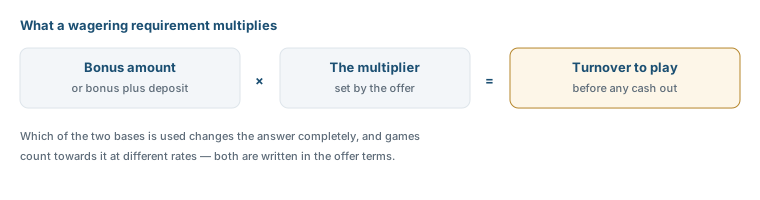
Here is the comparison without a single invented figure. Suppose a promotion credits an amount the terms call B, you paid in an amount D to qualify, and the stated multiplier is N. Under the narrow basis you must record staking of N times B. Under the wide basis you must record staking of N times the sum of B and D. Whenever D is anything other than nothing, the second obligation is strictly the larger, and where a promotion matches your payment closely the wide basis can be close to double the narrow one at the same N.
This is why reading the multiplier without the basis is not a shortcut, it is a mistake. A promotion on a first qualifying payment almost always has a D in it, so the basis question applies to every welcome offer you will ever read.
Where the basis changes the answer completely
One promotion without a payment behind it has no D at all, so the two bases collapse into the same thing. That makes offers of the no-payment kind simpler to assess on this one axis, which is worth remembering when you compare them against funded ones: the mechanics of those are set out on the page about offers that need no deposit.
Where both a credit and a payment exist, the practical test takes seconds. Find the word immediately after the multiplier. If the clause says the multiplier applies to the bonus, the obligation is the narrow one. If it names both the bonus and the deposit, it is the wide one. If the clause does not specify — and some drafting genuinely does not — assume the wide reading and verify with support in writing before you play, because the ambiguity will not be resolved in your favour at the point of withdrawal.
One further variant appears occasionally and deserves a mention: a condition calculated on the winnings rather than on the credit. That one is unusual in that it grows as you succeed, so a good result increases the amount of staking you owe. It shows up most often on promotions paid in rounds rather than balance, which is covered on the page about credited rounds.
Two boxes and one multiplication. Which of the two bases is in use is the term worth finding first, because the multiplier cannot be interpreted without it.
What each round actually contributes
The second thing the terms fix is how much of each stake is credited towards the obligation, and the answer is almost never all of it on every game. A contribution rate is attached to each category of game, and a round's stake is counted at that rate. Stake a round on a full-contribution game and the whole stake counts. Stake the same round on a reduced-contribution game and only part of it counts, so money actually staked and staking recorded diverge immediately.
The categories are consistent across the industry even though the rates are not. Slots usually sit at the top of the scale, which is why they are where almost all promotional play happens and why the page on slots played for money is the natural companion to this one. Table games sit lower. Dealt games in a live studio sit lower still or are excluded outright.
Read the rate table before you choose a game, not after a session. Recorded progress that looks implausibly slow is nearly always a contribution rate doing exactly what it was written to do, and not a counter that has failed. Contribution is a property of the individual title, not of the category, so two games that look alike can count differently; the figure for a title such as Money Cart 3 lives in the offer terms, next to its name.
Line to find
The question it answers
Where it usually sits
The basis
Is the multiplier applied to the bonus, or to the bonus plus the deposit
The sentence containing the multiplier
Contribution rates
How much of each stake is actually recorded
A table or a linked schedule
Maximum stake while open
What a single careless round costs
The general bonus terms, not the offer page
Excluded games and bets
Which rounds count for nothing or void everything
A linked list, often long
The window
Whether the obligation is reachable at all
Near the headline
The five lines that decide a turnover condition
Why dealt tables usually count for least
The ranking of contribution rates is not arbitrary, and knowing why it exists makes it easier to predict on an offer you have not read yet. Rates track how much a skilled or cautious player can reduce the house's margin on a game. On a slot there is nothing to decide: the stake goes in, the outcome is drawn, and the margin is whatever the title is configured at. That predictability is what earns a high rate.
On a table game, decisions matter and a careful player narrows the margin considerably. On a roulette table played for money a player can also cover a large share of the possible outcomes in a single round, turning a large stake into a small expected loss, which would let turnover be manufactured almost for free. Hence low rates, outright exclusion, or a specific ban on opposite-side betting.
Dealt games in a studio attract the same treatment for the same reason, plus a practical one: rounds there are slow, so the operator gains little from promotional play on them. Which is why a dealt table in a live studio so often appears on the excluded list rather than merely a reduced one.
The stake cap, and why breaching it voids everything
For as long as the condition is open there is a maximum permitted stake per round, and it is the single most destructive term in bonus play. It is destructive not because it is harsh but because it is easy to breach without noticing. You adjust a stake upward after a dull run, or you open a game whose default stake sits above the cap, and one round is enough.
The consequence is disproportionate by design. The usual drafting does not disallow the offending round or pause the counter. It voids the promotion, removes the promotional balance, and on the firmer wording removes the winnings derived from it as well. The check runs automatically at the point of conversion, so a breach early in a session can sit undetected until the moment you try to take money out — which is one of the commonest reasons for a payout request being refused.
Two practical defences. First, find the cap before you stake anything and keep every round under it, including rounds funded by your own money, because on most drafting the cap belongs to the account state rather than to the funds. Second, do not use any feature that stakes on your behalf — autoplay at a remembered level, a feature purchase, a doubled stake option — without checking what it actually stakes.
Rounds that count for nothing, and rounds that void
Beyond the stake cap there is a second family of restrictions, and the difference between its two halves is worth keeping straight. Some behaviour merely fails to contribute: the round is allowed, the stake is simply not recorded. Other behaviour breaches the terms: the round is not allowed, and placing it ends the promotion.
Non-contributing behaviour is mostly a matter of game choice — an excluded title, or a bet type within a permitted title that the terms carve out, such as the lowest-margin side of a table. Breaching behaviour is about intent: covering both sides of an even-money proposition so that the outcome is close to certain, running two accounts, using a feature purchase where the terms forbid it, or staking above the cap.
Operators detect the second kind reliably because it leaves an obvious pattern in the bet log. If you think a void was applied wrongly, the operator's internal complaints process is the first step and the independent resolution route is the second; what each of them can realistically do is set out on the page about an operator refusing to pay.
What you did
What the system does
What it costs you
Staked on a reduced-contribution game
Records part of the stake
Slower progress only
Staked on an excluded game
Records nothing
The stake, with no progress
Placed an excluded bet type
Records nothing, or voids on firmer wording
Progress, and possibly the promotion
Staked above the maximum
Voids the promotion at conversion
The credit, and often the winnings from it
Covered both sides of a proposition
Voids, and flags the account
The promotion, and the account's standing
Let the window expire
Removes the credit and closes the offer
Everything that had not yet converted
Two kinds of restriction, with two very different costs
The window, and what happens when it runs out
Every condition has an expiry, and when it passes the unconverted balance is removed rather than frozen for later. The window is normally expressed in days from a stated event, and the event matters as much as the length: crediting, the qualifying payment, the opt-in and the first eligible round are all used as starting points, and they are not the same moment.
Expiry is also the term that makes an otherwise reasonable condition unreachable. A gentle multiplier inside a short window can require more staking per day than you would ever choose to do, and a generous window attached to a harsh multiplier can be perfectly comfortable. The two terms have to be read as a pair, because neither is informative on its own.
The practical test is to divide, and it takes a moment with no numbers from anybody else. Work out the obligation as the product of the basis and the multiplier, divide by the days in the window, and ask whether that daily figure is staking you would do for your own reasons. If the answer is no, the honest conclusion is that the promotion is not for you, and no amount of determination changes the arithmetic.
Where the progress counter lives and why it looks stuck
Any licensed cashier shows progress somewhere — in the promotions area, in the account summary, or as a bar on the bonus itself. Find it before you start, because an unseen counter is the main reason players misjudge where they are and keep playing past the point they intended.
Counters appear stuck for three mundane reasons. The first is contribution rates: you are staking on something recorded at a reduced rate, so the bar is genuinely moving far more slowly than the money is. The second is settlement lag, since rounds are credited towards turnover when they settle rather than when they are placed, and a game with a long feature sequence settles late. The third is that the counter measures recorded staking rather than your balance, so a losing run moves the bar forward while the balance falls — which is correct, and feels wrong.
If the counter has not moved at all across a stretch of eligible play, that is worth raising, and raising early. A counter that is actually broken is a support matter; a counter that is behaving as drafted is not going to be adjusted after the event.
Reading a clause in about a minute
Here is the sequence, and it is deliberately short. Find the multiplier, then read the words immediately after it to establish the basis. Multiply the basis by the multiplier to get the obligation. Open the contribution schedule and note the rate for the game you intend to play, which tells you how much actual staking that obligation represents. Find the maximum stake. Find the window and divide.
At that point you know four things that matter: what completion requires, how much of your own staking it represents, what a careless round costs, and whether the time is sufficient. You have not needed a single figure from anyone else, because every one of them came off the page in front of you.
The fifth thing to check is not in the promotional terms at all. It is whether an open promotion blocks withdrawals across the whole account, which it usually does, and whether a cap applies to what can leave once the promotion closes. Those constraints belong to the cashier rather than the offer, and they are set out under caps on what leaves per payment.
A large win while the condition is still open
This is the scenario worth rehearsing in advance, because it is the one where a misunderstanding is expensive. Suppose the rounds go very well while the obligation is only partly complete. Nothing has become money. The figure on screen is promotional balance, and three separate terms now stand between it and your bank: the remaining turnover, the conversion ceiling if the promotion has one, and the account's ordinary payment limits once it converts.
The ceiling is the one that surprises people most at this moment, because a large result makes it suddenly relevant when it had been irrelevant all session. If the promotion caps conversion, anything above the cap is trimmed when the offer closes, and completing more turnover does not raise it. The win was real, the reels did what they did, and the conversion is the figure the terms set.
Forfeiting is always available and is sometimes the right call, but it has to be weighed against the forfeiture clause rather than assumed to be safe. What becomes of the real-money portion of a balance when a promotion is abandoned varies between operators, and the ordinary exit rules that apply once it is gone are on the page about taking money out.
Offers with no turnover, and what they trade away
Promotions that attach no turnover condition at all do exist, and they are the easiest product in this category to assess because the obligation is zero and the arithmetic is over. What has not been suspended is the economics. The cost reappears elsewhere, usually as a smaller credit, a tighter conversion ceiling, a shorter window, or a restriction to a single game.
That is frequently the better bargain, and it is worth saying so plainly, because a small amount of money with no strings beats a larger credit you will not convert. What it is not is an absence of conditions. Read the ceiling and the eligible game list on a no-turnover promotion with the same attention you would give a multiplier on any other, because on that product they are the only terms doing any work.
Compare the two forms on their realistic outcomes rather than their labels: best achievable result under each, and the amount of play needed to get there. The comparison usually settles itself in under a minute once the obligation is written down.
When the condition is not worth starting
Some promotions are arithmetically unattractive, and the point of the method above is to let you see that in advance rather than halfway through. The two giveaways are an obligation whose daily staking exceeds anything you would do voluntarily, and a conversion ceiling low enough that the best possible outcome would not matter to you. Either one on its own is sufficient reason to decline.
There is a third giveaway that is about the operator rather than the offer: terms drafted so vaguely that the basis cannot be determined from the text. An offer that will not say what its multiplier applies to is telling you something about how a disagreement at the exit is likely to go. The licence behind the operator is at least verifiable in advance, and how to read a register entry is explained on the page about British licences; the register itself is at gamblingcommission.gov.uk.
The last point sits above all the arithmetic. A turnover condition is an instruction to keep staking, which makes it the one promotional term capable of changing how much you play rather than merely how you play. If a condition is the reason the session is continuing, the session has stopped being a choice. Confidential help is free at begambleaware.org and on the National Gambling Helpline, 0808 8020 133.
Questions people ask
Does the multiplier apply to the bonus or to my deposit as well?
Both forms are standard, so the terms have to be read rather than assumed. The clause containing the multiplier names its basis: either the bonus alone, or the bonus added to the qualifying payment. Where the wording does not say, assume the wider reading and get the answer in writing before you stake anything.
Why is my progress moving more slowly than the money I am staking?
Because stakes are recorded at a contribution rate rather than in full. Each category of game has its own rate, and on a reduced-rate game only part of each stake is credited towards the obligation. The counter is accurate; it is measuring something different from your balance.
Which games count fully towards turnover?
Typically slots, which is why promotional play is concentrated there. Table games are recorded at a lower rate because a careful player can narrow the house margin, and dealt games in a live studio are frequently excluded outright. The rates themselves are in a schedule linked from the terms.
What happens if I stake above the maximum by accident?
On most drafting the promotion is voided, the credit is removed, and on firmer wording the winnings derived from it go too. Intent is not part of the test, and the check runs automatically when the offer closes, so a breach early in a session can surface only when you request a payment.
Can I bet on both red and black to clear the requirement faster?
No. Covering both sides of an even-money proposition is the textbook breach and it is explicitly prohibited in essentially every set of bonus terms. It leaves an unmistakable pattern in the bet log, and the usual result is a voided promotion plus a note against the account.
Does the clock start when I claim the offer or when I play?
It depends on the event the terms name, and they are not consistent: crediting, the qualifying payment, the opt-in and the first eligible round are all used. Read the event as carefully as the length, because an offer accepted on a day you do not play may already be losing time.
Can a requirement be reduced or extended if I ask?
Extensions are occasionally granted as a goodwill gesture; reductions essentially never are, because the condition is the commercial basis of the promotion. The reliable lever is the opposite one: you can abandon the offer at any point and return the account to its ordinary state.
What does zero wagering actually mean?
That winnings are paid as money with no turnover attached, which is genuine where it is stated. The cost has moved rather than vanished, usually into a smaller credit, a tighter conversion ceiling, a shorter window or a single eligible game, so those terms deserve the attention the multiplier would otherwise have had.
Is the progress counter in the cashier reliable?
Generally yes, with two quirks that look like faults. Rounds are recorded when they settle rather than when they are placed, so a long feature sequence reports late. And the counter tracks recorded staking rather than your balance, so it advances during a losing run. If it has not moved at all across eligible play, raise it immediately rather than after the session.
My balance was cleared and nobody has told me why. What now?
Ask for the specific term relied on and the bet that triggered it, in writing, through the operator's own complaints process. A licensed operator has to give you that and has to tell you how to escalate to an independent resolution service if the answer does not satisfy you. Keep the bet history and the terms as they stood when you accepted the offer.
 UK Cash DeskOpen the cashier



 100% up to £100 on your first deposit