18+. The welcome offer shown here is the one the partner gives the site owner; availability depends on your country and your eligibility. Bonus size, qualifying deposit, wagering, eligible games, maximum bet, expiry and withdrawal limits are set out in the operator’s own terms and are not repeated here. We do not promise payout times. Offshore operator, not licensed by the Gambling Commission of Great Britain. Gambling involves financial risk — free confidential help at begambleaware.org, 0808 8020 133.
Short answerA card payment is a request that travels through four hands: yours, the cash desk's bank, the card scheme, and the bank that issued your card. Money is set aside before it is taken, which is why a statement can show an amount that has not actually left, and a payout is aimed back at the original request rather than at a number you type in again.
Our top pick
22BET — 100% up to £100 on your first deposit
Regulator
Gambling Commission of Great Britain
Credit cards
Banned for gambling since April 2019
Minimum age
18
Tax on winnings
None for the player
Self-exclusion
GAMSTOP, free and nationwide
Four parties, and only one of them is you
Typing a card number feels like handing money over. It is not. It is starting a conversation between four organisations, three of which you will never deal with directly, and the outcome depends on all four agreeing. Most of the frustration on this rail comes from assuming there are two parties in the exchange, you and the cash desk, and then being unable to explain the behaviour that follows.
The four are these. You, who initiates and confirms. The cash desk's own bank, which collects on its behalf and is called the acquirer. The card scheme, which routes the request and sets the rulebook everyone follows. And the bank that issued your card, which holds your money and gives the only answer that matters.
Each one can stop a payment, for its own reasons, without telling the others why. Learn which is which and a refusal stops being a mystery, because the symptoms differ. The place of this rail among the others is set out on the hub for payment routes; this page stays inside the card chain.
Party
What it does
What it can refuse
You
Enter the card and confirm the payment
Nothing, but abandoning the step ends it
The acquirer
Collects for the cash desk
A card programme, a country, a risk pattern
The card scheme
Routes the request, sets the rules
A transaction that breaks a scheme rule
Your issuer
Holds your money and answers
Balance, category, authentication, your own settings
The four parties and what each one can refuse
The acquirer: the party whose name you never see
The cash desk does not touch the card scheme itself. It has a bank of its own that does, and that bank takes on the risk of the merchant it has signed. Which means the acquirer has opinions about more than this one payment: it has a view on the merchant's business, on the countries it is willing to accept cards from, and on which card issuing programmes have given it trouble before.
So the first refusal in the chain can happen before your bank is ever asked. The request is assembled, the acquirer's own risk rules look at it, and it is stopped there. From your side this appears as an instant failure, with no authentication step and nothing at all recorded in your banking app.
This is the single most useful diagnostic on the rail. No entry in your app, not even a declined one, means your bank never saw the request. There is nothing to fix at your end, and the only practical moves are a different card from a different issuer or a different rail entirely.
What actually travels in the request
The request is small and specific. It carries the card number, the expiry, the amount and currency, the merchant's identifier and the classification code describing its line of business. It carries data about the environment the payment was made in, because a card used on the web is riskier than one presented in a shop. It does not carry your name as proof of anything, and it does not carry a note explaining what the money is for.
The classification code is the part worth dwelling on, because it is what lets a bank treat gambling differently from groceries without reading merchant names. It travels with every request, it was assigned by the acquirer when the merchant was taken on, and it is the hook that a bank gambling control catches.
What is absent is just as important. The request does not say which game you intend to play, whether a bonus is attached, or whether this is your first deposit. Those are the cash desk's business and they never reach your bank, which is why your bank's decision is coarse and your bank's explanation, when you get one, sounds oddly disconnected from what you were doing.
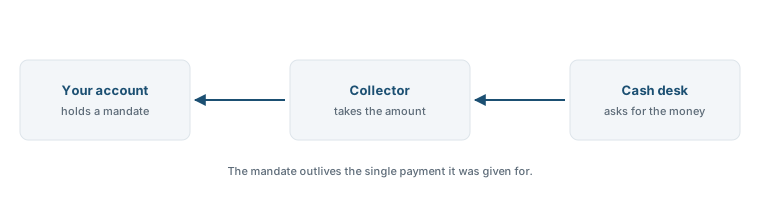
The desk asks; it never reaches your money directly. Every refusal happens somewhere along that arrow.
Authorised is not taken: why money is held
When your issuer says yes, it has not paid anybody. It has reserved the amount against your available balance and promised to honour a later request for it. Your spendable balance drops, the amount appears as pending, and your actual balance is untouched. This is an authorisation, and it is the normal first half of every card payment in existence.
Two consequences follow immediately. A pending amount can disappear without ever becoming a payment, if the reservation expires unused, and the period it survives for is set by your issuer rather than by the merchant. And a failed deposit can still show a pending amount, because the authorisation succeeded and something after it did not.
That second case accounts for a great many complaints that begin with the money has gone. It has not gone. It is reserved, nobody has it, and it will either be claimed or released. The difference is invisible on most statements, which is exactly why the next step matters.
Capture, and the gap that muddles statements
Capture is the merchant's later instruction to actually take what was reserved. For a cash desk it usually follows the authorisation quickly, because the balance has already been credited and the business wants the money settled. But quickly is not the same as instantly, and the gap between the two steps is where statements and reality drift apart.
Inside that gap, three true statements can coexist: your available balance has fallen, no money has left your account, and your gambling balance has already been credited. None of them contradicts the others. Read a statement in the gap and you will conclude something has gone wrong when nothing has.
The gap also explains a quirk on the way back. A payout requested while the deposit is still only authorised can produce two entries that look like they cancel out and do not, because a credit arriving on a card and a reservation being released are different events with different timings. The order in which a request is handled is set out under how a payout is processed.
The extra authentication step and what it is for
Somewhere in the sequence your bank will usually want to know that the person typing the number is the person who owns it. That is the step where the page pauses, hands you to your bank, and asks you to approve the payment in an app or with a code. It is a scheme-level mechanism, not an invention of the cash desk, and the gambling category is one where banks apply it most consistently.
It does something specific beyond being a nuisance. When a payment is authenticated this way, responsibility for a fraudulent transaction moves from the merchant to the issuer, which is why merchants are happy to insist on it and why skipping it is not on offer. If you have ever wondered why one site asks and another appears not to, the answer is that the second one asked and your bank decided it already had enough evidence.
The common failure here is yours, and it is easy to make. Leaving the page, losing the app, switching to a message to copy a code and not coming back: any of these abandons the step. The authorisation may have been placed already, so you are left with a hold and no deposit, which is the commonest route into a deposit that has not arrived.
Five places a card deposit stops, in order
Taking them in sequence is what makes a refusal diagnosable, because each one leaves a different trace. First, the cash desk itself: the rail is not offered, or the amount is under the floor for that method. Nothing has been sent anywhere, and the smallest amount a desk will accept is set per rail rather than per site, as described under deposit floors.
Second, the acquirer, which stops the request before your bank sees it. Third, the authentication step, where you and your bank were talking and the conversation ended without a conclusion. Fourth, your issuer, which answered no for a reason recorded in your banking app. Fifth, and least intuitive, the return journey: everyone said yes and the confirmation never got back to the cashier, leaving a credited card payment and an uncredited gambling balance.
Only the fifth one needs support. The others are either yours to change or nobody's. And in all five cases a second attempt before you know which one you are in makes things worse rather than better.
Where it stopped
What you see
What changes it
At the cash desk
A message before any card screen
A different amount or a different rail
At the acquirer
Instant failure, nothing in your app
A card from another issuer, or another rail
At the authentication step
A hold in your app, no deposit
Completing the step without leaving the page
At your issuer
A declined entry with a reason
Only the cause named in that reason
On the way back
Card charged, balance not credited
Support, with reference, amount and time
Five halting points and the trace each one leaves
Telling the issuer's no from everybody else's
The test takes one look and it is always the same look: open your banking app before you do anything else. A declined entry with a stated reason means your issuer answered, and that reason is the authoritative account of the payment. No cashier, no support agent and no retry will change it until the named cause changes.
A pending or held amount with no declined entry means the authorisation succeeded. Something after it failed, and the money is reserved rather than spent. An empty log, with neither of those, means the request never reached your bank at all.
Notice what is not on that list: the message on the cashier screen. Those messages are built from coarse codes that deliberately do not expose why a bank refused, because a merchant has no business being told about your balance or your settings. A cashier showing you something unhelpful is reporting the whole of what it received, and the patterns of refusal on the way out are a separate subject on the page about refused payouts.
Debit only, and why that is not the site being awkward
In Great Britain a gambling payment cannot be funded from credit. That rule removed credit cards from this rail entirely, and it was drafted to follow the source of the money rather than the plastic at the checkout, so sliding a credit card behind a wallet or a device payment does not revive it. The reasoning and the edges are on the page about the credit card ban.
Practically, this means a cashier will often refuse a card before any payment is attempted, having read the card's leading digits and identified the programme. That is a check at the cash desk, not a refusal from your bank, and it is the one case where the cashier genuinely knows exactly why and can say so.
Two edge cases catch people out. A prepaid card is not credit, so it is sometimes accepted and sometimes refused for separate reasons about traceability. And an overdraft is borrowing inside a current account, so a debit card dipping into one is still a debit payment in rule terms, whatever it is in substance.
When a bank treats the payment as cash-like
Some issuers classify gambling payments as closer to withdrawing cash than to buying something, on the grounds that the money becomes a balance you can spend rather than a product you received. That classification is internal to the bank and invisible in the cashier, and it has real effects.
It can change the authentication the bank insists on, how quickly the payment is treated as settled, and in some cases whether a charge applies, since the rules on fees differ between purchases and cash-like transactions. None of those effects can be quoted here honestly, because they are set per issuer and change; your own bank's tariff and terms are the only place the current answer lives.
What you can take from it is a habit. Before using a new card for this purpose, read the gambling section of your own bank's terms once. It takes a minute, it is the only authoritative source, and it answers questions that no cash desk and no guide can answer for you. Accounts built to be read in an app make this easier, which is part of the appeal of app-based accounts.
The payout: aimed at the original request
A card payout is not a transfer to a card. It is a refund mechanism aimed at a transaction that already exists, routed by the scheme using the reference it kept when the deposit was made. This is why you are not asked to re-enter a card number for a withdrawal, and why the payout reaches you even if the plastic has since been replaced.
It also sets the shape of the wait. The cash desk's part is a review and a release; the scheme's part is the delivery, and those are two different clocks. A payout released and then described as being with your bank is a true statement about a stage you cannot influence, and the general shape of the whole sequence is on how long a payout takes.
One asymmetry is worth knowing in advance. A credit arriving on a card often surfaces later than a debit does, because the posting rules differ. So the same rail can feel fast on the way in and slow on the way out without anybody having changed anything.
Why it has to be the same card
The closed loop is not a policy an operator chose. It falls out of the mechanism: the refund follows the original transaction, and there is only one card attached to that. Even where a desk could theoretically pay elsewhere, it has a strong reason not to, because paying the same instrument is how it demonstrates the money went back to the person it came from.
Which makes your deposit a decision about your payout, taken before payouts are on your mind. Fund from the card you want to be paid on. If several cards have funded an account, expect a payout to be split back across them in proportion, which is normal and often surprises people.
When the original card genuinely cannot receive money, because the account is closed or the programme does not support refunds, the desk has to use a second rail. That means registering it, proving it belongs to you, and waiting for the check; what gets asked for is on the page about identity checks. The replacement is always slower than the card would have been.
A card that keeps failing: what is worth trying
Work from the trace rather than from hope. If your app shows a declined entry, address the reason it names and nothing else. If it shows a hold, wait for the reservation to clear rather than attempting again, because a second attempt against a held balance can fail for a reason that has nothing to do with the first. If it shows nothing, your bank was never asked, and nothing you adjust in your own settings will help.
In that last case there are two honest options. Another card from a different issuer, since the refusal was about the programme rather than about you. Or another rail: a push from your account avoids the acquirer's view of card programmes entirely, and a card presented through a device wallet or its Android equivalent sometimes passes where the raw number did not, because the substitute number and the authentication change the risk picture.
And one option that is not an option. If the refusal is your own gambling control doing its job, the rail is not the thing to change. That setting exists because you put it there, and the correct response to meeting it is to stop rather than to route around it.
Questions people ask
Why has money left my available balance when the deposit failed?
Because the authorisation succeeded even though a later stage did not. Your issuer reserved the amount and nobody has claimed it, so it will either be captured or released after the period your issuer allows. It is not a payment yet, and paying again while it sits there usually reserves a second amount.
Can a casino charge my card without my confirming it?
Not for a deposit you did not start. What can happen is that a stored card is charged again by a process you set up yourself, so it is worth checking whether anything was saved for repeat use. If an amount appears that you cannot account for at all, the entry in your banking app is where the merchant identifier lives and that is what support on both sides will need.
My bank declined it but says there is nothing wrong with my account.
Then the refusal most likely came from before your bank, at the cash desk's own acquirer, which decides what it will accept and never explains itself. The test is whether your banking app recorded anything at all: an empty log means your bank genuinely was not asked and is telling you the truth.
Does the cash desk see my card number?
The cashier handles it long enough to build the request, and a desk that offers to save the card for next time is storing a token rather than the digits in most modern setups. If you would rather it held nothing at all, a wallet or a one-off virtual number keeps the real card out of its records entirely.
Why does a withdrawal go back to the card I deposited with?
Because the payout is routed along the original transaction rather than to a number you supply, and that transaction has exactly one card attached. It is also how the operator shows the money returned to the same person. Where several cards funded the account, the payout is usually split back across them.
What happens if that card has expired or been replaced?
The scheme normally follows the replacement, because the refund is tied to the account behind the card rather than to the printed digits. If the account itself has closed, no refund can land and the desk has to pay by another rail, which means registering and verifying it first and waiting longer than the card would have taken.
Will using a card cost me a fee?
That depends on your own issuer and on whether it treats gambling as a purchase or as something cash-like, and the two are charged under different rules. Your bank's own tariff is the only current source, and it is worth reading once before the first deposit rather than after a surprise.
Is a prepaid card the same thing as a debit card here?
Not quite. It is not credit, so the credit rule does not exclude it, but it is often refused for a separate reason: a card not tied to a named bank account is harder to trace and harder to pay a withdrawal back to. Where one is accepted, check whether it can receive a refund before relying on it.
Do I pay tax on winnings paid back to my card?
No. A player in the United Kingdom pays no tax on gambling winnings, and a credit arriving on a card is a record of money moving rather than income to declare. The duty in this market is charged to the operator instead.
I am on the self-exclusion register and my card still works.
That is expected. The register operates at the gambling business rather than at your bank, so licensed sites refuse the account itself while your card carries on working everywhere else. Adding your bank's own gambling control covers a different route rather than the same one again. The National Gambling Helpline is on 0808 8020 133.
 UK Cash DeskOpen the cashier


 100% up to £100 on your first deposit