18+. The welcome offer shown here is the one the partner gives the site owner; availability depends on your country and your eligibility. Bonus size, qualifying deposit, wagering, eligible games, maximum bet, expiry and withdrawal limits are set out in the operator’s own terms and are not repeated here. We do not promise payout times. Offshore operator, not licensed by the Gambling Commission of Great Britain. Gambling involves financial risk — free confidential help at begambleaware.org, 0808 8020 133.
Short answerA prepaid voucher is money you set aside before you sat down, and when it is gone the session ends without anyone having to decide to stop. That hard ceiling is the point of the instrument, not a drawback of it.
Our top pick
22BET — 100% up to £100 on your first deposit
Regulator
Gambling Commission of Great Britain
Credit cards
Banned for gambling since April 2019
Minimum age
18
Tax on winnings
None for the player
Self-exclusion
GAMSTOP, free and nationwide
A voucher is money you set aside before you played
Buying a prepaid voucher separates two decisions that every other rail glues together: how much you are willing to spend, and when you are going to spend it. You make the first decision at a till, sober and unhurried, and you cannot revisit it later from the cash desk.
That is unusual. Nearly every route into a gambling cash desk leaves a funding source attached to your account, which means the amount is always decided at the moment you feel like deciding it. A voucher removes the source entirely and leaves only a quantity.
The rest of this page follows from that single structural difference, including the parts that are inconvenient. An instrument designed to be finite is not going to be good at bringing money back.
It is also worth being clear that nothing about a voucher makes a gambling account anonymous, cheaper or more likely to pay out. The only property it genuinely has is a boundary on the amount, and reading it as anything grander will lead you to use it for jobs it cannot do.
The ceiling that empties itself
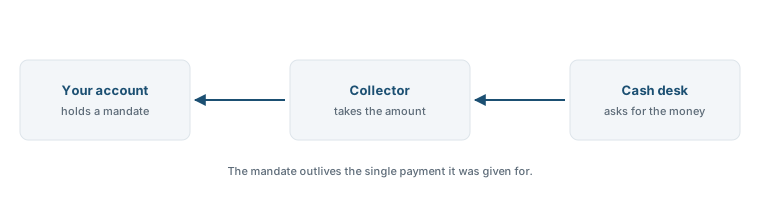
Most spending controls depend on somebody enforcing them. A limit in a cash desk has to be respected by the cash desk. A bank block has to be left switched on. A voucher needs nothing: the value simply stops existing, and no appeal, raised limit or late change of mind brings it back.
This is the only control on the whole list that cannot be lifted in the moment. You cannot top a voucher up from a card, you cannot borrow against it, and the cash desk cannot extend you anything on the strength of it. When the balance reaches nothing, the decision has already been made by an earlier version of you.
Compare it with a limit held inside your gambling account, which is a strong tool but lives with the party you are playing against, and with a block placed at your bank, which is stronger still but covers only what passes through the bank. The voucher is weaker in scope and harder in nature.
The value is bought first and consumed once: nothing refills it from behind.
Where you buy one and what you are actually holding
Vouchers are sold over the counter in newsagents, petrol stations and supermarkets, and online through resellers. In a shop you pay cash or use a debit card, and you walk out with a printed slip or a receipt carrying a code.
What you hold is not an account. There is no login that owns the value, no statement and no customer file with your name on it. The code itself represents the money, in the same way a banknote does, and it behaves accordingly if you lose it.
Keep the slip until the value is spent. If a deposit fails halfway, the code is the only evidence that the value existed, and support at a cash desk cannot look up something that was never tied to your identity in the first place.
Buying in a shop and buying online are not quite equivalent, either. At a counter you hand over money and leave with the code, and the transaction is finished. Online you are giving a reseller a payment instrument, so the privacy of the voucher now depends on a company you chose in a hurry, and the trail starts with your card after all.
The code is the money
This is the sentence to take away. A prepaid voucher is a bearer instrument: entitlement follows whoever can produce the code, not whoever bought it. There is no name attached, so there is nothing for anybody to check against.
It follows that a code shared is a code spent. A photograph in a chat, a code read out over the phone, a slip left on a counter, all amount to handing over the value. Nobody involved has a mechanism for deciding that a particular spender was the wrong one.
It also follows that recovery is effectively impossible once it has been used. There is no issuing bank to ask for a reversal and no cardholder protection to invoke, because no card and no account took part. A debit card is a far better instrument when you want recourse, which is one of the quieter arguments for keeping deposits on a card you hold.
Why nobody should ever see your code, including people who sound official
Because the code is bearer value, it is the favourite instrument of anyone asking strangers for money that cannot be traced or reversed. The pattern is consistent: somebody with a plausible reason asks you to buy a voucher and read the code to them.
No legitimate business, gambling site, bank, tax office, utility or courier will ever ask for a prepaid voucher code. Not for a fee, not to release a payout, not to verify an account, not as a deposit against anything. A request for a code is, without exception, a request to hand over cash to someone you cannot identify.
The rule worth holding is simple. A voucher code goes into one box only, the deposit field of a cash desk you have opened yourself by typing its address. It never goes into a chat window, an email, a phone call or a page you reached by clicking a link somebody sent you.
What the cash desk learns about you
Almost nothing from the payment itself. A voucher deposit tells the site that a code of a given value was valid and has been consumed. It carries no bank details, no card number and no name, so none of that enters the gambling business.
That changes what the site has to ask for elsewhere. A licensed British operator still has to know who holds the account, and with no instrument in your name to lean on, the identity check before a payout is done entirely on documents you supply. Nothing about the anonymity of the deposit carries through to the account.
Expect that work to land when you first ask for money rather than when you first play. Doing it in the opposite order is the single easiest way to shorten the gap between winning and being paid.
People sometimes read the privacy of the deposit as a sign that fewer questions will be asked later. The opposite is closer to the truth: a site with no instrument of yours on file has more to establish, not less, and it will establish it at the point where you are keenest to move quickly.
A voucher against a card, side by side
The two instruments differ in what they tell the site, in what they let you reverse and in which direction they run. Setting them out together makes it clear why most people end up using both: one to come in, one to go out.
Read the last row first if you are deciding today, because it is the only one that describes a purpose rather than a property.
The row about recourse deserves a second look as well. Dispute rights are the thing people miss most when they move away from cards, and they only notice the absence at the worst possible moment, which is after a payment has gone somewhere it should not have gone.
Question
Prepaid voucher
Debit card
Who the instrument is registered to
Nobody, unless you open a separate account
You, with name and address held by your bank
Can the amount grow during a session
No, the value is fixed when you buy it
Yes, up to whatever your bank allows
Does it carry money back out
No
Yes, usually to the same card
Is there any recourse after a payment
None, the value is gone
Your bank has a dispute process
What the gambling site receives
A valid code and a value
A card number, a name and an issuing bank
Useful for
Capping what a session can cost
Taking winnings out and proving who you are
Prepaid voucher and debit card compared on what matters at the cash desk
Combining vouchers inside one session
Because each voucher carries a fixed value, a session funded this way often involves more than one code. Cash desks generally accept them one after another, each as a separate deposit.
That habit erodes the whole advantage. The point of the instrument was that the ceiling was decided in advance; feeding in a second and third code moves the decision back to the moment of play, which is exactly what the voucher was supposed to prevent.
Neosurf is the other prepaid voucher British players actually look for, and it works on the same principle. You buy a fixed value in a shop or online, you receive a code, and you spend it once. There is no balance behind it and no route back.
The practical differences are about distribution rather than mechanics: which shops stock it, which cash desks accept it and which denominations are on the rack. Everything written above about bearer value, privacy and the absence of recourse applies to it word for word.
Which one you can use is decided by the site rather than by you. If a cash desk lists one and not the other, that is the end of the matter, and the choice is not worth moving site over.
British interest in these vouchers is real but narrow, and it clusters around people who want a fixed amount and no card on file. If that is not your reason for looking at them, there is probably a simpler instrument that does what you actually want with less friction attached.
Getting money out when you came in on a voucher
You cannot be paid to a voucher. A voucher is consumed value with no account behind it, so there is nothing for a payout to arrive in, and no site offers it as a destination however you came in.
So a second instrument is needed, and it has to be in your name. In practice that means a transfer to your own bank account or a debit card, added to the account and checked before anything moves. None of that is a penalty for using a voucher; it is simply the first time the site has had to find out who you are.
The common failure is leaving all of it until the moment you have won. A payout request against an account with no verified route out is the classic cause of a withdrawal being refused, and the refusal is usually about paperwork rather than about the money.
The account that turns a voucher into something two way
Prepaid voucher brands do offer registered accounts, and that changes the picture. With an account the value is held somewhere with your name on it, which makes a return payment at least conceivable.
Two cautions. The first is that having such an account does not oblige a cash desk to pay out to it; the site has to support that destination, and many do not. The second is that opening it undoes the privacy that drew you to vouchers in the first place, since you now have a registered financial account with identity documents attached.
If you want a two way rail, it is usually cleaner to use one designed for the job. The routes money takes coming back out are short in number and a bank account is on all of them.
Leftovers, part spent codes and the remainder
A partly spent code keeps its remaining value, and that remainder is where vouchers quietly leak. A small amount left over is too awkward to use, too small to care about and perfectly capable of expiring while you ignore it.
Expiry and any charge on a dormant balance are set by the voucher provider and stated in its own terms, which is where you should read them rather than taking a figure from anybody else. The one reliable habit is to spend a code down to nothing in the session you bought it for.
Keep the slip until then. A remainder you cannot prove is a remainder you do not have, because there is no account holding it on your behalf.
There is a tidier habit available if the leftovers irritate you: buy a value you intend to spend in full and stop, rather than a round figure chosen for convenience at the till. The denominations on the rack were designed for topping up phones and buying games, not for whatever you had in mind this evening.
When a voucher is the right tool, and when it is in the way
It is the right tool when the amount is the thing you want to control, when you would rather no gambling business ever held a card number of yours, and when you have already arranged how winnings would leave. Used that way it does something no other rail does.
It is in the way when you are playing for amounts worth withdrawing, because you will end up building the exit anyway and the voucher adds a step. It is also the wrong instrument if you want recourse: there is none, by design.
One more thing worth knowing before you buy. Paying for gambling with a credit card is prohibited in Great Britain, and the rule reaches past the final payment to the site, so buying a voucher on credit in order to gamble with it is not a way around anything. The background is set out under why credit cards are barred from gambling. Whether the site you intend to use is licensed at all is a matter of public record on the register of licensed operators, and if what draws you to vouchers is the wish to make spending harder to see, free and confidential help is available from the national advice service on 0808 8020 133.
Questions people ask
Can I withdraw winnings to a prepaid voucher?
No. The voucher is consumed when it is used and has no account behind it to receive a payment. You will need a bank account or a debit card in your own name, added and verified before the payout is processed.
Someone has asked me to buy a voucher and send them the code. Is that normal?
It is never normal. No bank, gambling site, government office or company will ask for a voucher code, because the code is cash in a form that cannot be traced or reversed. Treat every such request as an attempt to take money from you.
What happens if I lose the slip with the code on it?
Almost certainly the value is lost with it. There is no account tied to your identity, so nothing can be reissued and nobody can confirm the code belonged to you. Photograph or save the code somewhere private as soon as you buy it.
Is a voucher better than a card for controlling what I spend?
It is better in one specific way: the value is fixed when you buy it and cannot be raised in the moment. It is worse in every other way, since it carries no recourse and nothing comes back out along it.
How is Neosurf different?
In mechanics, hardly at all. It is another prepaid voucher bought as a fixed value and spent once, and the differences are about which shops sell it and which cash desks accept it. The privacy and the absence of recourse are identical.
Can I buy a voucher with a credit card and use it for gambling?
No. The prohibition on gambling with credit cards in Great Britain covers the route, not just the last step, so funding gambling by buying a voucher on credit is not permitted. A debit card or cash is the ordinary way to pay at the counter.
Does a voucher deposit mean I can stay anonymous at the site?
Only the payment is anonymous. The gambling account is not: a licensed operator must establish who holds it, and with no instrument in your name on file, the whole identity check falls on documents you provide.
What happens to a small leftover balance?
It stays on the code and can be used again at a site that accepts it. Whether it expires, and whether any charge applies to a dormant balance, is set out in the voucher provider own terms, which is the only place to check.
Will a voucher deposit arrive instantly?
The code is validated while you wait, so crediting is normally immediate. If the value is consumed and your playing balance does not move, that is a crediting fault at the site rather than a problem with the voucher, and the code is your evidence.
 UK Cash DeskOpen the cashier

 100% up to £100 on your first deposit