18+. The welcome offer shown here is the one the partner gives the site owner; availability depends on your country and your eligibility. Bonus size, qualifying deposit, wagering, eligible games, maximum bet, expiry and withdrawal limits are set out in the operator’s own terms and are not repeated here. We do not promise payout times. Offshore operator, not licensed by the Gambling Commission of Great Britain. Gambling involves financial risk — free confidential help at begambleaware.org, 0808 8020 133.
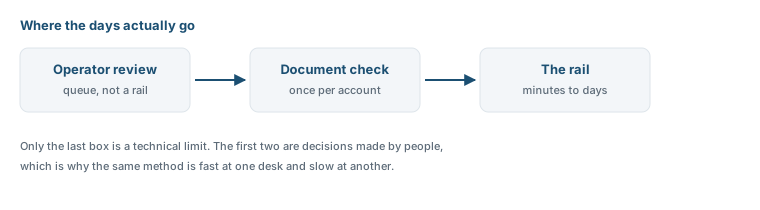
Short answerA payout is not one wait but three: a queue at the operator, a document check that happens once, and the rail that carries the money. Only the rail is a technical limit; the other two are decisions taken by people.
Our top pick
22BET — 100% up to £100 on your first deposit
Regulator
Gambling Commission of Great Britain
Credit cards
Banned for gambling since April 2019
Minimum age
18
Tax on winnings
None for the player
Self-exclusion
GAMSTOP, free and nationwide
The withdraw button writes a request, not a payment
Pressing withdraw sends money nowhere. It writes a line into the operator's own ledger, takes the amount out of the balance you are able to stake with, and parks it in a queue. No bank knows anything about it yet. The card scheme has not been contacted, no payment file has been built, and the figure that looks as though it has left is still sitting inside the operator's system.
That is the most useful single fact about payouts, because it explains why two people using the same debit card at two different desks wait very different lengths of time. The card is identical. What differs is how long the request sits untouched in the queue, and whether the documents behind the account have already been accepted. Neither of those is a property of the payment network.
It also explains why a request can be undone. While the amount is still a line in the operator's ledger it can be pushed back onto your playable balance, either by you or by the desk. Once the instruction has gone out to the rail there is no such button, and the pending state is exactly where that line falls.
Three separate waits, running one after another
Setting the legs out separately makes the arithmetic honest. First comes review: a human being, or a rule written by one, releases the request. Second, if this is your first payout or something about the account has changed, documents are looked at. Third, the money travels along a rail, and that leg has a length set by the rail itself and by the hours the rail keeps.
Only the third leg is a technical limit. The first two are queue positions, and a queue is a staffing choice. A desk that approves payouts through the night behaves differently from one that works through a batch each morning, even though both are using the same banking plumbing underneath. When somebody says a site pays quickly, this is almost always what they have measured.
Reading your own case means asking which leg you are stuck in. If the status has not changed, you are in the first. If you have been asked for a photograph of a document, you are in the second. If the desk has told you the payment has been sent and your statement disagrees, you are in the third, and that is the only one where your bank can tell you anything useful.
Leg
Who decides
Where you see it
Request accepted
The desk's own cashier software
Your cashier history, with a holding status against the amount
Review
The payments team at the operator
Nothing visibly moves; the status wording stays as it was
Document check
The compliance team, once per account
A request for files, in the account or by email
Instruction sent
The operator, to its payment provider
A status such as processed, sent or transferred
Settlement
Your bank, the card scheme or the wallet
Your own statement or banking app, not the casino page
Each leg of a payout and who owns it
The rail is the only leg with a fixed length. The two before it are queues.
Why a queue exists at all
A regulated operator is required to know who it is paying and to be able to show why it released a payment. That duty is easy to satisfy in bulk and awkward to satisfy one request at a time, so most desks batch the work: requests pile up, somebody runs through them, the cleared ones go out together. The size of the pile and the number of people working it are commercial decisions, and they move with the calendar.
This is also where bonus money is untangled. If any part of the balance came from an offer with play-through attached, the desk has to work out which pounds are yours outright and which are still conditional. That calculation is a term of the offer rather than a payment rule, but it happens in the same queue, and an unfinished condition keeps the whole request waiting.
Nothing in the queue is visible from the outside, which is what makes it so frustrating. The request looks frozen because, from your side, it is. The only honest statement a desk can make about this leg is a target, and a target is a promise about staffing, not a technical fact.
The document check is a one-off you can get out of the way
Identity and address are confirmed once, and then stay confirmed unless something changes. The checks exist because a British licence obliges the desk to establish that you are old enough to gamble, that you are who you say you are, and that the money is going to an account you control. Age is the one hard figure on the subject: nobody under eighteen may hold a gambling account, and no amount of correspondence gets around it.
Where people lose days is in the order they do things. Nothing stops you uploading documents on the day you register, long before any winnings exist, and a desk that asks early is doing you a favour. Where the check is still outstanding when the first payout lands in the queue, the two waits run in series rather than side by side, and that is precisely the delay most complaints describe. The same logic runs through everything that gets sold as a fast payout.
Documents can also be accepted for your person but not yet for a payment method. Adding a new card or a new account after years of using an old one starts a small, separate check on that method alone.
What the rail adds, and what it cannot be blamed for
Once the instruction leaves the operator, the duration stops being negotiable. Card payouts travel back through the scheme that carried the deposit and land as a credit on the card; bank payments move on the schemes British banks use between themselves; wallet payments land in the wallet first and then need a second, separate move from you to get into your bank. Each of those has its own rhythm and its own hours, and the differences between rails are worth reading on their own.
Two things are routinely blamed on the rail and are not its fault. The first is a request that has not been approved yet, which has not touched the rail at all. The second is the rail's business day: a payment instructed outside banking hours queues until the next window, which looks like silence but is simply a clock. Neither of these can be fixed by sending the request again.
A third point is worth keeping in mind for payouts that go back onto a debit card: the credit appears when your card issuer posts it, not when the operator sends it, and those two moments are rarely the same.
Money leaves by the road it arrived on
The closed-loop rule is the one principle that surprises people most, and it is close to universal at licensed desks. Funds are returned to the instrument that paid them in: the card that was charged, the wallet that was debited, the account that sent the transfer. You will sometimes see it described as a payment policy; in substance it is a money-laundering control, because it makes the cash desk a dead end rather than a route for moving money between strangers.
In practice that means your choice of deposit method is also a choice of payout method, made before you have won anything. It is the reason a deposit route that feels effortless can turn into the slow part later. Anyone weighing up which route to put money in through is really choosing both directions at once.
Partial returns follow the same road. Where a balance was built from several deposits on several instruments, a desk will often split the payout to mirror them, which produces more than one credit and more than one clock. That is normal, and it is not the same thing as a payment being refused.
When the method you paid with cannot receive
Several popular deposit routes are one-directional. A charge to a phone bill can be collected but not reversed as a payout, because the billing relationship runs between you and a network, not between you and a casino; the same is true of a voucher bought with cash in a shop. For anyone who used a mobile account to top up a balance, the return journey has to happen somewhere else.
What desks do in that case is fall back to a bank transfer in your own name, and they will ask for proof that the account is yours. That fallback is why a payout to a bank account turns up as an option even for players who have never used it in the other direction. Expect the method check described above to run on that account before the first payment goes out on it.
Two British rules interact with this. Credit cards may not be used to gamble at all, so no payout is ever a credit-card credit. And where a route is tied to a device rather than an account, as with phone-based wallets, the payout generally goes to the underlying card or bank rather than the wallet itself.
Ceilings sit above all of it
Separately from timing, a desk decides how much it will release at once and over a period. A single large win can therefore be paid in instalments on a schedule the operator sets, which stretches the total wait without any individual payment being slow. The size of those steps varies widely between operators and is published in the cashier terms rather than fixed by any rule, so the ceilings on a payout are worth checking before you need them, not after.
There are also figures that get quoted as a measure of a site and mean something quite different. A published share of stakes returned to players describes the long-run behaviour of games, not how reliably the cashier sends money, and the two are often confused. If you want to know what that kind of number can and cannot tell you, the arithmetic behind published return figures is a separate subject.
Deposit-side ceilings are different again: they are a protective tool you can set on yourself, and lowering one has no effect on the pace of a payout.
Reading the status words without guessing
Cashier wording is not standardised, and desks use the same labels for different states. What matters is which side of the hand-off you are on. Anything along the lines of requested, pending or in review means the money is still in the operator's ledger. Anything along the lines of approved, processed or sent means an instruction has gone out and the question has moved to your bank. The jump between those two families is the only status change that actually tells you something.
Where the second family appears and nothing arrives, the useful question is not when but which: which rail, which reference, which exact amount, and in which time zone the instruction was stamped. Support can answer all four, and with them your bank can trace a credit that has not posted. Without them, both sides are describing a feeling.
This is also the point at which a stalled payout stops being an ordinary wait. A request that has gone quiet after approval behaves very differently from one that was refused outright and pushed back to the balance, and the two need different handling.
What to do when the money genuinely does not come
Escalation works in a fixed order, and skipping steps costs time. Ask the desk in writing for the rail reference and the timestamp. Give the rail its own business window to settle. Then put a formal complaint to the operator, which a licensed British operator must have a written procedure for, and which must tell you where to go next. That next step is an independent adjudicator the operator is obliged to be signed up to.
Behind the adjudicator stands the regulator. You can confirm that a desk really holds a licence, and see what conditions sit on it, on the public register at gamblingcommission.gov.uk, and the register is the fastest way to tell a regulated operator from a site that merely looks like one. Reading the conditions attached to a licence takes a minute and changes what you are able to demand.
Where a desk has stopped answering altogether, the pattern is different from a slow queue and worth recognising early; a refusal to pay at all follows its own script.
What lands in your account, and what the taxman wants
For a player in the United Kingdom, gambling winnings are not taxable income. There is nothing to declare and no deduction to expect, which means the figure that leaves the cash desk should be the figure that reaches you. Where an amount arrives short, the cause is a charge somewhere on the route rather than tax, and the tax position for a British player is simple enough to be worth knowing once.
Charges, where they exist at all, are set by the operator or by the provider of the method, and they are disclosed in the cashier before you confirm. This site does not quote figures for them, because any number would be out of date the week it was written and wrong for most readers anyway. The place to read them is the confirmation screen at the moment you press the button.
Currency is the other reason an amount can change on the way. A payout to an account held in another currency is converted by whoever does the conversion, on their terms, and that is not something the casino controls.
A short list worth running before you press withdraw
None of this needs to be remembered in the moment. It fits into a handful of checks you can run once per account and then forget.
Clear your documents early, in quiet time, rather than on the day there is money waiting.
Know which instrument the desk considers your deposit route, because that is where the money will try to go back.
If that route cannot receive, have a bank account in your own name ready to prove.
Finish or abandon any bonus condition before requesting, so the queue has nothing to untangle.
Read the cashier's own ceilings so a staged payment does not come as a surprise.
Write down the reference and the timestamp the moment a status says sent.
Gambling costs money and is not a way of making it. Free and confidential support is available from begambleaware.org and the National Gambling Helpline on 0808 8020 133, and your bank can switch on a block on gambling payments if you would rather the cash desk could not reach you at all.
Why the same method behaves differently from desk to desk
Put the legs together and the answer falls out. The rail is shared: the same scheme carries a card payout from every operator that uses it. The queue is not shared, the document check is not shared, and the hours the payments team keeps are not shared. Two desks on identical plumbing can therefore produce completely different experiences, and the gap between them says nothing about the technology.
That is also why advice to pick a method for speed is only half useful. Choosing a faster rail helps once you are past review; it does nothing for a request nobody has looked at. The order of operations matters more than the choice of rail, and the order is mostly in your hands: documents first, bonus conditions resolved, then a request made during a working week rather than against a weekend.
Everything else on this part of the site is a close-up of one of those legs, from how long each rail really takes to what the holding state means and what to do when a request comes back refused.
Questions people ask
How long does a casino withdrawal take?
There is no single answer, because the total is made of a queue at the operator, a possible document check and the rail itself. Only the rail has a length that is fixed by the payment system; the first two depend on how the desk staffs its payments team. Your own figure is the one in your cashier terms and, after approval, in your banking app.
Why can I not withdraw to a different card from the one I deposited with?
Licensed desks return money along the route it came in on, which keeps the cash desk from being used to move money between people. Until the original instrument has had its deposits returned, an alternative is usually refused. Where the original route cannot receive money at all, the desk will ask for a bank account in your own name instead.
Does the first payout take longer than later ones?
Usually, and not because of the rail. The first request is the one that collides with the document check, so the two waits run one after another instead of overlapping. Later payouts on the same cleared method skip that step entirely, which is why the second feels like a different site from the first.
Can I cancel a withdrawal once I have requested it?
While the amount is still sitting in the operator's ledger, many desks let you push it back onto your playable balance. After the instruction has gone to the rail, there is no such button and the payment has to complete. The reasons to leave that button alone are set out on the page about the holding state.
The casino says paid but nothing has arrived. What now?
Ask support for three things in writing: the rail used, the provider's reference for the payment, and the timestamp with its time zone. Give the rail its own business window to settle, since a payment instructed outside banking hours waits for the next one. With the reference in hand, your bank can trace a credit that has not posted; without it, nobody can.
Do I pay tax on money I withdraw from a casino?
No. Gambling winnings are not taxable income for a player in the United Kingdom, so there is nothing to declare and nothing withheld at the cash desk. If an amount arrives smaller than expected, look for a charge on the route or a currency conversion rather than tax.
Why was my big win paid in instalments?
Because operators cap how much they release in one payment and over a period, and a win above that cap is spread across several payments on their schedule. Each individual payment can be quick while the total takes much longer. The caps are published in the cashier terms and differ widely from desk to desk.
Does an unfinished bonus hold up the whole request?
It can. Where part of the balance is still tied to an offer, the desk has to separate the money you own outright from the money that is still conditional, and the request waits while that happens. Finishing or giving up the offer before you request keeps the queue simple.
Is a site with a high published payout percentage quicker to pay?
The two have nothing to do with each other. A payout percentage describes how much of all stakes the games give back over an enormous number of rounds, which is a property of the games. How fast the cashier releases money is a property of the operator's staffing and procedures.
What is the single best way to shorten the wait?
Clear your identity and method documents before there is any money to pay out. That removes the one leg that reliably adds days, and it costs nothing to do on the day you open the account. Everything else, including the choice of rail, matters less than this.
 UK Cash DeskOpen the cashier



 100% up to £100 on your first deposit