18+. The welcome offer shown here is the one the partner gives the site owner; availability depends on your country and your eligibility. Bonus size, qualifying deposit, wagering, eligible games, maximum bet, expiry and withdrawal limits are set out in the operator’s own terms and are not repeated here. We do not promise payout times. Offshore operator, not licensed by the Gambling Commission of Great Britain. Gambling involves financial risk — free confidential help at begambleaware.org, 0808 8020 133.
Short answerGambling with a credit card is not permitted in Great Britain, which is why a cashier that happily takes your debit card refuses the credit one from the same wallet. The rule follows the money rather than the piece of plastic.
Our top pick
22BET — 100% up to £100 on your first deposit
Regulator
Gambling Commission of Great Britain
Credit cards
Banned for gambling since April 2019
Minimum age
18
Tax on winnings
None for the player
Self-exclusion
GAMSTOP, free and nationwide
What is actually prohibited
The prohibition is narrow and precise: a credit card may not be used to pay for gambling in Great Britain. It is not a policy chosen by individual operators, not a risk setting on your account, and not something a support agent can lift for a good customer. It applies across the market, which is why the answer is the same at every licensed desk you try.
It covers gambling online in all its forms, and the only carve-out concerns buying lottery tickets in person, which helps nobody standing at a cashier screen. For practical purposes, if you are funding a gambling balance, a credit card is not a payment method that exists.
The important consequence is that a site offering you one is telling you something about itself. A cashier with a credit card option for a casino deposit is either not licensed here or not following the rules it is licensed under, and both are reasons to go back to the public register that names the company before you type anything at all.
Why the rule was made at all
The reasoning is about debt rather than about payments. Money borrowed to gamble has two losses built into it: the stake, and then the cost of the borrowing, which keeps running after the stake has gone. Losing money you have is painful. Losing money you have to repay at a card's interest rate turns a bad evening into a balance that grows on its own.
There is a second, quieter reason. A credit limit does not feel like a boundary in the way an account balance does. A debit card stops when the account is empty; a credit card keeps saying yes until a limit nobody is thinking about in the moment is reached. Removing that instrument from gambling takes away the mechanism that turns a short session into a long one.
That is also why the ban is phrased around the source of the funds rather than the brand of the card. A rule written about plastic would have been obsolete in a year. A rule about borrowed money still bites when the borrowing is wrapped in something newer.
Why your debit card is still welcome
A debit card moves money you already have, from an account in your name, with the balance shrinking as you spend. There is no loan, no interest and no limit beyond what is in the account, so none of the reasoning above applies to it. It remains the ordinary way into a British cashier, and the way debit cards behave at a desk is worth reading separately, because the card out is a different operation from the card in.
This is the distinction people find arbitrary until they look at what each instrument does. The two cards may be the same size, from the same bank, in the same wallet, and they are not the same product. One is a window onto your own money. The other is a line of credit with a payment schedule attached.
The practical upshot: keep the debit card as the funding route and expect the credit card to be declined wherever gambling is involved, including on a site that accepted it once by mistake. A mistake that worked yesterday is not a method.
How a cashier knows which card you handed it
Nothing about this is guesswork. The opening digits of a card number identify the issuer and the product behind it, and that range is looked up before the payment is attempted. The desk therefore knows it is holding a credit card the moment the number is complete, which is why the refusal is usually instant and often appears as a message rather than a failed payment.
Typing a credit card into a field labelled debit changes nothing: the number carries the answer. Nor does entering it through a different screen, a mobile layout or a saved-card list. The check happens on the number, in the payment chain, every time.
Where a payment does fail at the bank rather than at the desk, the reason is usually something else entirely. Security checks, a block you set yourself, an address mismatch and an expired card all produce refusals that look identical at the cashier. If money left your account and nothing arrived on the balance, the question belongs with a deposit that has not appeared yet rather than with this rule.
Charge cards, deferred payment and other borrowings
Credit comes in more shapes than it used to. A charge card settles in full each month but is still a credit product. Buy-now-pay-later splits a purchase into instalments, which is borrowing with friendlier wording. An overdraft on a current account is credit too, even though it reaches the cashier through a debit card.
The first two run into the same prohibition for the same reason: the money being staked is not yours yet. The overdraft is a different case, because the card presenting it is a debit card and the desk sees your own account behind it. That is a gap in what any payment rule can see, and it is a real risk rather than a trick worth using: an overdrawn account is borrowed money with a cost, whatever the plastic says.
If that is a pressure you recognise, the practical control is not a different card but a block at the bank. The gambling block your bank can apply works at the level of the transaction category and does not care which instrument is behind it.
A wallet topped up from a credit card hits the same wall
This is the route most people try next, and it is the one the rule was written to catch. Fund a wallet from the credit card, then pay the casino from the wallet, and on paper the gambling payment comes from the wallet. The prohibition, however, follows the origin of the money, not the last hop before the cashier.
In practice the chain breaks in one of three places. The wallet provider refuses to let a credit-funded balance pay a gambling merchant. The operator declines payments from wallet accounts it cannot confirm are funded from a permitted source. Or the card issuer declines the top-up itself once the destination is identified. Which of the three fires depends on the provider, and from your side they are indistinguishable: the payment simply does not complete.
The same logic covers device wallets. Apple Pay at a cashier and a Google Pay deposit are not payment methods in their own right; they present a card you have already added, and if that card is a credit card the payment is refused exactly as it would be if you typed the number. A balance inside a wallet used for casino payments or in a Revolut account at the desk is subject to the same question about where the money came from.
What your statement shows while this is happening
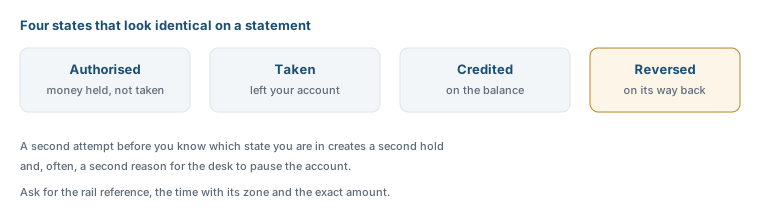
Failed and reversed card payments leave marks, and the marks confuse people far more than the refusal did. An authorisation can appear as a pending line, hold an amount that has not actually left, and then vanish when the authorisation expires. A payment can be taken and then reversed, which shows as two entries rather than none.
The practical rule is to read the state rather than the amount. Money held is not money taken; money taken and returned is not a payment that worked. Trying again before you know which state you are in is how a single refused deposit becomes two holds on an account, and on a credit card it is also how a declined gambling payment turns into an interest-bearing one if any part of it settles.
If a line will not resolve itself, the bank can tell you which state it is in, and the question to ask is specific: was the amount authorised only, captured, or captured and reversed, and on what date and time. Those three words are the whole diagnosis. Support staff at a cashier cannot see your statement and will guess; your own bank can read the entry and will not.
Four states that look alike on a statement. Only one of them means the money is on the balance.
If a credit card payment went through anyway
It happens, usually on a site that should not have taken it. The sequence that works is documentary. Screenshot the cashier confirmation and the statement line. Raise it with the operator in writing, stating plainly that the card is a credit card and that the payment should not have been accepted. Ask for the deposit to be returned to the same card.
Only after that, and only if the desk refuses, take it to the card issuer. Going to the issuer first invites a chargeback, and a chargeback against a gambling operator reliably ends with a closed account and a frozen balance, including any winnings you had no argument about. That is a bad trade even when you are in the right.
Keep in mind that a returned deposit does not undo the play it funded. Money already staked is gone in the ordinary way, and no rule about payment methods reverses a losing session. The refund conversation is about the deposit, not about the outcome.
What the ban touches and what it leaves alone
The table separates the cases people conflate. Reading the middle column tells you what will happen at the cashier; the right-hand column explains why, which is what stops you trying the same thing in a new wrapper.
Funding route
At a licensed British cashier
Why
Debit card
Accepted
Moves money already in your account
Credit card
Refused
Gambling paid for with credit is not permitted
Credit card behind a device wallet
Refused
The wallet presents the same card to the chain
Wallet balance topped up from a credit card
Refused somewhere in the chain
The rule follows where the money came from
Charge card or instalment plan
Refused
Still a credit product, however it is described
Current account overdraft via a debit card
Accepted by the chain
The desk sees a debit card; the borrowing is between you and your bank
Credit, debit and the routes in between
Why gambling spend is easy for others to see
Card payments carry a category that describes the kind of merchant being paid, and gambling has its own. That single field does a lot of work. It is what lets a bank recognise a gambling payment and refuse it on request, what puts a recognisable label beside the line on your statement, and what makes the spend visible to anybody who later reads the account with permission.
That last part matters more than the ban itself for some people. Lenders assessing affordability, and anyone reviewing accounts during an application, can see gambling payments as a category rather than as anonymous card spend. Nothing about using a debit card hides it; the category travels with the transaction regardless of the instrument.
It also means the categorisation is not a judgement about you. It is a routing label, applied by the payment chain, and it works identically for a small deposit and a large one. If you prefer such payments not to be possible at all, that is exactly the switch described on the page about limits, pauses and help.
What the ban does not change about the cashier
Removing credit from the picture does not remove anything else. The desk still verifies who you are before money leaves, and the three checks behind that process are unaffected by which card you funded with. Payout routes still follow the way the money came in, so a debit card deposit normally means a debit card payout.
Nor does it alter the arithmetic of what you are paying for. A permitted payment method is not a safer bet; it is simply a payment made with money that is already yours. The rule caps how bad a loss can get, not how likely it is.
And it has nothing to say about the tax position, which confuses a surprising number of people. Winnings reaching a British player are not taxed in their hands, and the reasons for that — together with what you should still keep — sit on tax and gambling winnings in the UK.
Choosing a funding route once the credit card is out
With credit off the table, the sensible question is which of the remaining rails suits what you actually do. A debit card is the default and the simplest to prove when verification arrives. A bank-based rail moves money directly from the account and leaves a clean trail. A voucher bought in a shop caps the amount by design, and the trade-off is that it cannot usually carry money back to you.
Each of those has its own behaviour on the way out, which is the part worth deciding before you deposit rather than after you win. The overview of every rail at the desk compares them side by side, including which ones are a one-way street.
One habit is worth more than any comparison: fund from an account whose balance you can see, in amounts you have already decided on, and keep the instrument the same in both directions. That removes most of the friction this page describes before it starts.
A short answer to the question behind the question
People rarely arrive here wanting a legal explanation. They want to know whether there is a way to make the credit card work, and the honest answer is that every route which turns borrowing into stakes runs into either the rule or a cost you will carry afterwards.
The routes that technically still function — an overdraft, a cash advance, borrowing from somewhere else and paying with your own debit card — are not loopholes in any useful sense. They convert the same borrowed money into the same stakes, with the lender's charges added, and they are precisely the pattern the rule exists to interrupt.
If the question feels urgent rather than theoretical, that is worth noticing on its own. Free and confidential help is available from the National Gambling Helpline on 0808 8020 133, and a bank-side block can be in place in minutes without anybody else being involved.
Questions people ask
Can I use a credit card at any online casino in the UK?
No. Paying for gambling with a credit card is not permitted in Great Britain, so a licensed cashier will refuse it. A site that does offer the option is not following the rules it trades under, which is a reason to check who operates it.
Why does my debit card work when my credit card does not?
Because they are different products. A debit card spends money sitting in your account; a credit card creates a debt with a cost attached. The rule is about gambling with borrowed money, so the debit card is untouched by it.
Can I top up a wallet with my credit card and pay from the wallet?
That is the route the rule anticipates. The prohibition follows where the money came from, not the last step before the cashier, so the chain breaks at the wallet provider, at the operator or at the card issuer. From your side it simply fails.
Does Apple Pay or Google Pay get around it?
No, because neither is a funding source. Both present a card you have already added to the device, so a credit card behind the wallet is refused exactly as the number would be. A debit card behind the same wallet works normally.
A pending line appeared on my credit card statement after a refusal. Has money gone?
Most likely it is an authorisation hold rather than a payment. The amount is reserved but has not left, and the hold drops off when it expires. Check the state of the line before retrying, because a second attempt can create a second hold.
What if a site took my credit card payment?
Capture the confirmation and the statement line, then ask the operator in writing to return the deposit to the same card, saying plainly that it is a credit card. Approach the card issuer only if the operator refuses, since a chargeback usually ends with the account closed.
Is using my overdraft to gamble against the rule?
The payment chain sees a debit card and your own account, so it goes through. That does not make it a good idea: an overdraft is borrowing with a cost, which is the exact pattern the credit card rule exists to stop.
Will gambling payments show up on my statement?
Yes. Payments to gambling merchants carry their own transaction category, and it travels with the payment whichever card is used. That label is what a bank block reads, and it is visible to anyone who reviews your accounts with your permission.
Can I be paid winnings onto a credit card?
Since a credit card cannot fund gambling, it is not a route money comes back along either. Payouts follow the way the deposit arrived, so the destination will be the debit card, bank account or wallet you actually used.
 UK Cash DeskOpen the cashier


 100% up to £100 on your first deposit