18+. The welcome offer shown here is the one the partner gives the site owner; availability depends on your country and your eligibility. Bonus size, qualifying deposit, wagering, eligible games, maximum bet, expiry and withdrawal limits are set out in the operator’s own terms and are not repeated here. We do not promise payout times. Offshore operator, not licensed by the Gambling Commission of Great Britain. Gambling involves financial risk — free confidential help at begambleaware.org, 0808 8020 133.
Short answerPaying by phone bill means your network advances the money and collects it with everything else at the end of the billing period. That makes it a small credit line rather than a way of confirming a payment, and it changes what you should watch.
Our top pick
22BET — 100% up to £100 on your first deposit
Regulator
Gambling Commission of Great Britain
Credit cards
Banned for gambling since April 2019
Minimum age
18
Tax on winnings
None for the player
Self-exclusion
GAMSTOP, free and nationwide
A phone bill deposit is a small credit line
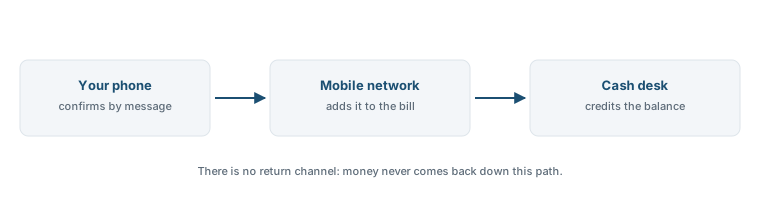
Strip away the interface and what remains is a loan with a very short life. Your network pays the gambling site now, writes the amount against your account, and asks you for it when the billing period closes. Nothing is debited from anywhere you keep money, because at the moment of the deposit no money has moved on your side at all.
That is a different proposition from a rail where your handset merely proves who you are. On this one the device is incidental; the arrangement that makes the payment possible is the monthly account your network already has with you, and the credit judgement it made when it opened that account. Among the ways into a cash desk it is the only one that creates an obligation rather than moving a balance.
Understanding it as credit explains the rest of this page. Credit has a ceiling set by the lender, it hides the cost until a statement arrives, and it is awkward to unwind once drawn. All three show up here, and none of them is a quirk of a particular site.
It is worth saying plainly that the amounts involved are small and the arrangement is legitimate. The point is not that the rail is dangerous in itself, but that it behaves according to rules written by a telecoms company for telecoms reasons, and those rules were never designed around someone trying to keep track of what they spend on gambling.
The month you pay in is not the month you played
The lag is the single most important thing about this route. A deposit made in the first week of a billing period is paid for after the period ends, which can put weeks between the decision and the money leaving your hands. By then the amount sits in a line on a telecoms bill rather than in a place where you think about gambling.
People who track spending by looking at their current account will not see these payments as gambling at all. They arrive bundled into one familiar outgoing to a mobile provider, beside calls, data and a handset instalment. The record exists, but it is filed under the wrong heading in your own head.
If you use this rail, the honest move is to total the gambling lines on the bill each month and treat that figure as what you spent. It is the only number on the bill that was a choice, and the only one that can grow without anybody telling you.
The site is paid straight away; you pay when the billing period closes.
What your network is actually agreeing to
Your network is not processing a payment on your behalf in the way a bank does. It is agreeing to be out of pocket for a while on the strength of your payment record, and it will be out of pocket again if you do not settle. That exposure is why the terms are tight and why the network, not the gambling business, holds the controls that matter.
It also means the network has a commercial reason to be cautious about gambling charges in particular. Charges that are later disputed cost it money and goodwill, so some tariffs simply do not permit them. Where the option is missing it is usually this, rather than anything about your account standing.
The site, for its part, has agreed with a collecting company to be paid regardless of whether you settle the bill. That is what the site is buying, and it is why the fee structures behind this rail are heavier than on a plain card payment even though you never see them itemised.
Small sums are the point, not a limitation
Everything about the arrangement pushes amounts downwards. The network is lending unsecured to a very large number of people at once, so it limits exposure per line and per period. The collecting company adds its own caution. Neither party gains anything from letting a single charge get large.
Trying to force a larger figure through by repeating small charges works against you twice. The period cap catches up with you, and a run of identical small payments is precisely the pattern that invites a closer look from the collecting company. The ceiling is better treated as a decision somebody else has already made for you.
The bar you can put on your own line
Every British network can bar third party charging on a line. Once that bar is on, charges of this kind are refused before they reach the question of limits or credit standing. You ask for it through your network, in the app or by speaking to them, and it applies to the line rather than to any particular website.
This is the only control that sits in the same place as the charge. It is the matching instrument to the bank level blocks described under the blocks you can ask for and where each one lives, and it fills the exact gap those blocks leave open, because a bank cannot see a transaction that never touched it.
Nothing about asking for the bar signals a problem, and networks treat it as a routine request. If you would rather not have the option available on a quiet evening, removing it from the line is more reliable than relying on remembering. Free, confidential advice is available from the national advice service and on 0808 8020 133.
Why a bar at the network outlives a setting in a cash desk
A control is only as strong as the layers it cannot be routed around. A setting inside one cash desk governs one account at one site. Open an account elsewhere and the setting does not follow, because no site is obliged to know what another site was told.
A bar on the line is different in kind. It stops the charge at the party that would have to advance the money, so it holds across every site using the rail, including ones that do not exist yet. You cannot route round it by changing where you play, only by asking your network to take it off, which is a deliberate act with a delay built into it.
Site side tools are still worth using for what they do well. A deposit limit set inside a cash desk caps the total you can put in regardless of rail, which no network bar can do. The two work at different heights and the sensible arrangement uses both.
Who controls what on a phone bill deposit
Disputes on this rail go wrong when the question is sent to the wrong party. Four parties take part and each one owns a different decision, so the first job is working out which decision you are arguing with.
The table below splits them. Note that two of the four have no relationship with you at all, which is why their refusals arrive without reasons attached.
One line of the table is worth reading twice. The network is the only party that can put money into this transaction, and it is also the only party with no mechanism for taking money out of it. Every frustration people report on this rail traces back to that single asymmetry rather than to any individual company behaving badly.
Party
What it decides
What it cannot do
You
Whether to confirm, and whether a bar is on the line
Change the ceiling or see the risk rules
Your mobile network
Whether to advance the money, and how much per period
Pay anything back to you as a gambling payout
The collecting company
Whether this charge looks acceptable on its own rules
Credit your playing balance or discuss your account
The gambling site
Whether your account may receive the deposit at all
Override a refusal made by the network
The four parties behind a phone bill deposit
Family plans, work handsets and whose bill it is
The rail quietly assumes that whoever holds the phone is whoever pays the bill. On a family plan, a shared business account or a handset passed on within a household, that is simply untrue, and nothing in the flow pauses to ask.
Two consequences follow, and the second is the serious one. A charge appears on an account belonging to somebody else, and the account holder is the person the network will pursue for it. Where that person is an employer, a gambling line on a company bill is a conversation with a different kind of weight.
There is also a matching problem later. A British site expects the money going out to reach an instrument in the name on the account, and the identity check carried out before a payout is where the mismatch surfaces. A line registered to someone else gives you nothing useful to produce at that point.
What an itemised bill will and will not tell you
Your bill is the primary record of what this rail cost you, and it is more useful than the deposit history inside a cash desk because it covers every site at once. Each charge appears with a date, an amount and a merchant description, usually under a heading for charges made by other companies.
What it will not give you is the name of the gambling site in plain language. The description belongs to the company that collected the money, so one unfamiliar name can cover several sites and tells you nothing about which session a charge belongs to. Working out that mapping is the subject of how a collecting company sits between the site and your network.
Keep the bills. If you ever need to show a pattern of spending to your bank, to your network or to a site complaints team, an itemised telecoms bill is documentary evidence of a kind that in-app deposit lists are not.
The exit is somewhere else entirely
There is no return journey. A network can add to what you owe and cannot send you an arbitrary sum, so winnings never come back as a credit on a bill. The money leaves the site by a completely different instrument, which you will have to add and prove before anything moves.
That turns a convenient entrance into an unfinished piece of work. Before the first deposit, it is worth reading what actually happens when you ask for money back and deciding which instrument will carry it. For most people this ends as a debit card in their own name, because a card can take money in both directions.
The timing is also asymmetric. A phone bill deposit is agreed in seconds while the stages a payout passes through involve checks that cannot be done in seconds. Nothing about the quick entrance shortens the exit.
A charge you did not make
Because the charge was advanced by your network, the network is where a disputed charge is raised. It holds the record, it carried the risk and it is the party you have a contract with. Going to the gambling site first usually wastes a week, since the site can confirm a deposit landed but cannot reverse a telecoms charge.
Act from the bill rather than from memory. Identify the date and the amount, ask your network what the merchant description refers to, and ask for the bar to be put on the line while the matter is open so the same thing cannot repeat mid dispute.
If the argument is with the gambling business rather than the charge, the question becomes who licenses it. Check the company against the public register of licensed operators before anything else, because a site missing from it has no British complaints route behind it and no obligation you can lean on.
How this rail differs from confirming a payment by handset
The two are often described as the same thing and they are not. One is about who said yes; this one is about who is out of pocket and for how long. A payment can be confirmed from a handset and still be funded from prepaid credit you had already bought, in which case no credit is extended and the money is gone immediately.
The distinction matters for one practical reason. Credit can grow quietly across a month; prepaid credit cannot, because it runs out. If you want the rail without the borrowing, a prepaid line gives you exactly that.
When to come off the bill
Come off it when the monthly total starts to be a figure you would rather not add up. That is the point at which the lag has stopped being convenient and started doing the only thing a delay can do, which is hide the size of something.
Come off it too if you are playing seriously enough to want money back. The ceiling will frustrate you, the exit has to be built anyway, and you will have two records to reconcile instead of one.
What this rail is good for is a deliberate small payment by someone who does not want a card number anywhere near a gambling site, who keeps an eye on the bill, and who has already decided where any winnings will land. Outside that, it is a borrowing arrangement dressed as a convenience, and the dress is the part that does the damage.
Questions people ask
Is a phone bill deposit the same as paying by mobile?
Not quite. Both are confirmed on a handset, but a bill deposit is advanced by your network and settled at the end of the period, while a prepaid line spends credit you have already bought. Which one you get depends on your tariff.
Can I pay a gambling deposit on a work phone?
Technically it may go through, and the charge will land on the account holder bill. If that holder is your employer, the amount appears on a company invoice with a merchant description beside it. It is not a route worth using.
How do I stop these charges completely?
Ask your mobile network to bar third party charging on the line. The refusal then happens before any limit or credit question, it covers every site using the rail, and it cannot be undone by opening an account somewhere else.
Why is the maximum so low?
Because your network is lending without security and caps its exposure per line and per billing period. The collecting company applies its own caution on top. The gambling site has no say in either figure and cannot raise it for you.
Where do I find out exactly how much I can charge?
In your network terms or in the app where charges by other companies are listed. Those are the only accurate sources, since each network sets its own figures and reviews them when it chooses. Numbers quoted elsewhere are guesses.
Will the gambling site name appear on my bill?
Usually not. The description belongs to the company that collected the payment, so one name can stand for several different sites. If you cannot match a line to a session, ask your network what that description refers to.
Can winnings be taken off what I owe on the bill?
No. Netting a payout against a telecoms debt is not something either party is set up to do, and no site offers it. Winnings leave the cash desk by card or bank transfer, and the bill is settled separately as normal.
Does this count as gambling on credit?
It is not a credit card payment, so the credit card ban does not reach it. In substance you are deciding now and paying later, which is the behaviour the ban was aimed at, so treating it as borrowing is the realistic view.
Do I owe tax on winnings funded this way?
No. A player in the United Kingdom pays no tax on gambling winnings, whatever instrument funded the stake. The telecoms charge is a cost you settle with your network and has no bearing on how a win is treated.
 UK Cash DeskOpen the cashier


 100% up to £100 on your first deposit