18+. The welcome offer shown here is the one the partner gives the site owner; availability depends on your country and your eligibility. Bonus size, qualifying deposit, wagering, eligible games, maximum bet, expiry and withdrawal limits are set out in the operator’s own terms and are not repeated here. We do not promise payout times. Offshore operator, not licensed by the Gambling Commission of Great Britain. Gambling involves financial risk — free confidential help at begambleaware.org, 0808 8020 133.
Short answerA pending payout is a request the cash desk has accepted but not yet handed to a payment provider. The money is off your playable balance and still on the operator's books, which is exactly why it can be sent back the other way.
Our top pick
22BET — 100% up to £100 on your first deposit
Regulator
Gambling Commission of Great Britain
Credit cards
Banned for gambling since April 2019
Minimum age
18
Tax on winnings
None for the player
Self-exclusion
GAMSTOP, free and nationwide
What the word pending is actually describing
A pending payout is a bookkeeping position rather than a payment in flight. The cashier has recorded your request, subtracted the amount from the balance you can stake with, and put the request where the people who release payments will find it. At that point the money is in a holding position inside the operator's own accounts. Your bank has not been told anything. There is nothing for your bank to trace, which is why asking it to look is wasted effort at this stage.
Everything that is frustrating about the state follows from that. You are waiting on a decision rather than on a network, there is no reference number yet because no payment exists, and the status text will not change until a person or a rule moves it. Knowing which of the legs of a payout you are standing in is the difference between sensible patience and chasing the wrong party.
It also means the request is still reversible in a way it will never be again. That is the genuinely important thing about pending, and most of this page is about it.
Who is looking at the request, and for what
The release decision is a short checklist, not an investigation. Is the account's paperwork in order. Is the destination one the desk has paid before. Is any part of this balance still tied to an offer. Does the amount fall inside what the operator releases automatically. Has anything on the account behaved oddly enough to want a second pair of eyes. Most requests fail none of those and go out when somebody reaches them.
Where one of them does catch, the desk should tell you which, and a good one does so inside the account rather than waiting for you to ask. The commonest single catch is paperwork, because a first payout and a first document check tend to arrive together; clearing the identity check is the one preparation that removes the usual cause.
The second commonest is promotional money. Until an offer's condition has been met or abandoned, a balance has two kinds of pounds in it, and the way play-through is counted has to be resolved before any of them can leave.
The wording differs, the state does not
Cashier vocabulary is not standardised and the same label means different things at different desks. What is worth learning is the small set of states underneath the words, because once you can place yourself in one of them you know who to ask and what to ask for. The table below is the translation most British cashiers fit, even when the phrasing is their own.
One word deserves suspicion: in process. At some desks it means the payment has been instructed, at others it means a human has picked the request up and nothing has been sent. The way to tell is to ask whether a reference exists. If one does, the payment is on a rail and the question is about settlement; if not, you are still in the queue, and the pace of the rails has no bearing on your situation yet.
What you see
What it usually means
The useful next step
Requested, awaiting approval
In the release queue, untouched
Wait; check nothing is outstanding in the account
Pending or on hold
Held off the balance, not instructed
Ask what is missing, in writing inside the account
Under review
A person is reading the account
Answer any request completely and in one go
In process
Could be either state; ambiguous
Ask whether a payment reference exists yet
Approved, processed, sent
Instructed to a rail
Get the reference and the timestamp with its zone
Reversed or cancelled
Back on your stakeable balance
Decide whether to request again straight away
Holding states and what each one asks of you
The same four words cover both directions of the cash desk. On a payout, the last one is the state you can choose.
Reverse withdrawal: the most expensive button on the site
While a request is pending, many cashiers show a way to take it back. The amount returns to your playable balance and the request disappears. There is no charge for doing it, nothing is forfeited, and that is precisely what makes it expensive: the cost is not a fee, it is that money which had left the game is now back inside the game, available to stake, at the moment you are least well placed to leave it alone.
Think about when that button gets used. It is pressed during a wait, by somebody watching a figure sit still, usually after a win larger than usual. The desk did not have to persuade anybody of anything; it simply made the money reachable again for a few days and let the wait do the work. No other control in a cashier takes a completed decision and quietly undoes it.
If you have ever cancelled a payout and later wished you had not, nothing about that is unusual or a sign of poor character. It is the predictable result of a design that puts winnings within reach during the exact period they are hardest to ignore.
Why a holding period exists in the first place
Part of the holding period is work: the checks above take time and staff. Part of it is prudence, since a payment that has gone out cannot be recalled and a mistake is costly. And part of it, at some desks, is a deliberate window, long enough that a player who requested in a flush of discipline has time to change their mind.
Those three reasons are mixed together and no operator separates them for you. What you can do is notice the shape of your own waits. A desk whose payments reliably leave soon after approval is doing the first two; one where the status sits still for a long stretch with the cancel button prominent on the same screen is doing something else as well, whatever the terms say.
Nothing here is illegal, and a holding period is not evidence of bad faith. It is simply worth seeing the mechanism for what it is, so that you are choosing rather than reacting.
How many times can you cancel and request again?
There is no common rule, and anyone quoting a figure is describing one operator rather than the market. Some desks place no limit at all and will let a balance go round that loop indefinitely. Some count reversals and stop offering the option after a point. Some remove it from an account once a player asks. The only reliable way to know which you are dealing with is to read your own cashier terms, because this is one of the places where operators genuinely differ.
What is close to universal is that you can have the option taken away on request. A message asking for reversals to be disabled on your account, or for a pending balance to be released so it cannot be pulled back, is a normal thing to send and a licensed desk should act on it. Put it in writing inside the account so there is a record, and do it before there is a pending payout rather than during one.
Repeating the loop has a second cost that is easy to miss: each new request starts its own queue position. A balance cancelled and re-requested several times can take weeks to leave, not because any single payment was slow but because the clock was reset each time.
What a reversal does to your balance, exactly
The amount comes back as ordinary stakeable funds. It is not a deposit, it is not a bonus, and in most cashiers it carries no conditions with it. That sounds harmless and contains the trap: because it is not a deposit, it does not pass through anything you have set up to govern deposits. A daily or weekly cap on what you put in is untouched by money arriving back from a cancelled payout, so a deposit limit you have set on yourself does not stand in its way.
Where a payout was being released in stages, cancelling can undo the whole request rather than the stage in front of you, which puts the entire balance back in play and starts the staged schedule again from the beginning. Anybody with a win big enough to be paid in instalments should check how their desk treats this, since the caps on how much is released at once interact with reversals in ways the cashier does not explain on screen.
One more detail worth knowing: a reversal does not reinstate anything you gave up to make the request. If you abandoned an offer in order to withdraw cleanly, cancelling the withdrawal does not bring the offer back.
Pending is a pause, not a verdict
A refusal looks different and behaves differently. It has a reason attached, the money is returned to your balance by the desk rather than by you, and there is something specific to fix before trying again. A pending request has none of that: no reason has been given because no decision has been made. Treating the two as the same thing leads people to start fixing problems that do not exist.
The practical test is whether anything was asked of you. Silence with no request attached is a queue. A message asking for a document, a question about a payment method, or a note that a condition is unmet is a decision in progress. And an amount that reappeared on your balance without you touching the cancel button is neither of those; a request that was turned down follows its own path and needs a different response.
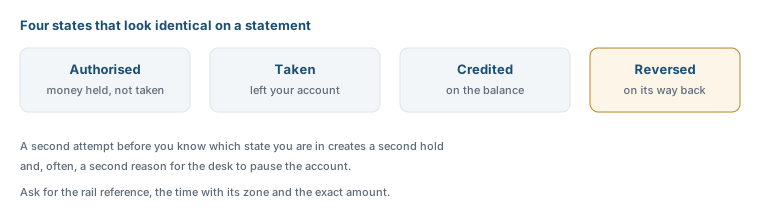
Resubmitting during a pause rarely helps and sometimes hurts, because two live requests for overlapping amounts is the kind of thing that pulls an account out of the automatic lane and onto somebody's desk.
When the wait stops being normal
There is no regulated maximum, so the benchmark has to be the operator's own. Find the target the cashier states for releasing a payment and treat a clear breach of it as the moment to act rather than wait. Alongside that, a handful of patterns are worth reacting to regardless of how long they have run.
Documents you have already sent and had accepted are requested again, without explanation.
A new condition appears only after the payout was requested and was not in the terms you accepted.
Each exchange with support ends with a fresh reason rather than progress on the last one.
The status moved to sent, but nobody will give you a reference or a timestamp.
Replies stop entirely, or the account is restricted while money is held in it.
Those are the signatures of a problem rather than a queue, and the response is a formal written complaint to the operator, which a licensed British operator must have a published procedure for, followed by the independent adjudicator it is obliged to be signed up to. Where it has gone that far, a desk that will not pay at all is the page that covers the escalation properly.
What to keep while you are waiting
Records cost nothing to make and decide complaints. Screenshot the cashier history showing the request and its timestamp. Keep every message inside the account rather than in a chat window that disappears when you close it. Note the exact wording of each status and when it changed. If documents are requested, note what you sent and when you sent it.
Two facts are worth confirming in the same sitting. One is whether the operator holds a British licence and what conditions are attached to it, which is public information on the register at gamblingcommission.gov.uk. The other is which independent adjudicator stands above the operator's own complaints process, which the terms are required to tell you.
None of this is confrontational. It is the difference between a complaint somebody can act on and a complaint that consists of remembering being annoyed.
A pending deposit is a different animal entirely
The same word is used at the other end of the cash desk and means something unrelated. A deposit that has not appeared is usually a payment your bank has authorised but not yet settled, or one the operator has not matched to your account, and the trace runs in the opposite direction: your statement first, then the operator. Resending it is the classic way to end up having paid twice.
Because the vocabulary overlaps, searches about one problem constantly land on advice about the other. If the money you are waiting for is going into the balance rather than out of it, a deposit that has not arrived is the subject you want, and almost none of this page applies to it.
The one thing both share is the rule about second attempts: find out which state the first one is in before you make another.
If the holding period is working on you
There is a version of this that stops being a payments question. If you find yourself opening the cashier repeatedly during a wait, or if a payout has been cancelled and re-requested more than once, the pending period is doing what it was shaped to do, and reading more about rails will not help. The useful steps are the blunt ones: ask for reversals to be disabled, set a deposit limit, or take a break from the account.
Beyond the operator's own tools, the controls that work best are the ones it cannot override. A block on gambling payments at your bank sits outside the casino entirely, and the national self-exclusion register closes licensed accounts on your behalf for a period you choose. Going around either of those means leaving the licensed market, and with it the complaints route and the regulator that make a payout enforceable at all.
Confidential support, free of charge, is offered by begambleaware.org, and the National Gambling Helpline takes calls on 0808 8020 133. If any of this is familiar, the tools for keeping control are a better use of the wait than refreshing a status.
The short version of all of it
Pending means the money is still the operator's to move and yours to reclaim. The first of those is why the wait exists, and the second is why the wait is dangerous. Nothing has been refused, nothing is traceable yet, and the only two useful actions are to make sure nothing is outstanding on your side and to leave the cancel button alone.
If you want the wait itself to be shorter next time, the work happens long before the request. An account with accepted documents and a destination that has been paid before is the one that gets released by rule rather than by hand, and what a quick payout really depends on is almost entirely that preparation.
Questions people ask
What does a pending withdrawal mean?
It means the cash desk has accepted your request and taken the amount off your stakeable balance, but has not yet instructed a payment to anybody. The money is still in the operator's own accounts. There is no payment reference to trace and nothing for your bank to look for at this point.
How long should a withdrawal stay pending?
There is no regulated maximum, so the only benchmark is the target the operator publishes in its own cashier terms. A clear breach of that, or a pattern of fresh reasons rather than progress, is the point to put a written complaint rather than to keep waiting. Public holidays and weekends stretch the staffed part of the process.
What is a reverse withdrawal?
It is the option to cancel a pending payout and return the amount to your playable balance. It costs nothing in fees, which is exactly the problem: money that had left the game is back in it during the period you are least likely to leave it alone. It is the one control in a cashier that undoes a decision you already made.
How many times can I reverse a withdrawal?
That depends entirely on the operator, and anyone quoting a number is describing one desk. Some allow it without limit, some count reversals and withdraw the option, and some remove it when a player asks. Your own cashier terms are the only reliable source.
Can I stop myself cancelling a payout?
Yes, and it is a normal request to make. Ask in writing inside the account for reversals to be disabled, or for a pending balance to be released so it cannot be pulled back. Send it before there is a payout waiting, since that is when the decision is easiest to make clearly.
Does cancelled withdrawal money count against my deposit limit?
No, and that is worth knowing. A reversal is not a deposit, so money arriving back from a cancelled payout passes none of the caps you have set on what you put in. If deposit limits are part of how you keep control, reversals are the gap in them.
Is pending the same as declined?
No. A pending request is waiting with no decision attached; a declined one comes back with a reason and something specific to put right. If an amount reappeared on your balance without you cancelling it, that is a refusal rather than a pause, and it needs a different response.
Should I request the withdrawal again if nothing is happening?
Usually not. Two live requests covering overlapping amounts is the sort of thing that pulls an account out of automatic release and onto a person's desk, which makes the wait longer. Ask what is outstanding instead, and keep the question inside the account in writing.
The status says sent but the money is not here. Is it still pending?
No, and the difference matters. Once a payment has been instructed there should be a reference and a timestamp, and with those your bank can look for a credit that has not posted. If the desk says sent but cannot produce either, that discrepancy is itself the thing to complain about.
Why is my first withdrawal the one that sits pending longest?
Because it is the request that collides with the account's first document check and, often, with the first look at a payment destination. Those checks happen once. Later payouts on the same cleared method skip them, which is why the second request behaves nothing like the first.
 UK Cash DeskOpen the cashier



 100% up to £100 on your first deposit