18+. The welcome offer shown here is the one the partner gives the site owner; availability depends on your country and your eligibility. Bonus size, qualifying deposit, wagering, eligible games, maximum bet, expiry and withdrawal limits are set out in the operator’s own terms and are not repeated here. We do not promise payout times. Offshore operator, not licensed by the Gambling Commission of Great Britain. Gambling involves financial risk — free confidential help at begambleaware.org, 0808 8020 133.
Short answerEvery deposit meets three separate minimums at the same time, and the one you feel is simply the tallest of them. Only one of the three is printed next to the payment button, which is why the figure so often turns out not to be the figure.
Our top pick
22BET — 100% up to £100 on your first deposit
Regulator
Gambling Commission of Great Britain
Credit cards
Banned for gambling since April 2019
Minimum age
18
Tax on winnings
None for the player
Self-exclusion
GAMSTOP, free and nationwide
Three different questions hide behind one phrase
Ask what the minimum deposit is and you will get three answers, all of them true. The first is a question about the route the money takes: what is the smallest sum this rail is willing to move at all. The second is a question about the account: what is the smallest sum this cash desk will accept onto a balance. The third is a question about a promotion: what is the smallest sum that makes an offer apply to you. Three different parties decide those numbers, they are written in three different documents, and they change on three different schedules.
Almost every argument about minimums starts with those three being mixed up. One player pays in a small amount, watches it land, finds no bonus attached and concludes the desk has cheated. Another is refused at the payment screen and blames the casino, when the refusal was handed down by the rail before the desk saw the attempt. So the useful habit is to ask, of any figure you read, which of the three it belongs to. The rest of this page is arranged around that question, and each of the ways money reaches a cashier brings its own answer to it.
The rail sets the first floor
A rail is whatever actually moves the money: a card scheme, a bank payment, a wallet, a prepaid voucher, a mobile account. Each one has a smallest amount it will process, and that floor has nothing to do with gambling. It exists because handling a payment costs the rail a fixed amount of work however small the payment is — a message to send, a check to run, a record to keep, a line to settle. Below some figure the work costs more than the payment is worth, so the rail refuses rather than lose money on it.
This is why an amount that goes through on one route is rejected on another at the same desk with the same account. The desk has not changed its mind; the rail has changed underneath you. Voucher and mobile routes were drawn up around small, frequent charges and their floors sit low as a result. Bank-to-bank routes were drawn up to move larger sums reliably, and a tiny transfer is pure cost to them. When the payment screen refuses a small amount without explaining itself, the rail is the first suspect, not the terms page. On mobile rails the floor is often set by the billing aggregator rather than by the desk, which is why a Boku payment can refuse an amount the cashier itself would accept.
The cash desk sets the second floor
The desk's own minimum is a commercial decision and it is the only one of the three a casino writes itself. It covers the cost of carrying an account that may never be used again: record keeping, checks, support time, the reporting that attaches to every customer regardless of how little they paid in. Some desks publish one figure for every route. Others publish a figure per route, and that is the arrangement people find most confusing, because the number beside the amount field then changes as you click between methods in the same cashier.
The desk's floor is normally the easiest of the three to find. It tends to appear next to the amount field the moment a method is selected, and it is repeated in the banking or payments part of the site terms. Where a desk states a floor for debit cards and a separate one for wallets, treat those as two independent numbers rather than one number with an exception bolted on. That distinction comes back later, when the balance has to travel in the other direction.
The offer sets a qualifying amount, which is not a floor
The third number is the odd one out, because it stops nothing. A qualifying amount is a condition: pay in at least this much, by a method the offer accepts, and the offer attaches to the account. Pay in less and the payment still clears, the balance still rises, and nothing attaches. No warning is shown, because by the desk's reckoning nothing has gone wrong. The money is there to play with; the promotion was never triggered.
Qualifying amounts live in the offer terms rather than in the cashier, which is exactly why they are met by accident as often as they are missed by accident. The same terms decide what the amount qualifies you for, and that is rarely a single thing. Sitting beside the amount is the condition that makes an offer cheap or expensive — the turnover a bonus has to pass through before anything can be taken out. Read the turnover a bonus carries in the same sitting as the qualifying figure, because either one on its own tells you almost nothing.
Why the tallest of the three is the number you pay
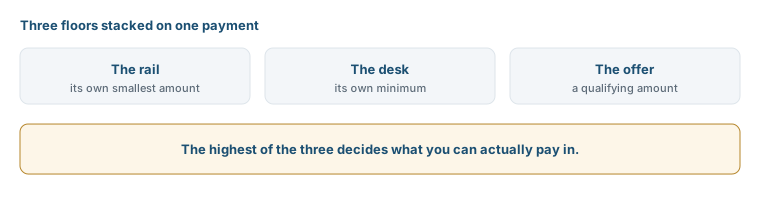
Three floors on one payment resolve in the obvious way: the payment has to clear all of them, so the tallest decides. If the rail will not move less than one amount and the desk will not take less than another, your smallest possible deposit is the larger of the two. Add an offer you actually want and the qualifying amount joins the stack. It cannot be satisfied by paying less, and it cannot be satisfied by paying in halves unless the terms expressly allow halves.
Put plainly, you do not have a minimum, you have a shortlist, and only the top of the shortlist is real. The practical consequence is that shaving your deposit by switching routes works only until the desk's figure takes over, and shaving it below the qualifying amount shaves nothing at all — it changes what you are buying. People who feel a desk has quietly raised its minimum are usually feeling a different member of the stack step forward.
One payment, three floors. The tallest of them is the only one you meet.
Where each of the three numbers is written down
Each figure lives in a document kept by whoever owns it. The rail's floor is in the rail's own terms, or it is not published anywhere and shows itself only as a refusal at the payment screen. The desk's floor is on the cashier and in the payments part of the site terms. The qualifying amount is in the offer terms, which are usually a page of their own with their own revision date. Three documents, three owners, and no obligation on any of them to match the other two.
There is a fourth document worth opening before any of those: the public register of licensed operators. It names the company standing behind the desk, which is the company whose terms you are reading and the company any complaint would be made against. The register is searchable at gamblingcommission.gov.uk. A desk that will not put its floors in writing is unusual; a desk you cannot find in the register is a different order of problem.
The floor
Who sets it
Where you read it
What happens below it
The rail
The card scheme, bank, wallet or mobile network
The rail's own terms, or only as a refusal
The payment is not accepted at all
The cash desk
The operator
Beside the amount field and in the site terms
The amount field refuses before money moves
The qualifying amount
The offer, which the operator also writes
The offer terms, on a page of their own
The deposit lands and the offer stays off
Three floors, three owners, three places to read them
Which routes carry the smallest amounts, and why
Routes designed for small, repeated charges carry small deposits without complaint. A deposit charged to phones works that way by construction: the network already bills you in small increments once a month, so adding one more line to that bill costs it nothing worth mentioning. Prepaid vouchers are the same idea in physical form — the amount was fixed when the voucher was bought, so there is no account to interrogate and no balance to check at the moment of payment.
Routes built around larger transfers behave in the opposite way, and cards sit between the two: the scheme will move small sums happily enough, but the desk's figure usually bites first. If the smallest steps are the point, the three pound step and the handful of routes that support it are worth reading before you choose a desk, because the rail decides whether that step exists for you at all. Vouchers deserve a separate look as well, since a voucher bought with cash behaves unlike every account-based route once you want money back.
What changes as you climb the steps
Moving up the steps does more than raise the balance. It changes which of the three floors is doing the work, and it changes what the deposit is capable of switching on. Down at the bottom of the range you are negotiating with the rail and little else. In the middle you clear the desk and start running into qualifying amounts. Higher up, the deposit stops being the constraint altogether and the conditions attached to it become the part worth reading twice.
That progression is why this site treats the common steps as separate subjects rather than one page with three figures sprinkled through it. The questions genuinely differ. At the smallest step the question is whether the payment will move at all. One step up, the question is what the deposit now obliges you to do. A step above that, the question is whether the balance can leave, by which route, and in whose name.
The step
The floor that binds
The question worth asking
£3
The rail
Will this route move the amount at all
£5
The offer's qualifying amount
What condition attaches once it counts
£10
Neither; the conditions bind instead
Can this balance leave, and by which route
Which question each step is really about
The step you pick decides how often you come back
A small step is not only a small amount, it is a repeated amount. Paying in the least the rail allows means returning to the cashier whenever the balance runs down, and every return is another payment with its own statement entry, its own confirmation and its own chance to go sideways. Nothing about that is forbidden and nothing about it is unusual. It does, however, produce a shape, and the shape has consequences.
Two of them are worth naming. The first is attention: a column of near-identical small lines is hard to read, so it becomes hard to say what has gone in over a month without adding it up deliberately. The second is that a run of small payments is the pattern risk systems are built to notice, and being noticed costs time you had not planned for. If one of those payments then seems to disappear, you will want the deposit that never arrived traced by its reference rather than repeated, and tracing is harder when there are a dozen look-alike entries to choose from.
A deposit that is accepted is not a deposit that counts
Acceptance and counting are separate events, and the gap between them is where most disappointment collects. Acceptance is technical: the rail moved the money and the desk credited the balance. Counting is contractual: the desk decided the payment satisfies a condition written in an offer. A payment can be accepted and not counted, which is the ordinary outcome below a qualifying amount. It can also be accepted, counted, and counted towards something you had no interest in.
Method matters here as much as size. Offers routinely list routes that do not qualify, so the same amount paid two ways produces two different outcomes on the same day at the same desk. That exclusion is not one operator's quirk; it is a standard clause, and it sits in the offer terms rather than on the cashier screen. The five pound qualifying step is where this stops being a footnote and becomes the whole subject, because it is the step people most often ask about as a qualifying amount.
The exit has a floor too, and nobody shows it first
There is a fourth number, and it belongs to another page: the smallest amount the desk will pay out. It is set independently of the deposit floor, and no rule obliges the two to match. That asymmetry is easy to walk into. A balance can be comfortably above the figure needed to get in and still below the figure needed to get out, in which case the money is not trapped exactly — it is simply not yet a payout.
The remedy is to read in reverse. Look at the floors and caps on payouts before you look at the deposit screen, because that number decides what the balance can do once it exists. The ten pound step is where the two floors first face each other closely enough to be worth planning around. The route matters as well as the amount, since money is frequently obliged to return along the path it arrived on.
Identity checks run on their own trigger, not on your figure
A small deposit does not buy a quiet account. A licensed desk has to know who holds each account, and the checks fire on things like the age of the account, the pattern of payments and the first request to take money out — not on the size of any single deposit. Nobody under 18 may hold a gambling account in the United Kingdom at all, and proving that point is an obligation on the operator rather than a favour it does you.
The sensible move is to get it out of the way early. Documents handed over on a quiet account are paperwork; the same documents demanded on the day you ask for a payout feel like obstruction, and they take the same time to process either way. What the identity check asks for is predictable enough that there is no advantage in waiting to be asked. A deposit of any size can sit behind a check if the account itself has not been cleared yet.
Working out your own minimum before you pay anything
The sequence is short. Settle the route first, because the rail's floor is the one you cannot argue with. Read the desk's figure for that specific route on the cashier, not the one you remember from a different method. Then decide whether you want an offer to attach at all; if you do, the qualifying amount joins the stack and the excluded-method list applies to you. Last, check the payout floor, so that the balance you build is able to leave when you want it to.
One more number belongs on that list, and it is the only one you set yourself. A cap you place on yourself fixes what the account will accept from you over a chosen period, which makes the whole question of the minimum far less interesting. And if choosing a figure is the difficult part rather than the arithmetic, that is worth saying out loud to someone: free, confidential help is at begambleaware.org, and the National Gambling Helpline is on 0808 8020 133.
Questions people ask
Does a casino have one minimum deposit for the whole site?
Only if it has chosen to publish one figure for every route. Plenty publish a figure per method, which is why the number beside the amount field moves as you switch methods inside the same cashier. Read it after selecting the route you actually intend to use.
Why was a small deposit refused with no reason given?
Because the refusal most likely came from the rail rather than the desk, and rails seldom explain themselves to the customer. Either try the same amount on a route designed for small charges, or raise the amount on the route you were already using. The desk's support team can usually confirm which side said no.
Does a deposit below the qualifying amount still reach my balance?
Yes, provided it cleared the rail's floor and the desk's floor. It arrives as ordinary money and the offer simply stays off. Nothing is lost and nothing is unlocked.
Can two smaller deposits add up to a qualifying amount?
Only where the offer terms say so, and many ask for a single qualifying payment instead. If the terms are silent on the point, assume a single payment is meant. Asking support in writing before paying costs nothing and gives you something to quote later.
Which routes carry the smallest deposits?
The ones built for small, frequent charges: mobile accounts and prepaid vouchers. Routes built for larger transfers carry a higher floor because the handling work is the same whatever the amount, so a tiny payment loses money for them.
Can a deposit be paid by credit card?
Not for gambling in the United Kingdom, where that is prohibited rather than discouraged by individual desks. Debit cards, bank payments, wallets, vouchers and mobile accounts remain available, and each brings a floor of its own.
Is the minimum payout the same as the minimum deposit?
No, and nothing links them. They are set separately and published on separate pages, so a balance can sit above the deposit floor and below the payout floor at the same moment. Check the payout figure before you decide how much to pay in.
Does a larger deposit make verification easier?
No. The checks are driven by the account and the way it is used, not by the size of one payment. Clearing them while nothing is pending turns them into paperwork instead of a delay at the exit.
Where do I complain if a minimum was applied differently from the terms?
Start with the operator's own complaints route, in writing, quoting the clause and the payment. If that goes nowhere, the licence tells you which regulator stands behind the desk, and the public register tells you which company the operator actually is. Keep the reference number from the payment with the complaint.
Is the lowest minimum the best minimum?
A low floor is a convenience, not a mark of quality. The figures worth comparing are the conditions that attach once a deposit counts and the floor on the way out, because those two decide what happens to the money afterwards.
 UK Cash DeskOpen the cashier



 100% up to £100 on your first deposit